
 中文
中文 English
 한국어
한국어 日本語
日本語 Español
 Français
 Русский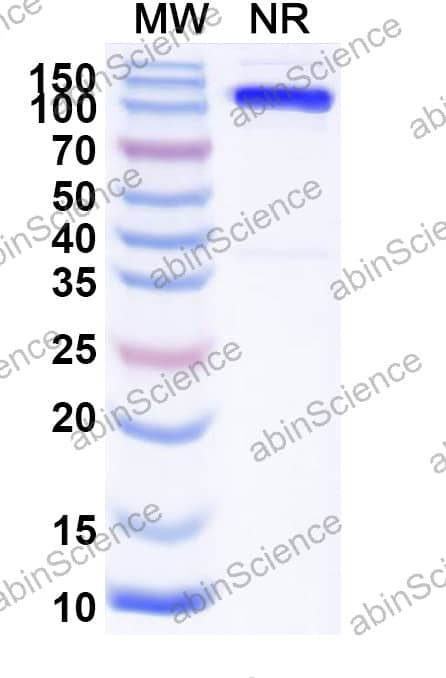
| Catalog No. | MA561013 | ||||
|---|---|---|---|---|---|
| Description |
Anti-Mouse Mu-type opioid receptor/OPRM1/μOR Nanobody (SAA2285) [SAA2285] (MA561013) is a human monoclonal antibody detecting Mu-type opioid receptor in ELISA, IF, FCM. Suitable for Mouse.
Highlights
|
||||
| Species reactivity | Mouse | ||||
| Applications | ELISA, IF, FCM | ||||
| Host species | Human | ||||
| Isotype | VHH-hFc | ||||
| Clone ID | SAA2285 | ||||
| Clonality | Monoclonal | ||||
| Target | Mu-type opioid receptor, M-OR-1, MOR-1, Mu opiate receptor, Mu opioid receptor, MOP, hMOP, OPRM1 | ||||
| Endotoxin level | Please contact with the lab for this information. | ||||
| Purity | >90% as determined by SDS-PAGE. | ||||
| Purification | Protein A/G purified from cell culture supernatant. | ||||
| Accession | P42866 | ||||
| Form | Liquid | ||||
| Storage buffer | 0.01M PBS, pH 7.4. Please refer to the specific buffer information in the hardcopy of datasheet or the lot-specific COA. |
||||
| Product Usage Information |
| ||||
| Stability and Storage | Use a manual defrost freezer and avoid repeated freeze thaw cycles. Store at 2 to 8°C for frequent use. Store at -20 to -80°C for twelve months from the date of receipt. | ||||
| Background | Mu-type opioid receptor (OPRM1/μOR) is a ~44 kDa protein. Receptor for endogenous opioids such as beta-endorphin and endomorphin. Receptor for natural and synthetic opioids including morphine, heroin, DAMGO, fentanyl, etorphine, buprenorphin and methadone. Also activated by enkephalin peptides, such as Met-enkephalin or Met-enkephalin-Arg-Phe, with higher affinity for Met-enkephalin-Arg-Phe. Agonist binding to the receptor induces coupling to an inactive GDP-bound heterotrimeric G-protein complex and subsequent exchange of GDP for GTP in the G-protein alpha subunit leading to dissociation of the G-protein complex with the free GTP-bound G-protein alpha and the G-protein beta-gamma dimer activating downstream cellular effectors. The agonist- and cell type-specific activity is predominantly coupled to pertussis toxin-sensitive G(i) and G(o) G alpha proteins, GNAI1, GNAI2, GNAI3 and GNAO1 isoforms Alpha-1 and Alpha-2, and to a lesser extent to pertussis toxin-insensitive G alpha proteins GNAZ and GNA15. 1. George, SR. et al. (2000) The Journal of biological chemistry 275, 26128-35. PMID: 10842167 2. Rios, C. et al. (2006) British journal of pharmacology 148, 387-95. PMID: 16682964 3. Milan-Lobo, L. et al. (2011) The Journal of pharmacology and experimental therapeutics 337, 868-75. PMID: 21422164 4. Manglik, A. et al. (2012) Nature 485, 321-6. PMID: 22437502 5. Huang, W. et al. (2015) Nature 524, 315-21. PMID: 26245379 6. Kaufman, DL. et al. (1995) The Journal of biological chemistry 270, 15877-83. PMID: 7797593 7. Sora, I. et al. (1997) Proceedings of the National Academy of Sciences of the United States of America 94, 1544-9. PMID: 9037090 8. Trieu, BH. et al. (2022) Science (New York, N.Y.) 375, 1177-1182. PMID: 35201898 | ||||
| Note | For research use only. |
SDS-PAGE for Anti-Mouse Mu-type opioid receptor/OPRM1/μOR Nanobody (SAA2285)
+86-27-65523339
Building C, No. 666, Shen Dun Si Lu, Wuhan, 430206, China


