
 中文
中文 English
 한국어
한국어 日本語
日本語 Español
 Français
 Русский

| Catalog No. | HF739033 | ||||
|---|---|---|---|---|---|
| Species reactivity | Human | ||||
| Applications | Blocking, ELISA | ||||
| Host species | Mouse | ||||
| Clonality | Monoclonal | ||||
| Isotype | IgG1 | ||||
| Clone ID | 1D7 | ||||
| Target | Apo-E, Apolipoprotein E, APOE | ||||
| Endotoxin level | Please contact with the lab for this information. | ||||
| Purity | >95% as determined by SDS-PAGE. | ||||
| Purification | Protein A/G purified from cell culture supernatant. | ||||
| Accession | P02649 | ||||
| RRID | Anti-Human APOE Antibody (1D7) (abinScience Cat# HF739033, RRID:AB_3729106) |
||||
| Form | Liquid | ||||
| Storage buffer | 0.01M PBS pH 7.4 Please refer to the specific buffer information in the hardcopy of datasheet or the lot-specific COA. |
||||
| Product Usage Information |
| ||||
| Stability and Storage | Use a manual defrost freezer and avoid repeated freeze-thaw cycles. Store at 4°C short term (1-2 weeks). Store at -20°C 12 months. Store at -80°C long term. | ||||
| Background | Apolipoprotein E (APOE) is a ~36 kDa protein. APOE is an apolipoprotein, a protein associating with lipid particles, that mainly functions in lipoprotein-mediated lipid transport between organs via the plasma and interstitial fluids. APOE is a core component of plasma lipoproteins and is involved in their production, conversion and clearance. Apolipoproteins are amphipathic molecules that interact both with lipids of the lipoprotein particle core and the aqueous environment of the plasma. As such, APOE associates with chylomicrons, chylomicron remnants, very low density lipoproteins (VLDL) and intermediate density lipoproteins (IDL) but shows a preferential binding to high-density lipoproteins (HDL). It also binds a wide range of cellular receptors including the LDL receptor/LDLR, the LDL receptor-related proteins LRP1, LRP2 and LRP8 and the very low-density lipoprotein receptor/VLDLR that mediate the cellular uptake of the APOE-containing lipoprotein particles. 1. Krimbou, L. et al. (2004) Journal of lipid research 45, 839-48. PMID: 14754908 2. Arnon, R. et al. (1991) Biochimica et biophysica acta 1085, 336-42. PMID: 1911868 3. Marcel, YL. et al. (1983) Biochimica et biophysica acta 750, 411-7. PMID: 6860692 4. Sehayek, E. et al. (1991) The Journal of biological chemistry 266, 18259-67. PMID: 1917954 5. Verghese, PB. et al. (2013) Proceedings of the National Academy of Sciences of the United States of America 110, E1807-16. PMID: 23620513 6. Kowal, RC. et al. (1989) Proceedings of the National Academy of Sciences of the United States of America 86, 5810-4. PMID: 2762297 7. Ji, ZS. et al. (1997) The Journal of biological chemistry 272, 31285-92. PMID: 9395455 8. Li, X. et al. (2003) Biochemistry 42, 10406-17. PMID: 12950167 | ||||
| Note | For research use only. | ||||
| Isotype Control | Mouse IgG1, kappa Recombinant Isotype Control Antibody (MOPC-21) (MV080207) |
SDS-PAGE for Anti-Human APOE Antibody (1D7)
Western blot analysis was performed using anti-APOE4 monoclonal antibody at 1ug/mL on various samples.
Lane 1: recombinant human APOE4 (Catalog No: HF739022)
Lane 2: negative control
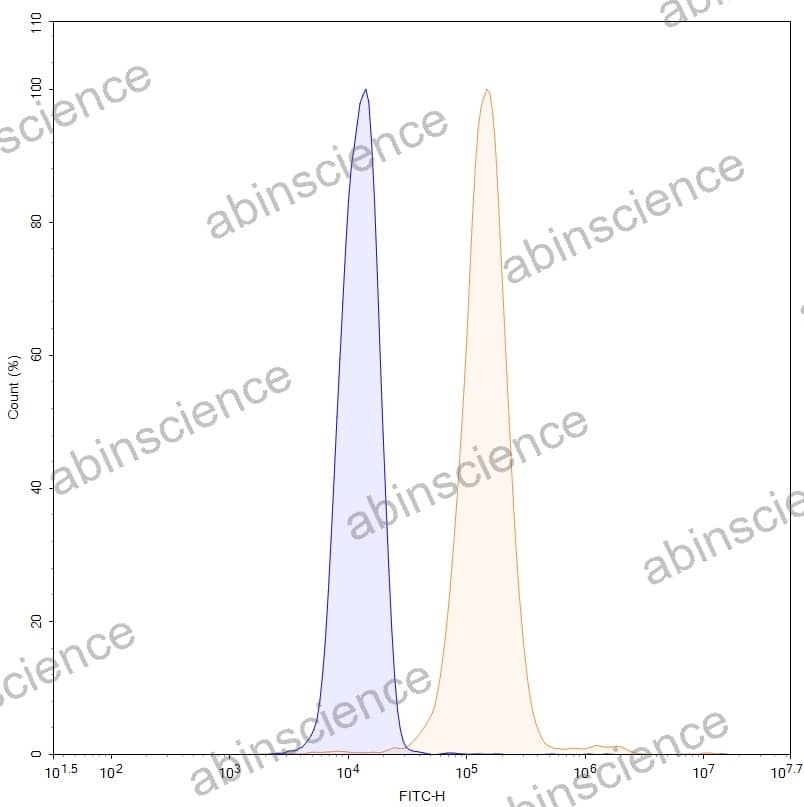
Flow-cytometry using anti-human APOE antibody. HepG2 cells were stained with an irrelevant antibody (Blue Histogram) or an anti-human APOE monoclonal antibody (Catalog HF739033, Yellow Histogram) at a concentration of 5 µg/ml for 30 mins at RT. After washing, bound antibody was detected using a Goat Anti-Mouse IgG H&L Polyclonal Antibody, FITC (abinScience: MF690414) and cells analysed on a NovoCyte Flow Cytometer.


Contact us for custom quotes, bulk requests and any other issues.
Mail: [email protected]
+86-27-65523339
Building C, No. 666, Shen Dun Si Lu, Wuhan, 430206, China


