
 中文
中文 English
 한국어
한국어 日本語
日本語 Español
 Français
 Русский
| Catalog No. | HV629014 | ||||||||
|---|---|---|---|---|---|---|---|---|---|
| Description |
Anti-PARK7 Polyclonal Antibody (HV629014) is a rabbit polyclonal antibody detecting PARK7 in ELISA, IHC, WB. Suitable for Human, Bovine, Chicken, Mouse, and Rat.
Highlights
|
||||||||
| Species reactivity | Human, Bos taurus, Chlorocebus aethiops, Chicken, Mesocricetus auratus, Mouse, Rat | ||||||||
| Applications | ELISA, IHC, WB | ||||||||
| Host species | Rabbit | ||||||||
| Isotype | IgG | ||||||||
| Clonality | Polyclonal | ||||||||
| Immunogen | E. coli - derived recombinant Human PARK7 (Met1-Asp189). | ||||||||
| Target | Parkinson disease protein 7, Oncogene DJ1, Parkinsonism-associated deglycase, DJ-1, PARK7, Maillard deglycase, Protein/nucleic acid deglycase DJ-1, Protein DJ-1 | ||||||||
| Purification | Purified by antigen affinity column. | ||||||||
| Accession | Q99497 | ||||||||
| Form | Liquid | ||||||||
| Storage buffer | 0.01M PBS, pH 7.4, 50% Glycerol, 0.05% Proclin 300. Please refer to the specific buffer information in the hardcopy of datasheet or the lot-specific COA. |
||||||||
| Product Usage Information |
| ||||||||
| Stability and Storage | Use a manual defrost freezer and avoid repeated freeze thaw cycles. Store at 2 to 8°C for frequent use. Store at -20 to -80°C for twelve months from the date of receipt. | ||||||||
| Background | Parkinson disease protein 7 (PARK7) is a ~19 kDa protein. Multifunctional protein with controversial molecular function which plays an important role in cell protection against oxidative stress and cell death acting as oxidative stress sensor and redox-sensitive chaperone and protease. It is involved in neuroprotective mechanisms like the stabilization of NFE2L2 and PINK1 proteins, male fertility as a positive regulator of androgen signaling pathway as well as cell growth and transformation through, for instance, the modulation of NF-kappa-B signaling pathway. Has been described as a protein and nucleotide deglycase that catalyzes the deglycation of the Maillard adducts formed between amino groups of proteins or nucleotides and reactive carbonyl groups of glyoxals. But this function is rebuted by other works. As a protein deglycase, repairs methylglyoxal- and glyoxal-glycated proteins, and releases repaired proteins and lactate or glycolate, respectively. 1. Honbou, K. et al. (2003) The Journal of biological chemistry 278, 31380-4. PMID: 12796482 2. Clements, CM. et al. (2006) Proceedings of the National Academy of Sciences of the United States of America 103, 15091-6. PMID: 17015834 3. Junn, E. et al. (2009) Journal of neuroscience research 87, 123-9. PMID: 18711745 4. Xiong, H. et al. (2009) The Journal of clinical investigation 119, 650-60. PMID: 19229105 5. Chen, J. et al. (2010) Human molecular genetics 19, 2395-408. PMID: 20304780 6. Richarme, G. et al. (2015) The Journal of biological chemistry 290, 1885-97. PMID: 25416785 7. Advedissian, T. et al. (2016) Biochemical and biophysical research communications 473, 87-91. PMID: 26995087 8. Matsuda, N. et al. (2017) Scientific reports 7, 12816. PMID: 28993701 9. Niki, T. et al. (2003) Molecular cancer research : MCR 1, 247-61. PMID: 12612053 10. Taira, T. et al. (2004) EMBO reports 5, 213-8. PMID: 14749723 | ||||||||
| Note | For research use only. |
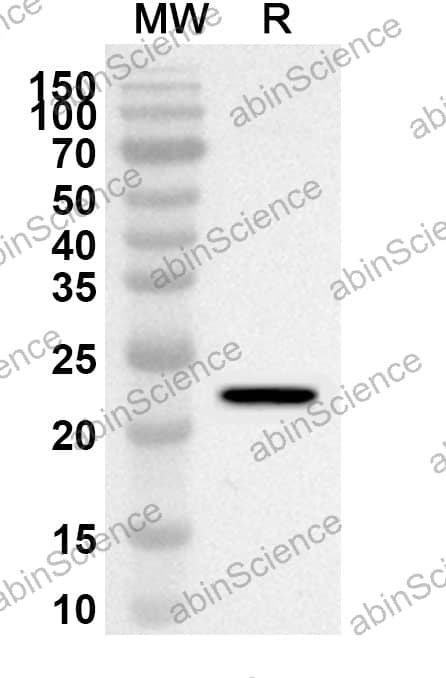
Western blot analysis was performed using anti-PARK7 polyclonal antibody at 1ug/mL on recombinant PARK7 (Catalog No. HV629012).
Contact us for custom quotes, bulk requests and any other issues.
Mail: support@abinScience.com
+86-27-87433958
Building C, No. 666, Shen Dun Si Lu, Wuhan, 430206, China


