Please ensure Javascript is enabled for purposes of website accessibility
Home > Featured Products > Bacteria & Viruses-related products > Hepatitis C Virus (HCV)

Research-grade reagents for Hepatitis C Virus (HCV) — a positive-sense, single-stranded RNA virus (family Flaviviridae, genus Hepacivirus) that establishes chronic infection in approximately 55–85% of acutely infected individuals, driving liver fibrosis, cirrhosis, and hepatocellular carcinoma (HCC). The HCV envelope glycoproteins E1 (gp35) and E2 (gp70) form heterodimers essential for viral entry via CD81, SR-BI, claudin-1, and occludin co-receptors, and are the primary targets for neutralizing antibody responses. Non-structural proteins NS3 (serine protease/helicase), NS4A (protease cofactor), NS5A (replication complex organizer), and NS2 (autoprotease) are critical for viral replication and are established targets for direct-acting antivirals (DAAs). We offer recombinant antibodies & nanobodies, reference antibodies (research biosimilars), InVivoMAb functional-grade antibodies, polyclonal antibodies, and recombinant proteins providing deep coverage of HCV structural and non-structural targets, validated for ELISA, Western blot, neutralization, and functional blocking assays. Comprehensive clone panels support vaccine immunogen design, broadly neutralizing antibody discovery, entry inhibitor screening, DAA resistance profiling, diagnostic assay development, and HCV virology research. RUO

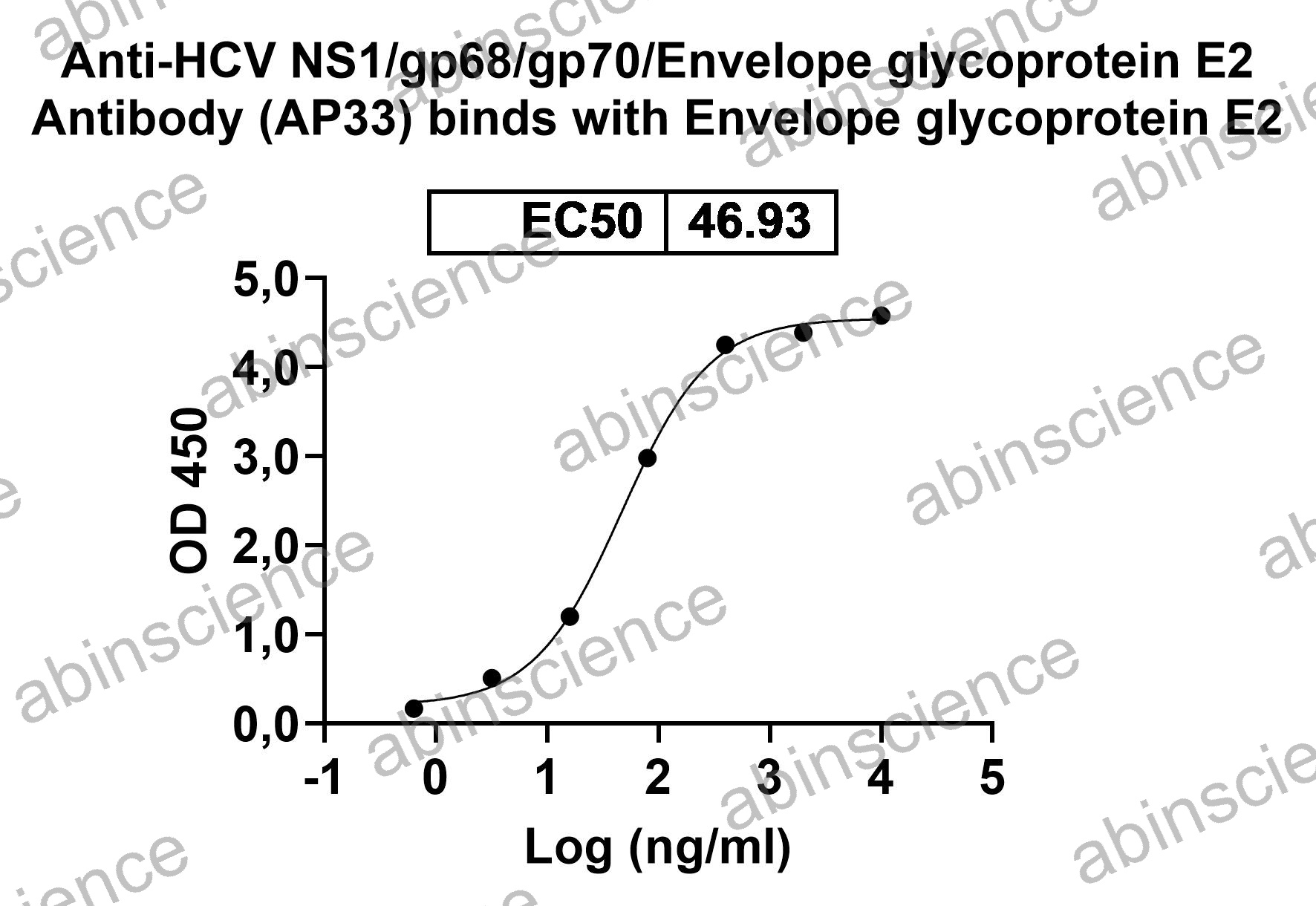
Recombinant Antibodies & Nanobodies An extensive panel of sequence-defined clones — one of the broadest available — predominantly targeting envelope glycoprotein E2 across multiple antigenic regions (AR3, AR4, AR5 and linear epitopes), with additional clones for E1 (IGH526), core protein p21 (19D9D6), NS3 helicase/protease, the E1/E2 heterodimer (cVH-E2, D32.10), and HCV ssRNA (Fab HCV2/HCV3). Includes well-characterized broadly neutralizing clones (AR3C, HC84.26, HC33.1, AP33, MRCT10.v362) validated for cross-genotype neutralization, epitope mapping, and vaccine immunogenicity benchmarking.
Reference Antibodies (Research Biosimilars) Research-grade analogs of clinical-stage anti-HCV E2 therapeutic antibodies, including MBL-HCV1 and HuMax-HepC. Suitable for mechanism-of-action studies, competitive binding assays, and as benchmarking standards for HCV entry inhibitor and bnAb discovery programs targeting post-DAA-era prophylactic vaccine strategies.
InVivoMAb Functional-Grade Low-endotoxin, azide-free neutralizing antibodies targeting E2 (RM2-01, HC84.26, HC84.22, HC33.1, HCV1, AP33) and the conformational E1/E2 heterodimer complex (AR4A, AR5A, HC33.4). Validated for in vivo neutralization, passive immunization, viral challenge protection, and functional blocking studies in humanized mouse models of HCV infection.
Polyclonal Antibodies Broad-spectrum detection reagents targeting envelope glycoprotein E1, capsid/core protein, and key non-structural proteins NS2 (autoprotease), NS3 (serine protease/helicase), NS4A (protease cofactor), and NS5A (replication complex phosphoprotein). Validated for Western blot and ELISA detection of HCV polyprotein processing products and replication intermediates.
Recombinant Proteins His-tagged, GST-tagged, and Fc-tagged HCV antigens covering envelope glycoproteins E1 and E2 (multiple tag formats), capsid/core protein, and non-structural proteins NS2, NS3, NS4A, and NS5A. Validated for SDS-PAGE and Western blot. Suitable as coating antigens for serodiagnostic ELISA, immunogens for antibody generation, substrates for protease activity assays, and reference standards for HCV vaccine potency testing.

All products manufactured by AtaGenix Laboratories under ISO 9001 & ISO 13485 quality systems.

References

1. Law M, Maruyama T, Lewis J, et al. Broadly neutralizing antibodies protect against hepatitis C virus quasispecies challenge. Nat Med. 2008;14(1):25-27. DOI

2. Liang TJ. Current progress in development of hepatitis C virus vaccines. Nat Med. 2013;19(7):869-878. DOI

3. Moradpour D, Penin F, Rice CM. Replication of hepatitis C virus. Nat Rev Microbiol. 2007;5(6):453-463. DOI

4. Cashman SB, Marsden BD, Dustin LB. Structure of and reactivity with HCV E1 and E2 provide insights into viral entry mechanisms. Curr Opin Virol. 2014;6:76-85. DOI

69 product results for "Hepatitis C Virus (HCV)"

Options+
Options
Confirm
  • Product types
    0 selected
    Proteins (9)
    Antibodies (58)
    Research Biosimilar (2)
  • Expression system
    0 selected
    E. coli (8)
    Mammalian cells (3)
  • Target
    0 selected
    Genome polyprotein (3)
    p21/Mature core protein (1)
    E1 & E2 (gp35 & gp70) (3)
    Hepacivirin/NS3P/Viroporin p70 (3)
    NS1/gp68/gp70 (47)
    NS4A (1)
    gp32/gp35/Envelope glycoprotein E1 (1)
    NS5A (1)
    ORF2 (2)
    ssRNA & Genome polyprotein (2)
    NS3 (1)
    Capsid (1)
  • Species
    0 selected
    Hepacivirus hominis (1)
    Hepatitis C virus (HCV) (16)
    Hepatitis C virus genotype 3a (isolate NZL1) (HCV) (1)
    Hepatitis E virus genotype 1 (HEV-1) (2)
  • Applications
    0 selected
    Bioactivity: FACS (2)
    Bioactivity testing in progress (6)
    Functional assay (2)
    Blocking (2)
    Research in vivo (2)
    Immunogen (9)
    WB (12)
    IHC (3)
    SDS-PAGE (9)
    Neutralization (53)
    ELISA (68)
  • Reactivity
    0 selected
    Hepatitis C virus genotype 1b (2)
    Hepatitis C virus (1)
    Hepatitis C virus genotype 4a (1)
    Hepatitis C virus genotype 6k (1)
    Hepatitis C virus genotype 1a (2)
    Human (1)
    Hepatitis C virus genotype 1c (1)
    Hepatitis C virus genotype 5a (2)
    Hepatitis C Virus (HCV) (47)
    Hepatitis C virus genotype 6b (1)
  • Host species
    0 selected
    Human (56)
    Rabbit (3)
    Alpaca (1)
  • Clonality
    0 selected
    Monoclonal (57)
    Polyclonal (3)
  • Conjugate
    0 selected
    Unconjugated (60)