Human metapneumovirus (hMPV) is a paramyxovirus discovered in 2001 that causes acute respiratory tract infections in infants, young children, elderly, and immunocompromised patients. The virus has a negative-sense single-stranded RNA genome encoding structural proteins including the fusion protein (F) and attachment glycoprotein (G), and non-structural proteins (N, P, M, M2-1, SH). The F protein is the primary target for neutralizing antibodies and vaccine development, while G protein is important for viral attachment and immune evasion. Diagnostic antibodies and functional reagents are critical for clinical research, vaccine development, and antiviral therapeutic studies.
Research Use Only (RUO)Not intended for diagnostic or therapeutic procedures.
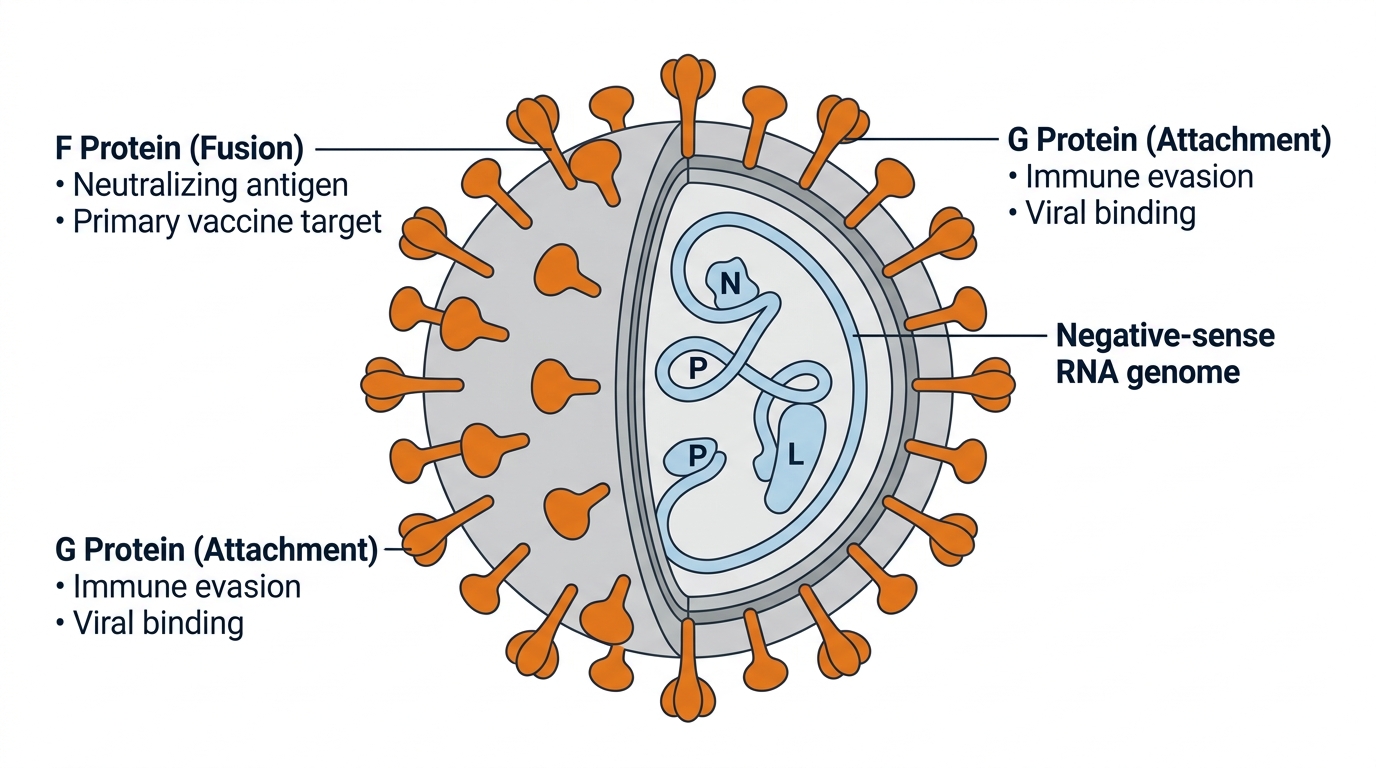
Fig. 1 hMPV structure. F protein mediates membrane fusion; G protein mediates viral attachment and immune evasion. Negative-sense RNA genome packaged with N, P, and L proteins.
abinScience provides InVivoMAb functional-grade antibodies, recombinant antibodies, polyclonal antibodies, and recombinant antigens for hMPV research. All products manufactured by our parent company AtaGenix Laboratories under ISO 9001 & ISO 13485 quality systems. Contact us for vaccine development and neutralization assay design.
Fusion Glycoprotein (F) — F protein is the primary fusion mediator and the dominant neutralizing antigen. F-specific neutralizing antibodies provide the strongest protective immunity and are the basis of vaccine development. InVivoMAb anti-F antibodies (VK430013) support in vivo neutralization studies, passive immunization experiments, and vaccine immunogenicity assessment. Recombinant F protein (VK430011) serves as an immunogen and ELISA coating antigen. Anti-F monoclonal and polyclonal antibodies (VK430014) enable epitope mapping and mechanism-of-action studies.
→ Browse hMPV F protein products
Attachment Glycoprotein (G) — G protein mediates viral attachment to host cells and is an immune evasion factor that downregulates interferon responses. G-specific antibodies are important for understanding viral pathogenesis and immune antagonism. Anti-G polyclonal antibodies (VK673014) support diagnostic ELISA development and blocking assays. Recombinant G protein (VK673012) serves as a diagnostic coating antigen and immunogen for vaccine studies. G-specific responses complement F protein-directed immunity in protective immunity assessment.
→ Browse hMPV G protein products
Non-Structural and Matrix Proteins (N, P, M, M2-1, SH) — hMPV non-structural proteins are critical for viral replication and immune modulation. N protein encapsidates the genome; M2-1 regulates RNA synthesis; SH protein is an immune antagonist; M protein is the matrix scaffold. Antibodies against these proteins (VK671014, VK777014, VK739014, VK530014) enable detection of viral replication, study of viral assembly, and understanding of host-pathogen interactions. Recombinant non-structural proteins support diagnostic assay development and mechanistic studies of hMPV pathogenesis.
→ Browse all hMPV products
Vaccine Development & Neutralization Assays
hMPV F and G recombinant antigens are optimal ELISA coating antigens for serological assays and vaccine immunogenicity assessment. InVivoMAb anti-F and anti-G antibodies enable in vivo neutralization studies, passive immunization experiments, and functional antibody characterization. Monoclonal antibody panels support epitope-specific neutralization mapping and vaccine strain selection.
Viral Replication & Diagnostic Studies
Anti-hMPV polyclonal and monoclonal antibodies targeting F, G, N, P, and M proteins enable quantification of viral replication, IHC detection in respiratory tissue, and rapid diagnostic ELISA development. Ready-to-use ELISA kits (VK430018, VK673018, VK777018, VK571018) provide validated antigen or antibody detection platforms for clinical and research applications.
1. van den Hoogen BG, de Jong JC, Groen J, et al. A newly discovered human pneumovirus isolated from young children. Nat Med. 2001;7(6):719-724.
2. Falsey AR, Erdman DD, Anderson LJ, Walsh EE. Human metapneumovirus infections in young and elderly adults. J Infect Dis. 2003;187(5):785-790.
3. Biacchesi S, Pham QN, Contento RL, et al. The F protein of human metapneumovirus lacks a furin cleavage site and is not cleaved during viral replication. Virology. 2005;335(2):241-249.
4. Haller SL, Ortega-Barria E, Coloma J, et al. Human metapneumovirus: synthesis of a comprehensive review of virology, epidemiology, clinical presentation, and immunity. Microbes Infect. 2020;22(4-5):209-224.
All products manufactured by AtaGenix Laboratories under ISO 9001 & ISO 13485 quality systems. Contact us for custom antibody development.
Human respiratory syncytial virus (HRSV), Human metapneumovirus (HMPV)
ELISA, Neutralization
Human
IgG1, kappa
M2B6
Human respiratory syncytial virus (HRSV), Human metapneumovirus (HMPV)
ELISA, Neutralization
Human
IgG1, kappa
M2D2
Human respiratory syncytial virus (HRSV), Human metapneumovirus (HMPV)
ELISA, Neutralization
Human
IgG1, kappa
M1C7
Human metapneumovirus
ELISA, Neutralization
Human
IgG1
MPV458
Human metapneumovirus
ELISA, Neutralization
Human
IgG1
MPV465
Human metapneumovirus
Neutralization
Human
IgG1
SAA0840
Human respiratory syncytial virus A (strain A2), Human metapneumovirus
ELISA, SPR
Human
IgG1, lambda2
MPE8
Mammalian cells
Q8B9P5
Leu19-Gly490
ELISA, Immunogen, SDS-PAGE, WB, Bioactivity testing in progress
Human metapneumovirus (strain CAN97-83) (HMPV)
ELISA, IHC, WB
Rabbit
IgG
Human metapneumovirus (strain CAN97-83) (HMPV)
ELISA, IHC, WB
Rabbit
IgG