Please ensure Javascript is enabled for purposes of website accessibility
Home > Featured Products > Bacteria & Viruses-related products > Junin mammarenavirus (JUNV)

Junin mammarenavirus (JUNV) Research Reagents — Anti-JUNV Antibodies & Proteins for Diagnostics & Vaccine Development

Argentine hemorrhagic fever (AHF) is a severe and often fatal illness caused by Junin mammarenavirus (JUNV, genus Arenabus, family Arenaviridae). JUNV is endemic to Argentina, primarily in the Pampas region, with sporadic outbreaks affecting rural and agricultural communities. The virus is transmitted to humans through contact with infected rodents (Calomys musculinus) and their secretions, with limited human-to-human transmission occurring primarily in healthcare settings. The case fatality rate ranges from 15–30% in untreated infections, with higher mortality in patients experiencing hemorrhagic manifestations and late-stage disease. The bisegmented RNA genome encodes the glycoprotein complex (GPC, composed of GP1 and GP2), the nucleoprotein (NP), and the RNA-dependent RNA polymerase (L protein). Ribavirin has shown efficacy in reducing mortality when administered early, but no specific vaccines are currently approved, making diagnostic development and therapeutic antibody research important for outbreak response and disease management.

Research Use Only (RUO)Not intended for diagnostic or therapeutic procedures.

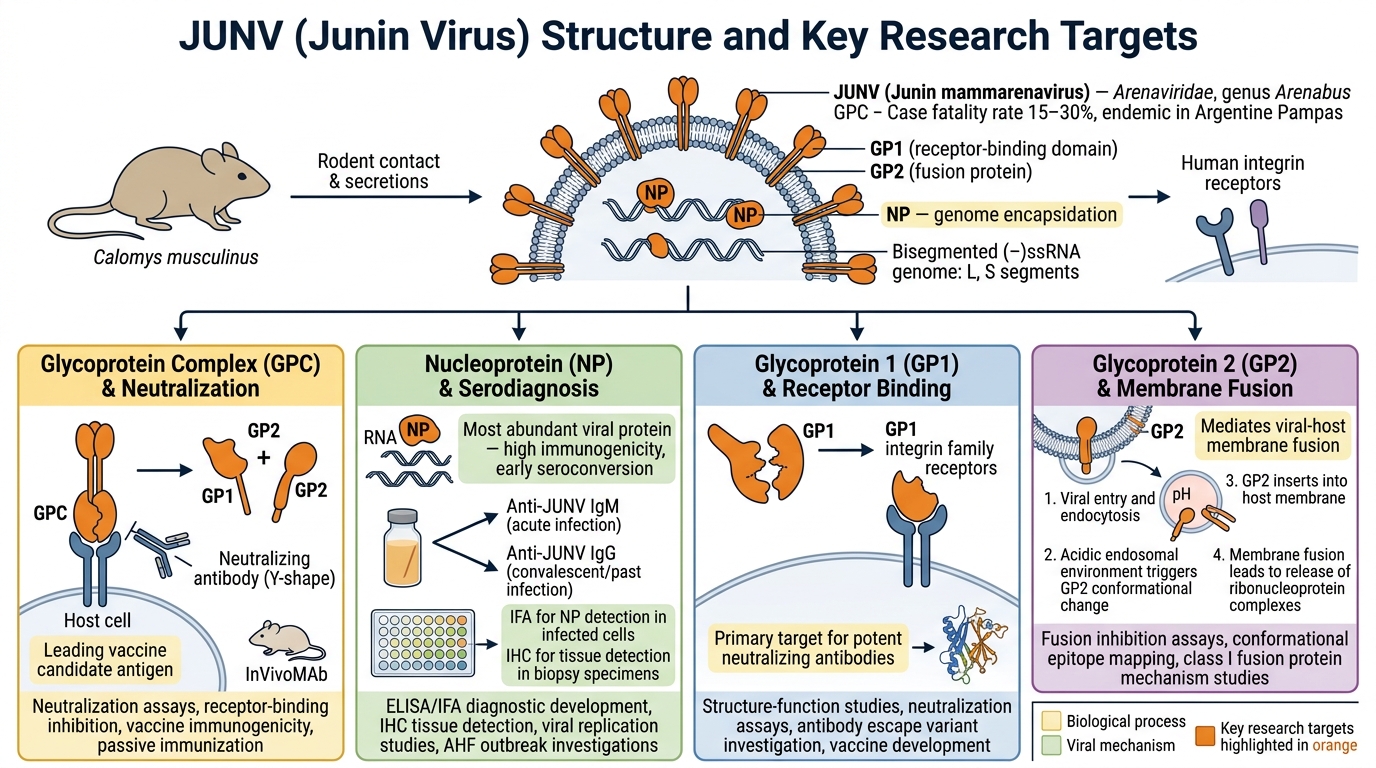
JUNV virion structure and key research targets — Glycoprotein complex, nucleoprotein, and L polymerase, with Calomys rodent transmission

Fig. 1 JUNV structure and transmission pathway. Glycoprotein complex (GPC) mediates receptor binding and cell entry; NP encapsidates the bisegmented genome. Key research targets highlighted in orange.

abinScience provides recombinant antibodies, polyclonal antibodies, InVivoMAb functional-grade antibodies, and recombinant proteins for key JUNV research targets. Products are validated for ELISA, WB, IHC, IF, neutralization, and SPR. All manufactured by our parent company AtaGenix Laboratories under ISO 9001 & ISO 13485 quality systems. Contact us for custom antibody development.

Key Research Targets

Glycoprotein Complex (GPC) — The GPC is the primary virion surface antigen responsible for receptor binding and cell entry. GPC is proteolytically cleaved into two functional subunits: GP1 (N-terminal, receptor-binding domain) and GP2 (C-terminal, fusion protein). GPC is the dominant target for neutralizing antibodies and the primary vaccine candidate antigen. Anti-GPC antibodies support neutralization assays, receptor-binding inhibition studies, vaccine immunogenicity evaluation, and conformational epitope mapping. InVivoMAb-grade anti-GPC enables passive immunization and protective efficacy studies in animal models.
→ Browse JUNV GPC antibodies & proteins

Nucleoprotein (NP) — NP is the most abundantly expressed viral protein and encapsidates both genomic RNA segments of the bisegmented JUNV genome. NP is highly immunogenic and undergoes early seroconversion, making it the primary diagnostic antigen in JUNV serological assays (IgM/IgG ELISA, immunofluorescence). Anti-NP antibodies and recombinant NP proteins support rapid diagnostic ELISA development, IHC-based tissue detection, and viral replication quantification studies in AHF outbreak investigations.
→ Browse JUNV NP antibodies & proteins

Glycoprotein 1 (GP1) — GP1 is the receptor-binding subunit of the GPC complex, mediating initial viral attachment to host cell surface receptors (including integrin family members). GP1 is a primary target for potent neutralizing antibodies and vaccine candidate antigen. Anti-GP1 antibodies enable structure-function studies of receptor recognition, neutralization assays, and investigation of antibody escape variants during natural infection and vaccine development.
→ Browse JUNV GP1 antibodies & proteins

Glycoprotein 2 (GP2) — GP2 is the membrane-anchored fusion subunit of the GPC complex. Following pH-triggered conformational changes in the endosomal compartment, GP2 mediates viral-host membrane fusion and virion release. Anti-GP2 antibodies support fusion inhibition assays, conformational epitope mapping, and mechanistic studies of the class I fusion protein mechanism shared across arenaviruses.
→ Browse JUNV GP2 antibodies & proteins

References

1. Maiztegui JI, Sabattini MS, Blejer JL, et al. Argentine hemorrhagic fever: epidemiological pattern, distribution, and transmission in a large cohort. Rev Infect Dis. 1989;11 Suppl 4:S624-S630.

2. Enria DA, Barrera Oro JG. Junín virus vaccines. Curr Top Microbiol Immunol. 2002;263:239-258.

3. Salvato MS, Shimomaye EM, Southern PJ, Oldstone MB. Biochemical and immunological properties of Junín virus S-segment-encoded proteins produced recombinantly by using baculovirus expression vectors. J Virol. 1991;65(5):2485-2491.

4. Weissenhorn W, Carfì A, Lee KH, et al. Crystal structure of the Ebola virus envelope glycoprotein and implications for membrane fusion. Proc Natl Acad Sci USA. 1998;95(20):11779-11784. [Comparative analysis of arenavirus fusion mechanisms]

16 product results for "Junin mammarenavirus (JUNV)"

Options+
Options
Confirm
  • Product types
    0 selected
    Antibodies (9)
    Proteins (7)
  • Expression system
    0 selected
    Mammalian cells (3)
    E. coli (4)
  • Target
    0 selected
    Glycoprotein G1 (2)
    Nucleoprotein (2)
    GP1 (5)
    GP1 glycoprotein (1)
    GP2 (4)
    GPC (1)
    Protein Z (1)
  • Species
    0 selected
    Junin mammarenavirus (4)
    Junin mammarenavirus (JUNV) (1)
    Junin mammarenavirus (JUNV) (Junn mammarenavirus) (3)
  • Applications
    0 selected
    Immunogen (7)
    SDS-PAGE (7)
    ELISA (16)
    IHC (2)
    Neutralization (4)
    WB (9)
  • Reactivity
    0 selected
    Machupo virus (1)
    Junin mammarenavirus (5)
    Junin mammarenavirus (JUNV) (3)
    Machupo virus (MACV) (1)
  • Host species
    0 selected
    Mouse (2)
    Alpaca (1)
    Rabbit (2)
    Human (4)
  • Clonality
    0 selected
    Monoclonal (7)
    Polyclonal (2)
  • Conjugate
    0 selected
    Unconjugated (9)