
 中文
中文 English
 한국어
한국어 日本語
日本語 Español
 Français
 Русский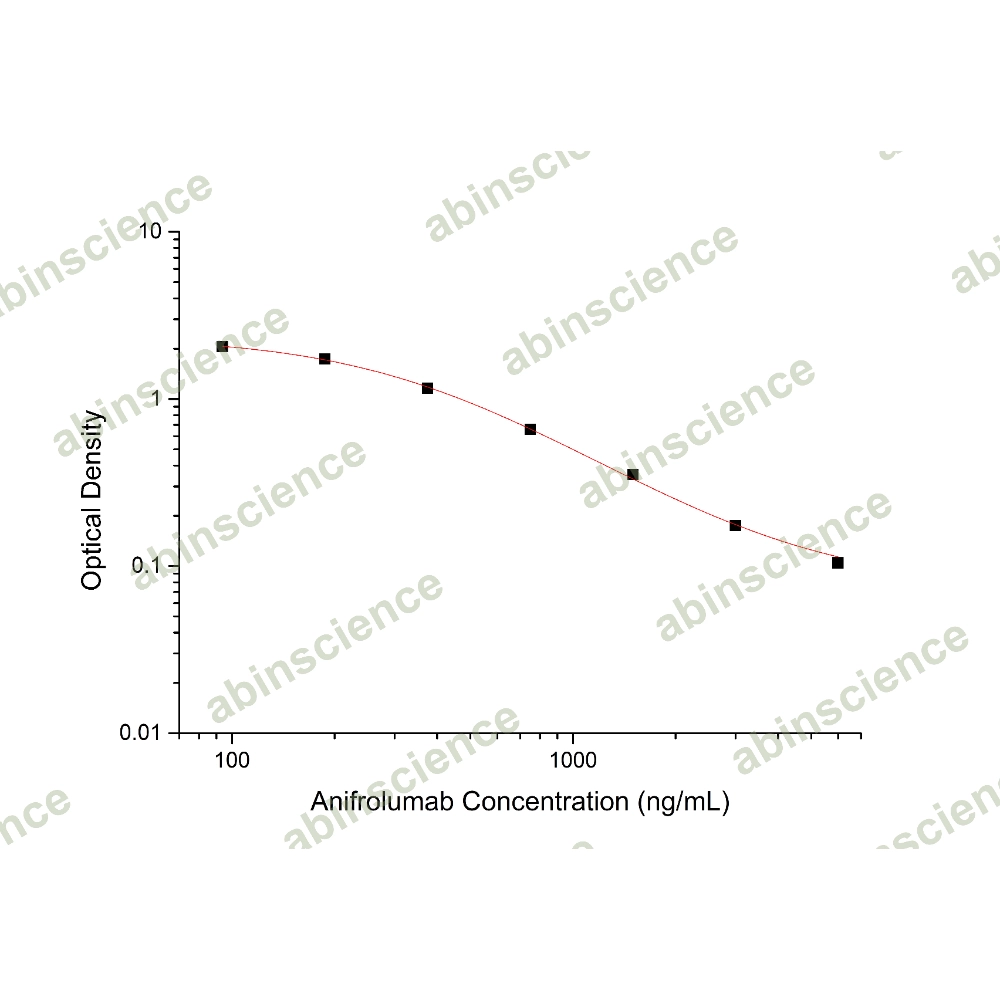
| Catalog No. | DB823018 |
|---|---|
| Description |
Anifrolumab ELISA Kit (DB823018) — Quantitative competitive ELISA for Anifrolumab. Sample: Plasma, Serum. Range: 0.31-5 μg/mL. Sensitivity: 0.156 μg/ml.
Highlights
|
| Sample type | Plasma, Serum |
| Sensitivity | 69.49 ng/ml |
| Range | 93.75-6,000 ng/ml |
| Accession | P17181 |
| Applications | ELISA |
| Detection method | Colorimetric |
| Assay type | Quantitative |
| Recovery | 80-120% |
| Shipping | 2-8 ℃ |
| Stability and Storage | The stability of ELISA kit is determined by the loss rate of activity. The loss rate of this kit is less than 10% prior to the expiration date under appropriate storage condition. |
| Specifications | Anifrolumab |
| Alternate Names | MDX-1333, MEDI-546, 1326232-46-5 |
| Background | Interferon alpha/beta receptor 1 (Anifrolumab) is a ~63 kDa protein. Together with IFNAR2, forms the heterodimeric receptor for type I interferons (including interferons alpha, beta, epsilon, omega and kappa). Type I interferon binding activates the JAK-STAT signaling cascade, resulting in transcriptional activation or repression of interferon-regulated genes that encode the effectors of the interferon response. Mechanistically, type I interferon-binding brings the IFNAR1 and IFNAR2 subunits into close proximity with one another, driving their associated Janus kinases (JAKs) (TYK2 bound to IFNAR1 and JAK1 bound to IFNAR2) to cross-phosphorylate one another. The activated kinases phosphorylate specific tyrosine residues on the intracellular domains of IFNAR1 and IFNAR2, forming docking sites for the STAT transcription factors. STAT proteins are then phosphorylated by the JAKs, promoting their translocation into the nucleus to regulate expression of interferon-regulated genes. 1. Russell-Harde, D. et al. (1999) Biochemical and biophysical research communications 255, 539-44. PMID: 10049744 2. Kumar, KG. et al. (2003) The EMBO journal 22, 5480-90. PMID: 14532120 3. Kumar, KG. et al. (2004) The Journal of biological chemistry 279, 46614-20. PMID: 15337770 4. Uzé, G. et al. (1990) Cell 60, 225-34. PMID: 2153461 5. Thomas, C. et al. (2011) Cell 146, 621-32. PMID: 21854986 6. Zheng, H. et al. (2013) Cell reports 5, 180-93. PMID: 24075985 7. Hernandez, N. et al. (2019) The Journal of experimental medicine 216, 2057-2070. PMID: 31270247 8. Gothe, F. et al. (2022) Clinical infectious diseases : an official publication of the Infectious Diseases Society of America 74, 136-139. PMID: 33252644 9. Bastard, P. et al. (2022) The Journal of experimental medicine 219. PMID: 35442418 10. Abramovich, C. et al. (1994) The EMBO journal 13, 5871-7. PMID: 7813427 |
| Note | For Research Use Only. |
Standard Curve of Anifrolumab ELISA Kit


Contact us for custom quotes, bulk requests and any other issues.
Mail: [email protected]
+86-27-65523339
Building C, No. 666, Shen Dun Si Lu, Wuhan, 430206, China


