Key Challenges in NK Cell Functional Research
As crucial effector cells of the innate immune system, NK cells play important roles in antiviral defense, tumor immunity, and vaccine responses. Their functionality relies on rapid effector functions, including antibody-dependent cellular cytotoxicity (ADCC) and cytokine secretion. However, NK cell function is highly heterogeneous, with clear differences in output patterns under different stimulation conditions, making systematic evaluation by flow cytometry challenging.
Coupling of Multidimensional Function and Differentiation Status
NK cell function does not operate in isolation; the differentiation stage, activation status, and transcriptional regulation directly influence functional output. For example, NK cells at different maturation stages display distinct cytotoxic abilities and cytokine secretion profiles, while specific transcription factors regulate these functional pathways. Therefore, analysis based solely on a single dimension (such as phenotype or a single functional marker) often fails to fully describe the true state of NK cells, requiring more sophisticated flow cytometry experimental designs.
An NK Cell Analysis Panel for Multidimensional Functional Profiling
Based on NK cell phenotyping, OMIP-027 incorporates multiple functional markers and diverse stimulation conditions to evaluate NK cell functional output, differentiation status, and regulatory characteristics within a single experimental framework. This panel can assess NK cells across different functional pathways and compare functional differences under various disease states or immune backgrounds, providing a systematic and comparable tool for infection immunity research and vaccine evaluation.
OMIP-027 further integrates functional assessment with differentiation status within the traditional NK cell analysis framework, achieving a systematic analysis of NK cells within a "differentiation–regulation–function" framework in a single experiment. This panel provides a more direct and comprehensive technical approach for studying NK cell functional changes in infection, tumor immunity, and vaccine responses, and offers a reference method for functional assessment in complex immune environments.
1. OMIP-027 Panel
2. Gating Logic
1
Exclusion of Non-target Cell Populations:
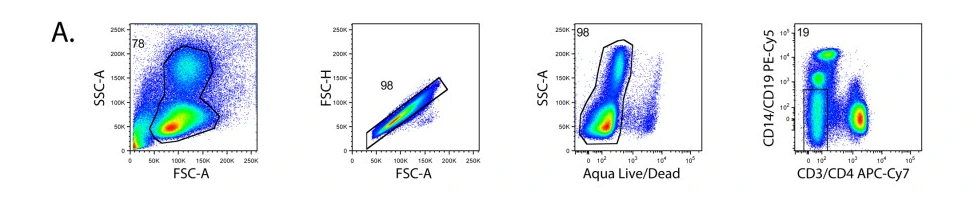
PBMC are first gated to select the lymphocytes. Doublets are excluded using FSC-H/FSC-A. Dead cells, T cells, monocytes, and B cells are excluded using viability dye, CD3, CD4, CD14, and CD19.
2
NK Cell Population Identification:
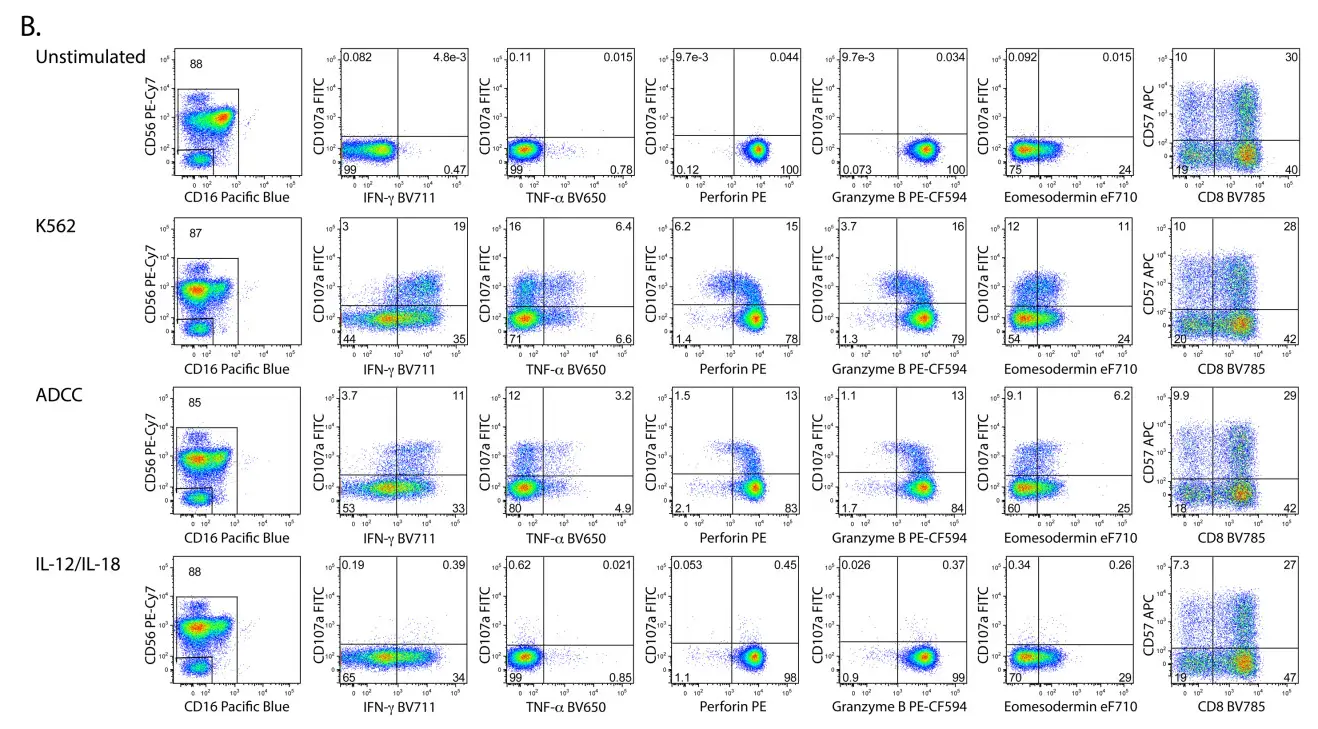
NK cells are gated out based on CD56 and CD16 expression within CD3−CD4−CD14−CD19−cells. Then analyzed the Expression levels of CD107a, IFN-γ, TNF-α, Granzyme B, Perforin, Eomes, CD57, and CD8.
3. Experimental Results
Within PBMC, lymphocytes are first gated, including cells with increased side scatter (SSC) due to granularity. Doublets are excluded using FSC-A/H. Dead cells, T cells, monocytes, and B cells are excluded with viability dye, CD3, CD4, CD14, and CD19 to identify CD3−CD4−CD14−CD19− cells.
Within CD3−CD4−CD14−CD19− cells, NK cells are gated out using CD56 and CD16. Expression levels of CD107a, IFN-γ, TNF-α, Granzyme B, Perforin, Eomes, CD57, and CD8 are analyzed. NK cell functional responses under different stimulation conditions are compared: unstimulated, K562 co-culture, ADCC stimulation, and IL-12/IL-18 stimulation.
4. Panel Interpretation
4.1 An Integrated “Regulation–Differentiation–Function” Framework for NK Cell Analysis
OMIP-027 integrates differentiation marker CD57, transcriptional regulator Eomes, and functional markers (CD107a, IFN-γ, TNF-α, Perforin, Granzyme B) to assess, at the single-cell level: the differentiation state of the NK cell, its cytotoxic capability, and the transcriptional regulation of its function. This “triple integration” analysis overcomes the limitations of single-dimensional NK cell analysis and provides unified technical support for studying NK cell exhaustion and maturation in chronic infections (e.g., HIV) and tumor microenvironments.
4.2 Dynamic CD16 Expression Reveals Functional NK Subsets
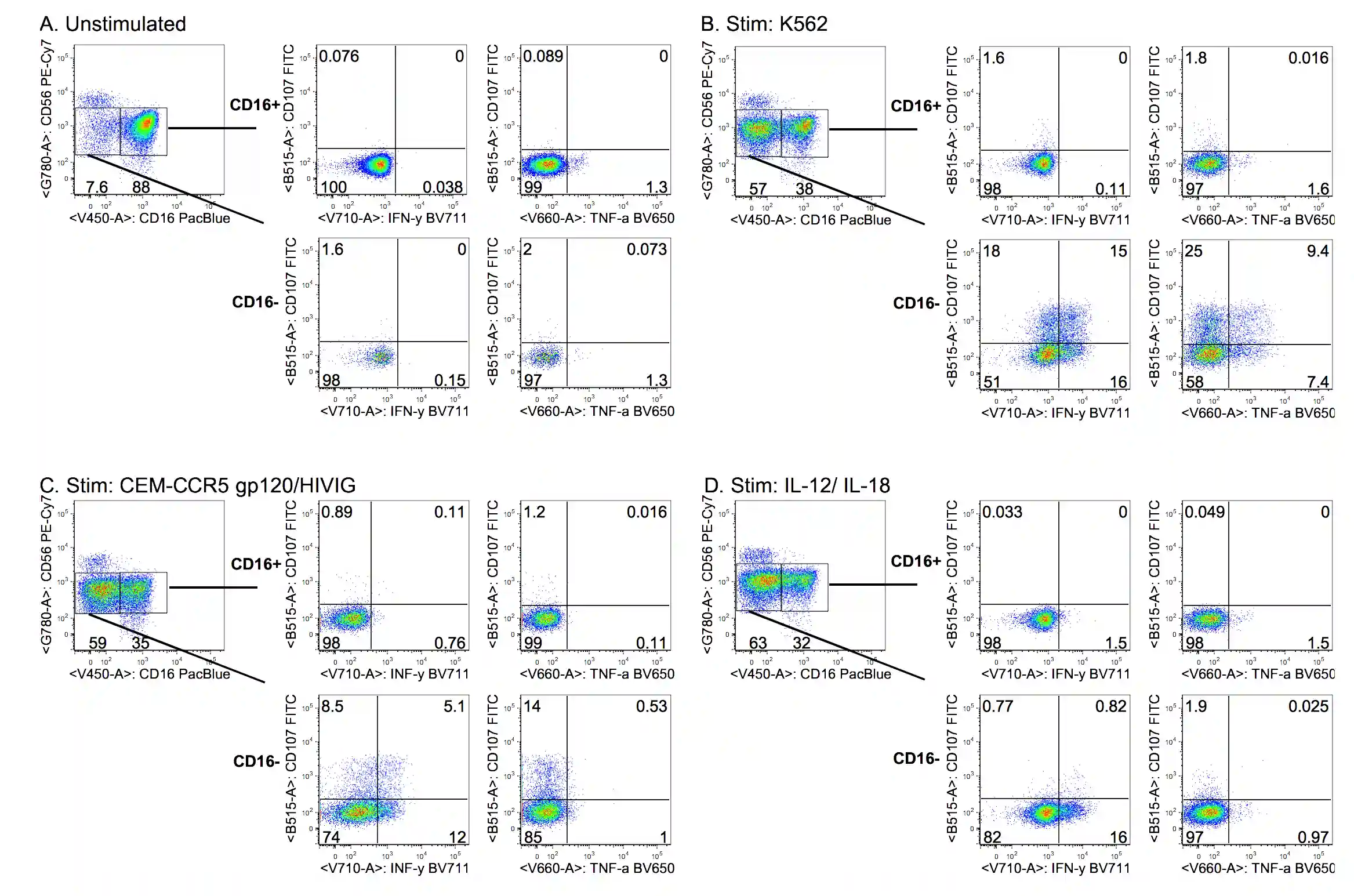
Systematic validation across multiple stimulation conditions shows that activated CD56dim NK cells downregulate CD16 expression, with functional responders (degranulation and cytokine production) predominantly found in the CD56dimCD16neg subset. This finding highlights that defining NK cell function solely by CD16 positivity may overlook key functional populations, emphasizing the need to redefine subpopulations based on activation state in functional analysis.
4.3 Multistimulation Design Enables Comprehensive Functional Assessment
OMIP-027 establishes four standardized stimulation conditions to simulate core NK activation pathways:
Natural cytotoxicity mediated by K562 cells
ADCC via gp120-coated target cells + HIVIG
Cytokine activation via IL-12/IL-18
Vaccine-related activation via MVA viral vector
This design fully covers experimental needs across basic mechanism research, disease pathology, and vaccine development, enabling direct comparison of NK cell functional responses under different activation pathways.
5. Applications
Infection immunology research Tumor immunology research Vaccine evaluation Basic immune mechanism studies Immunotherapy research Immune function monitoring and population studies
6. Conclusion
OMIP-027 centers on NK cell function, integrating differentiation status, regulatory characteristics, and functional readouts within a single experimental framework, enabling systematic multidimensional characterization of NK cells. Compared with conventional phenotype-based or single-function analyses, this panel provides a more comprehensive assessment of NK cell functional behavior under different stimulation and immune contexts. For applications in infection immunity, tumor research, and vaccine evaluation, OMIP-027 offers an interpretable and comparable analytical approach and serves as a reliable technical reference for studying NK cell function in complex immune environments.
Get More Flow Cytometry Antibodies
abinScience offers high-quality Flow Cytometry Antibodies for NK cell-related differentiation and function, supporting research on the multidimensional state of NK cells.
References
[1] Costanzo MC, Creegan M, Lal KG, Eller MA. OMIP-027: Functional analysis of human natural killer cells. Cytometry A. 2015 Sep;87(9):803-5. doi: 10.1002/cyto.a.22719. Epub 2015 Jul 17. PMID: 26189970.

About Us
As a strategic venture of AtaGenix (established 2011), abinScience was founded in 2023 to deliver premium life science reagents that accelerate discovery. Our flow cytometry antibody products cover commonly used detection markers, with a wide variety to meet the research needs of multiple species (Human/Mouse/Rat/Dog/Hamster/Monkey, etc.). We provide stable and reliable support for scientific research.
Explore abinScience Flow Cytometry Antibodies


 中文
中文 English
 한국어
한국어 日本語
日本語 Español
 Français
 Русский