
 中文
中文 English
 한국어
한국어 日本語
日本語 Español
 Français
 Русский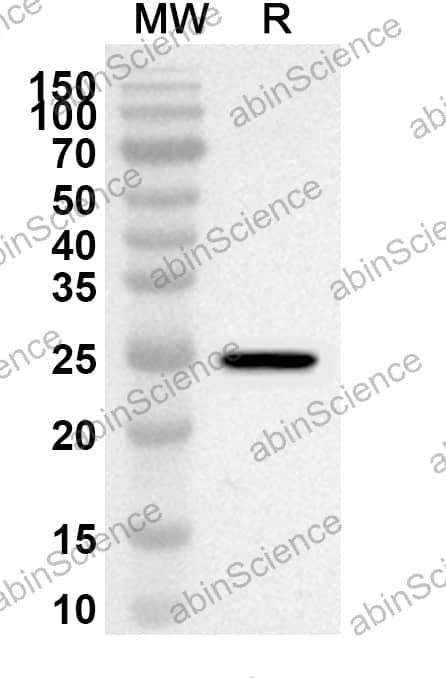

| Catalog No. | HY479012 |
|---|---|
| Description |
Recombinant Human EPRS1 Protein, N-His (HY479012) expressed in E. coli, spanning Asp749-Thr956. Purity: >90% by SDS-PAGE.
Highlights
|
| Expression system | E. coli |
| Accession | P07814 |
| Protein length | Asp749-Thr956 |
| Applications | ELISA, Immunogen, SDS-PAGE, WB, Bioactivity testing in progress |
| Species | Homo sapiens (Human) |
| Nature | Recombinant |
| Endotoxin level | Please contact with the lab for this information. |
| Purity | >90% as determined by SDS-PAGE. |
| Predicted molecular weight | 24.95 kDa |
| Form | Lyophilized |
| Storage buffer | Lyophilized from a solution in PBS pH 7.4, 0.02% NLS, 1 mM EDTA, 4% Trehalose, 1% Mannitol. Please refer to the specific buffer information in the hardcopy of datasheet or the lot-specific COA. |
| Reconstitution | Reconstitute in sterile water for a stock solution. Adjust the volume of sterile water so that, after reconstitution, the final stock concentration matches the value indicated on the product label or datasheet. RECONSTITUTION PROTOCOL 1. Allow the product to be reconstituted and the reconstitution diluent to reach room temperature. 2. Tap or briefly centrifuge the product vial before opening to dislodge any lyophilized material that may be dispersed on the wall or cap of the vial. 3. Use the diluent and stock concentration recommended in the product datasheet. If preparing a stock concentration higher than recommended, contact Technical Service. 4. After adding the diluent, re-cap the vial and invert gently by hand or place on a slow rocking platform to allow the reconstitution diluent to coat all the surfaces inside the vial. Note: Do not mix by vortexing or by pipetting the material up and down. 5. Allow the vial to sit at room temperature with gentle agitation for at least 15 minutes before aliquotting or using. 6. Store the reconstituted material in single use aliquots in polypropylene or siliconized tubes. Aliquots of 10 μL or larger are recommended. |
| Shipping | In general, proteins are provided as lyophilized powder/frozen liquid. They are shipped out with dry ice/blue ice unless customers require otherwise. |
| Stability and Storage | Use a manual defrost freezer and avoid repeated freeze thaw cycles. Store at 2 to 8°C for frequent use. Store at -20 to -80°C for twelve months from the date of receipt. |
| Alternate Names | EPRS, PARS, EPRS1, Bifunctional aminoacyl-tRNA synthetase, GLNS, QARS, QPRS, Glutamyl-tRNA synthetase, Glutamatyl-prolyl-tRNA synthetase, Prolyl-tRNA synthetase, Bifunctional glutamate/proline--tRNA ligase, Cell proliferation-inducing gene 32 protein, GluRS |
| Background | Bifunctional glutamate/proline--tRNA ligase (EPRS1) is a ~170 kDa protein. Multifunctional protein which primarily functions within the aminoacyl-tRNA synthetase multienzyme complex, also known as multisynthetase complex. Within the complex it catalyzes the attachment of both L-glutamate and L-proline to their cognate tRNAs in a two-step reaction where the amino acid is first activated by ATP to form a covalent intermediate with AMP. Subsequently, the activated amino acid is transferred to the acceptor end of the cognate tRNA to form L-glutamyl-tRNA(Glu) and L-prolyl-tRNA(Pro). Upon interferon-gamma stimulation, EPRS1 undergoes phosphorylation, causing its dissociation from the aminoacyl-tRNA synthetase multienzyme complex. It is recruited to form the GAIT complex, which binds to stem loop-containing GAIT elements found in the 3'-UTR of various inflammatory mRNAs, such as ceruloplasmin. 1. Zhou, H. et al. (2013) Nature 494, 121-4. PMID: 23263184 2. Son, J. et al. (2013) Acta crystallographica. Section D, Biological crystallography 69, 2136-45. PMID: 24100331 3. Mendes, MI. et al. (2018) American journal of human genetics 102, 676-684. PMID: 29576217 4. Thömmes, P. et al. (1988) Nucleic acids research 16, 5391-406. PMID: 3290852 5. Yoon, I. et al. (2023) EMBO molecular medicine 15, e16940. PMID: 37212275 6. Sampath, P. et al. (2004) Cell 119, 195-208. PMID: 15479637 7. Arif, A. et al. (2012) Molecular and cellular biology 32, 5046-55. PMID: 23071094 8. Arif, A. et al. (2017) Nature 542, 357-361. PMID: 28178239 |
| Note | For research use only. |
SDS-PAGE for Recombinant Human EPRS1 Protein, N-His
Contact us for custom quotes, bulk requests and any other issues.
Mail: support@abinScience.com
+86-27-65523339
Building C, No. 666, Shen Dun Si Lu, Wuhan, 430206, China


