
 中文
中文 English
 한국어
한국어 日本語
日本語 Español
 Français
 Русский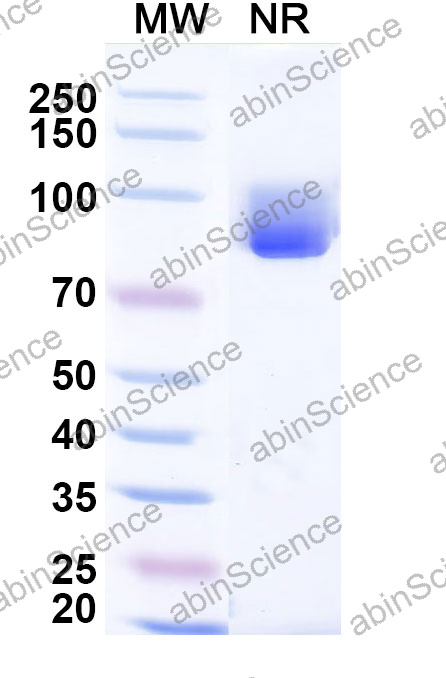
| Catalog No. | JN116013 | ||||
|---|---|---|---|---|---|
| Description |
Anti-Escherichia coli ompA Nanobody (SAA2320) [SAA2320] (JN116013) is a human monoclonal antibody detecting OmpA in ELISA, FCM. Suitable for Escherichia coli.
Highlights
|
||||
| Species reactivity | Escherichia coli | ||||
| Applications | ELISA, FCM | ||||
| Host species | Human | ||||
| Clonality | Monoclonal | ||||
| Isotype | VHH-Fc | ||||
| Clone ID | SAA2320 | ||||
| Target | Outer membrane protein A, OmpA, Outer membrane porin A, Outer membrane protein 3A, Outer membrane protein B, Outer membrane protein II*, Outer membrane protein d, ompA, con, tolG, tut | ||||
| Endotoxin level | Please contact with the lab for this information. | ||||
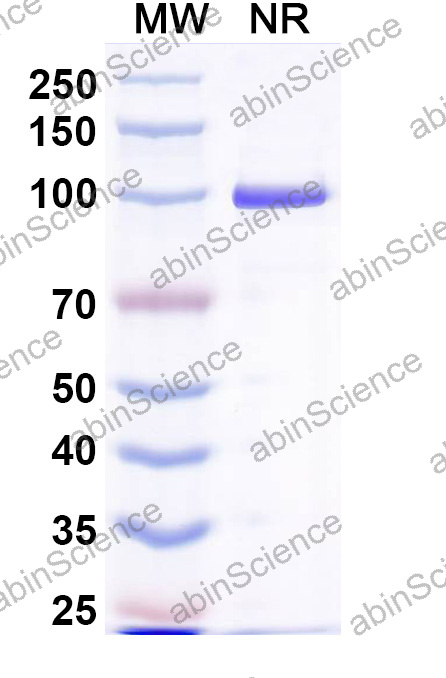
| Purity | >95% as determined by SDS-PAGE. | ||||
| Purification | Protein A/G purified from cell culture supernatant. | ||||
| Accession | P0A910, P0A911 | ||||
| Form | Liquid | ||||
| Storage buffer | 0.01M PBS pH 7.4 Please refer to the specific buffer information in the hardcopy of datasheet or the lot-specific COA. |
||||
| Product Usage Information |
| ||||
| Stability and Storage | Use a manual defrost freezer and avoid repeated freeze thaw cycles. Store at 2 to 8°C for frequent use. Store at -20 to -80°C for twelve months from the date of receipt. | ||||
| Background | Outer membrane protein A (ompA) is a ~37 kDa protein. With TolR probably plays a role in maintaining the position of the peptidoglycan cell wall in the periplasm (Probable). Plays a role in resistance to environmental stress, and a role in outer membrane functionality and cell shape. Non-covalently binds peptidoglycan (Probable). Acts as a porin with low permeability that allows slow penetration of small solutes. A very abundant protein, there can be up to 210,000 OmpA molecules per cell. 1. Wang, Y. (2002) Biochemical and biophysical research communications 292, 396-401. PMID: 11906175 2. Sonntag, I. et al. (1978) Journal of bacteriology 136, 280-5. PMID: 361695 3. Ishida, H. et al. (2014) Biochimica et biophysica acta 1838, 3014-24. PMID: 25135663 4. Sugawara, E. et al. (1992) The Journal of biological chemistry 267, 2507-11. PMID: 1370823 5. Negoda, A. et al. (2010) Biochimica et biophysica acta 1798, 1480-4. PMID: 20004640 6. Negoda, A. et al. (2010) The FEBS journal 277, 4427-37. PMID: 21069910 7. Li, GW. et al. (2014) Cell 157, 624-35. PMID: 24766808 8. Sugawara, E. et al. (1994) The Journal of biological chemistry 269, 17981-7. PMID: 7517935 9. Arora, A. et al. (2000) The Journal of biological chemistry 275, 1594-600. PMID: 10636850 10. Zakharian, E. et al. (2005) Biochemistry 44, 6701-7. PMID: 15850404 | ||||
| Note | For research use only |
SDS-PAGE for Anti-Escherichia coli ompA Recombinant Nanobody (SAA2320)
Contact us for custom quotes, bulk requests and any other issues.
Mail: [email protected]
+86-27-65523339
Building C, No. 666, Shen Dun Si Lu, Wuhan, 430206, China


