
 中文
中文 English
 한국어
한국어 日本語
日本語 Español
 Français
 Русский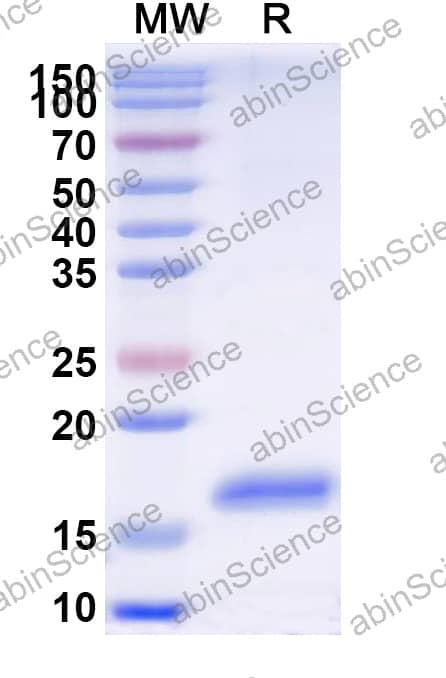
| Catalog No. | HY292013 | ||||
|---|---|---|---|---|---|
| Description |
Anti-Human GBA Nanobody (SAA2277) [SAA2277] (HY292013) is a alpaca monoclonal antibody detecting Human GBA in ELISA, BLI. Suitable for Human.
|
||||
| Species reactivity | Human | ||||
| Applications | ELISA, BLI | ||||
| Host species | Alpaca | ||||
| Clonality | Monoclonal | ||||
| Isotype | VHH-His | ||||
| Clone ID | SAA2277 | ||||
| Target | Lysosomal acid glucosylceramidase, Lysosomal acid GCase, EC:3.2.1.45, Acid beta-glucosidase, Alglucerase, Beta-glucocerebrosidase, Beta-GC, Beta-glucosylceramidase 1, Cholesterol glucosyltransferase, SGTase, EC:2.4.1.-, Cholesteryl-beta-glucosidase, EC:3.2.1.-, D-glucosyl-N-acylsphingosine glucohydrolase, Glucosylceramidase beta 1, Imiglucerase, Lysosomal cholesterol glycosyltransferase, Lysosomal galactosylceramidase, EC:3.2.1.46, Lysosomal glycosylceramidase, GBA1 | ||||
| Endotoxin level | Please contact with the lab for this information. | ||||
| Purity | >90% as determined by SDS-PAGE. | ||||
| Purification | Purified by Nickel column. | ||||
| Accession | P04062 | ||||
| Form | Liquid | ||||
| Storage buffer | 0.01M PBS pH 7.4 Please refer to the specific buffer information in the hardcopy of datasheet or the lot-specific COA. |
||||
| Product Usage Information |
| ||||
| Stability and Storage | Use a manual defrost freezer and avoid repeated freeze thaw cycles. Store at 2 to 8°C for frequent use. Store at -20 to -80°C for twelve months from the date of receipt. | ||||
| Background | Lysosomal acid glucosylceramidase (GBA) is a ~59 kDa protein. Glucosylceramidase that catalyzes, within the lysosomal compartment, the hydrolysis of glucosylceramides/GlcCers (such as beta-D-glucosyl-(1<->1')-N-acylsphing-4-enine) into free ceramides (such as N-acylsphing-4-enine) and glucose. Plays a central role in the degradation of complex lipids and the turnover of cellular membranes. Through the production of ceramides, participates in the PKC-activated salvage pathway of ceramide formation. Catalyzes the glucosylation of cholesterol, through a transglucosylation reaction where glucose is transferred from GlcCer to cholesterol. GlcCer containing mono-unsaturated fatty acids (such as beta-D-glucosyl-N-(9Z-octadecenoyl)-sphing-4-enine) are preferred as glucose donors for cholesterol glucosylation when compared with GlcCer containing same chain length of saturated fatty acids (such as beta-D-glucosyl-N-octadecanoyl-sphing-4-enine). 1. Ron, I. et al. (2005) Blood cells, molecules & diseases 35, 57-65. PMID: 15916907 2. Akiyama, H. et al. (2013) Biochemical and biophysical research communications 441, 838-43. PMID: 24211208 3. Akiyama, H. et al. (2020) The Journal of biological chemistry 295, 5257-5277. PMID: 32144204 4. Bannink, S. et al. (2024) Journal of lipid research 65, 100670. PMID: 39395789 5. Vaccaro, AM. et al. (1997) The Journal of biological chemistry 272, 16862-7. PMID: 9201993 6. Magalhaes, J. et al. (2016) Human molecular genetics 25, 3432-3445. PMID: 27378698 7. Kitatani, K. et al. (2009) The Journal of biological chemistry 284, 12972-8. PMID: 19279011 8. Marques, AR. et al. (2016) Journal of lipid research 57, 451-63. PMID: 26724485 9. Boer, DE. et al. (2021) Journal of lipid research 62, 100018. PMID: 33361282 | ||||
| Note | For research use only. |
SDS-PAGE for Anti-Human GBA Nanobody (SAA2277)


Contact us for custom quotes, bulk requests and any other issues.
Mail: [email protected]
+86-27-65523339
Building C, No. 666, Shen Dun Si Lu, Wuhan, 430206, China


