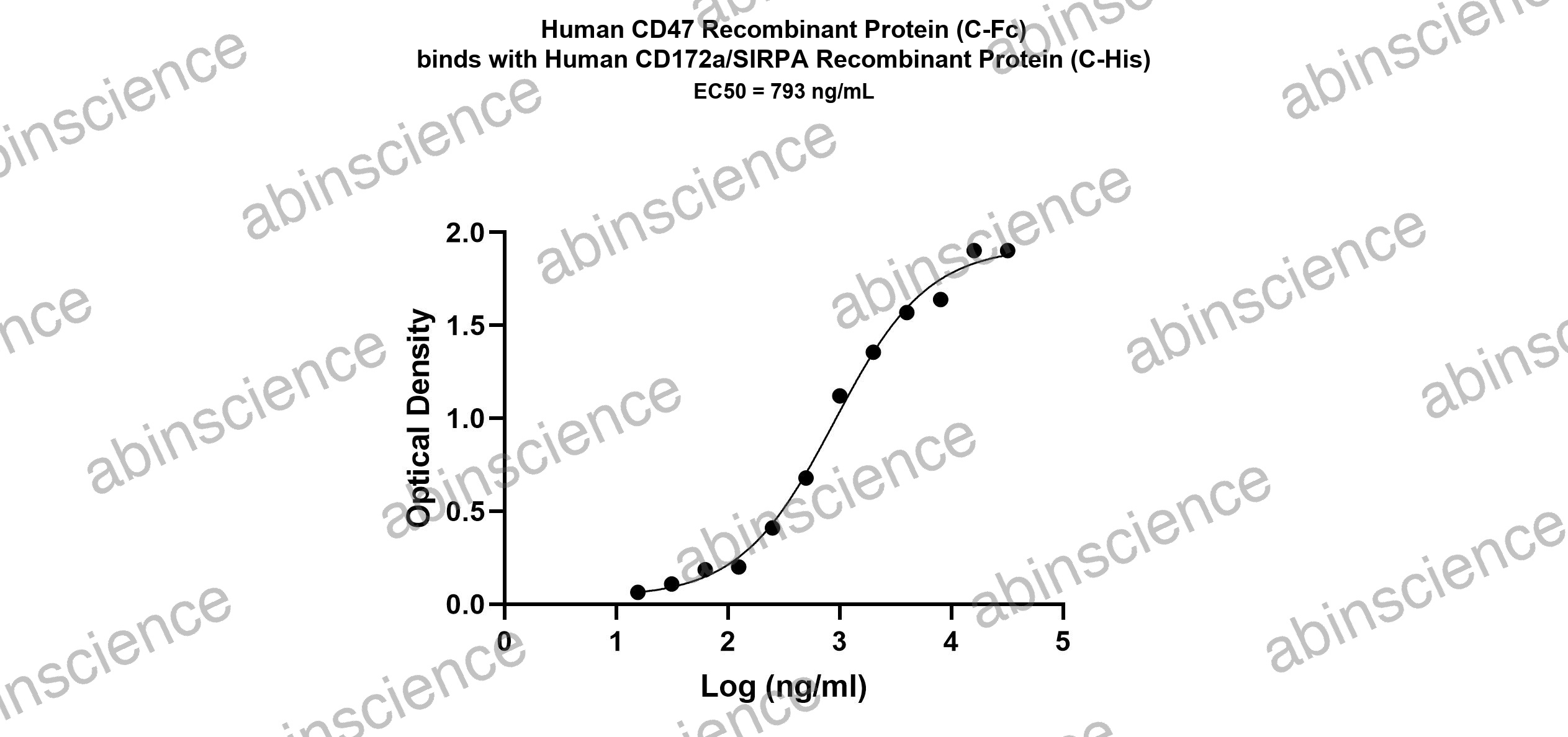
SIRPα (Signal Regulatory Protein Alpha / CD172a / SHPS-1) is an inhibitory receptor on macrophages and dendritic cells that recognizes CD47 ("don't eat me" signal) on target cells. The CD47/SIRPα axis is the dominant innate immune checkpoint governing phagocytosis — tumor cells upregulate CD47 to evade macrophage-mediated killing. Blocking the CD47/SIRPα interaction is a major therapeutic strategy with multiple candidates in clinical development, including Magrolimab (anti-CD47), Evorpacept (SIRPα-Fc), and anti-SIRPα antibodies. abinScience offers recombinant SIRPα and CD47 proteins, anti-SIRPα antibodies, and ELISA kits.
SIRPα Biology and the CD47/SIRPα Checkpoint
SIRPα is a ~110 kDa transmembrane glycoprotein with three extracellular Ig-like domains and an intracellular tail containing immunoreceptor tyrosine-based inhibitory motifs (ITIMs). It is expressed predominantly on macrophages, monocytes, dendritic cells, and neurons. When CD47 on a target cell binds the N-terminal IgV domain of SIRPα, the ITIMs are phosphorylated and recruit the phosphatases SHP-1 and SHP-2, which inhibit myosin accumulation at the phagocytic synapse and block engulfment.
Tumor cells exploit this axis by overexpressing CD47, sending a "don't eat me" signal that prevents macrophage-mediated phagocytosis. Therapeutic strategies to block this axis include anti-CD47 antibodies (Magrolimab), engineered SIRPα decoy receptors (Evorpacept/ALX148), and anti-SIRPα antibodies. A key challenge is that CD47 is ubiquitously expressed on normal cells — especially red blood cells — meaning anti-CD47 approaches risk causing anemia through RBC phagocytosis. Anti-SIRPα antibodies avoid this issue because they target the macrophage side rather than the RBC side.
Key Research Applications
CD47/SIRPα Blocking Assays Recombinant SIRPα and CD47 proteins for competitive ELISA, SPR/BLI kinetics, and cell-based phagocytosis assays. Measure the ability of candidate antibodies or decoy receptors to disrupt the CD47/SIRPα interaction.
Phagocytosis & ADCP Assays Anti-SIRPα blocking antibodies and CD47 proteins for studying antibody-dependent cellular phagocytosis (ADCP). SIRPα blockade combined with tumor-opsonizing antibodies (e.g., anti-CD20 Rituximab) synergistically enhances macrophage phagocytosis of tumor cells.
SIRPα Polymorphism Studies SIRPα is one of the most polymorphic immune receptors in humans. We offer SIRPα variant proteins (V1, V2, V8) for evaluating therapeutic antibody binding across SIRPα allelic variants — critical for ensuring population-wide drug coverage.
Flow Cytometry & Myeloid Profiling Anti-SIRPα/CD172a antibodies for identifying macrophages and DCs in multi-color flow panels. SIRPα is a key marker for distinguishing conventional DCs (cDC1 vs cDC2) and tissue-resident macrophage populations.
SIRPα Product Selection Guide
| Application |
Recommended Product |
Format |
| SPR/BLI binding kinetics |
Recombinant SIRPα protein |
Avi-tagged or biotinylated |
| CD47/SIRPα blocking ELISA |
SIRPα-Fc + CD47 protein |
Fc-chimera |
| Phagocytosis / ADCP assay |
Anti-SIRPα blocking antibody |
Unconjugated, low endotoxin |
| SIRPα polymorphism panel |
SIRPα V1, V2, V8 variant proteins |
His-tagged (matched format) |
| Flow cytometry / DC profiling |
Anti-CD172a antibody |
PE, APC, or BV421 conjugated |
| Cross-species preclinical work |
Mouse / cynomolgus SIRPα protein |
His-tagged or Fc-chimera |
| PK/ADA ELISA |
Anti-SIRPα antibody pair + calibrator |
Capture/detection pair |
SIRPα FAQs
Should I target CD47 or SIRPα for therapeutic development?
Both approaches disrupt the same checkpoint, but with different safety profiles. Anti-CD47 antibodies (Magrolimab) block CD47 on all cells including RBCs, causing dose-dependent anemia that requires priming dose strategies. Anti-SIRPα antibodies target only SIRPα-expressing macrophages/DCs, avoiding RBC depletion. SIRPα-Fc decoy receptors (Evorpacept/ALX148) offer an alternative by competing with endogenous SIRPα for CD47 binding. The choice depends on the desired therapeutic window and combination strategy.
Why is SIRPα polymorphism important for drug development?
SIRPα is one of the most polymorphic receptors in the human immune system, with over 10 common allelic variants. The N-terminal IgV domain — the CD47-binding domain and therapeutic antibody target — shows the highest variability. Anti-SIRPα antibodies that bind only one variant may not cover the full patient population. Regulatory agencies expect cross-variant binding data. Testing candidates against a SIRPα variant panel (minimally V1, V2, and V8) is now standard practice in anti-SIRPα drug development.
How do I set up a macrophage phagocytosis assay with SIRPα blockade?
Differentiate primary monocytes or THP-1 cells into macrophages (M-CSF, 7 days). Label target tumor cells with a fluorescent dye (CFSE or pHrodo). Pre-treat macrophages with anti-SIRPα blocking antibody (30 min), then co-culture with labeled tumor cells at a 1:5 E:T ratio (2-4 hours). Quantify phagocytosis by flow cytometry (% CD14⁺CFSE⁺ double-positive). For maximum effect, combine SIRPα blockade with a tumor-opsonizing antibody (e.g., anti-CD20 for lymphoma cells).
What is the difference between SIRPα, SIRPβ, and SIRPγ?
The SIRP family has three members. SIRPα (CD172a) is the inhibitory receptor — it binds CD47 and has ITIM motifs that suppress phagocytosis. SIRPβ (CD172b) is an activating receptor — it lacks ITIMs and instead associates with the adaptor DAP12/TYROBP to promote myeloid activation; SIRPβ does not bind CD47. SIRPγ (CD172g) is expressed on T cells, binds CD47 with low affinity, and may play a role in T-cell transendothelial migration. Only SIRPα is relevant to the CD47 "don't eat me" checkpoint.
Is SIRPα a good marker for flow cytometry myeloid cell identification?
Yes. SIRPα (CD172a) is widely used to identify monocytes, macrophages, and dendritic cell subsets. It is particularly useful for distinguishing cDC1 (SIRPα⁻/low) from cDC2 (SIRPα⁺) in human blood and tissue. In combination with CD11b, CD14, and HLA-DR, SIRPα helps define the full myeloid compartment in tumor immunophenotyping panels.
Key References
1. Veillette A, Chen J. (2018) SIRPα-CD47 immune checkpoint blockade in anticancer therapy. Trends Immunol. 39(3):173-184. PMID: 29336991
2. Takenaka K, et al. (2007) Polymorphism in SIRPα modulates engraftment of human hematopoietic stem cells. Nat Immunol. 8(12):1313-1323. PMID: 17982459
3. Advani R, et al. (2018) CD47 blockade by Hu5F9-G4 and Rituximab in non-Hodgkin's lymphoma. N Engl J Med. 379(18):1711-1721. PMID: 30380386


 中文
 English
 한국어
 日本語
 Español
 Français
 Русский