Please ensure Javascript is enabled for purposes of website accessibility
Home > Research Area > Autoimmune Diseases > Crohn’s Disease

Crohn's Disease Research Reagents

Crohn's disease (CD) is a chronic, relapsing-remitting inflammatory bowel disease characterized by transmural inflammation at any gastrointestinal segment. Dysregulated Th1/Th17 immunity, epithelial barrier dysfunction, and microbial dysbiosis drive pathogenesis in genetically susceptible individuals (NOD2, ATG16L1, IL23R). The biologic pipeline now spans anti-TNF-α (infliximab, adalimumab), anti-IL-12/23 p40 (ustekinumab), selective IL-23 p19 inhibitors (risankizumab, guselkumab), anti-α4β7 integrin (vedolizumab), and JAK inhibitors (upadacitinib), creating growing demand for immunogenicity monitoring, anti-drug antibody (ADA) detection, and mechanism-of-action research tools.

Research Use Only (RUO)Not intended for diagnostic or therapeutic procedures.

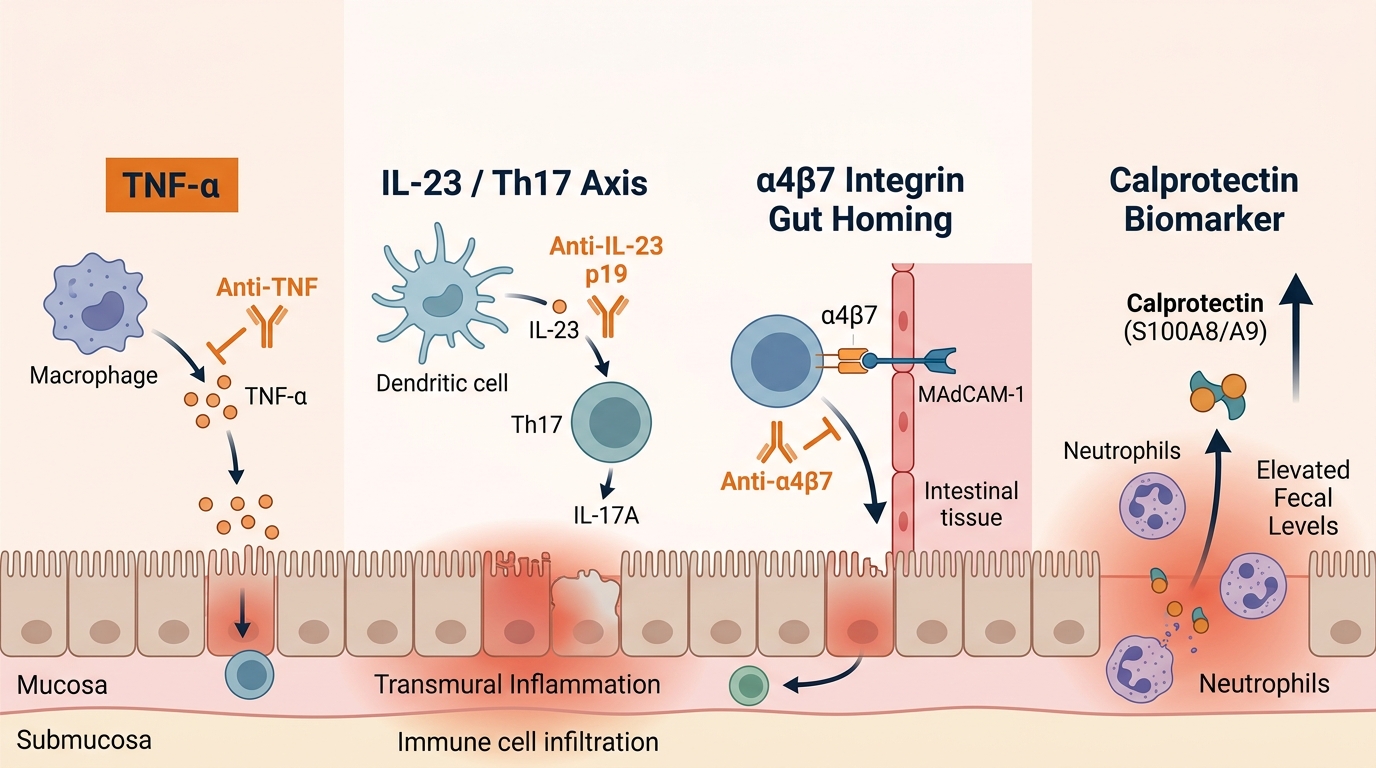
Crohn's Disease Research Reagents — key pathogenic pathways and research targets including TNF-alpha, IL-23/Th17 axis, alpha4beta7 integrin gut homing, and calprotectin biomarker

Fig. 1 Key pathogenic pathways and research targets in Crohn's disease. TNF-α & anti-TNF biologics, IL-23/Th17 axis, α4β7 integrin gut homing, and calprotectin (S100A8/A9) as a non-invasive biomarker. Key research targets highlighted in orange.

abinScience provides validated reference antibodies, recombinant proteins, ADA ELISA kits, and anti-drug antibodies covering all major Crohn's disease biologics. All products are manufactured by our parent company AtaGenix Laboratories under ISO quality systems. Browse products below or contact us for custom antibody development.

Key Research Targets

TNF-α — The central pro-inflammatory cytokine and first-line biologic target in Crohn's disease. Anti-TNF-α reference antibodies (infliximab, adalimumab, certolizumab) support biosimilar characterization, ADA bridging assays, and PK/PD studies. Drug-level and neutralizing antibody ELISA kits enable therapeutic drug monitoring (TDM) research.
→ Browse TNF-α antibodies, proteins & ELISA kits

IL-23 (p19 / p40) — The IL-23/Th17 axis drives pathogenic T cell differentiation in the gut mucosa. Selective IL-23 p19 inhibitors (risankizumab, guselkumab, mirikizumab) represent the newest biologic class for Crohn's disease. Reference antibodies and ADA ELISA kits support mechanism-of-action research and immunogenicity monitoring.
→ Browse IL-23 antibodies, proteins & ELISA kits

α4β7 Integrin — Integrin α4β7 mediates gut-selective lymphocyte homing via MAdCAM-1 interaction. Vedolizumab blocks this pathway to reduce intestinal inflammation. Anti-α4β7 reference antibodies and vedolizumab ELISA kits support receptor occupancy assays, cell trafficking studies, and TDM assay development.
→ Browse α4β7 integrin antibodies & ELISA kits

Calprotectin (S100A8/A9) — Fecal calprotectin is the gold-standard non-invasive biomarker for intestinal inflammation in IBD. Anti-calprotectin monoclonal antibodies and recombinant protein standards support diagnostic ELISA development, mucosal healing assessment, and disease activity monitoring research.
→ Browse calprotectin antibodies & proteins

IL-17A — A key effector cytokine downstream of IL-23 signaling in mucosal immunity. While anti-IL-17A therapy is contraindicated in Crohn's disease, IL-17A remains a critical research target for Th17 plasticity and mucosal immune regulation studies. Recombinant antibodies with fluorescent conjugates (FITC, APC) are available for flow cytometry.
→ Browse IL-17A antibodies & proteins

References

1. Torres J, et al. Crohn's disease. Lancet. 2017;389(10080):1741-1755. DOI

2. Sandborn WJ, et al. Vedolizumab as induction and maintenance therapy for Crohn's disease. N Engl J Med. 2013;369(8):711-721. DOI

3. Feagan BG, et al. Ustekinumab as induction and maintenance therapy for Crohn's disease. N Engl J Med. 2016;375(20):1946-1960. DOI

4. Loftus EV Jr, et al. Upadacitinib induction and maintenance therapy for Crohn's disease. N Engl J Med. 2023;388(21):1966-1980. DOI

259 product results for "Crohn’s Disease"

Options+
Options
Confirm