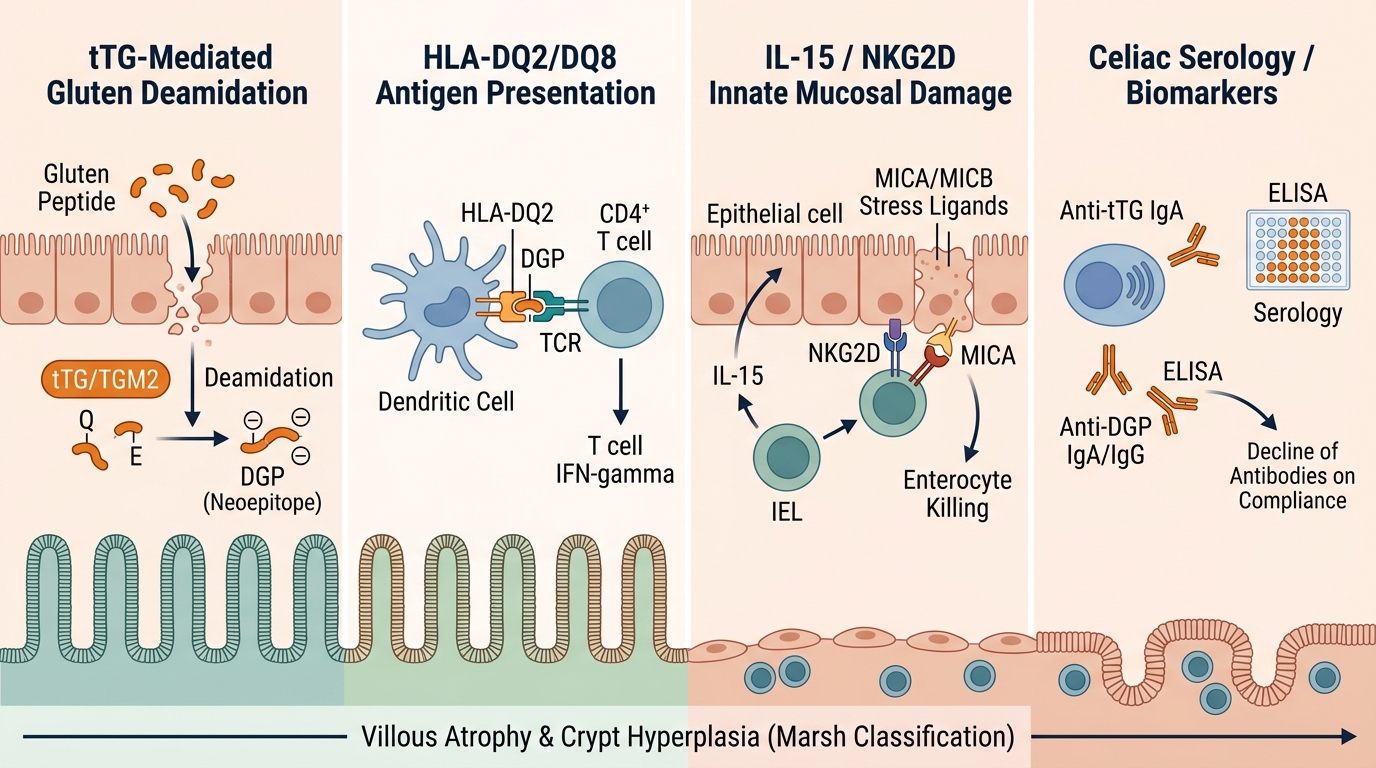
Celiac disease is a chronic, immune-mediated enteropathy triggered by dietary gluten in genetically susceptible individuals carrying HLA-DQ2 (present in ~90% of patients) or HLA-DQ8. The central pathogenic event is tissue transglutaminase (tTG/TGM2)-mediated deamidation of gluten peptides, generating high-affinity neoepitopes for HLA-DQ2/DQ8 presentation to CD4+ T cells in the lamina propria. This adaptive response, combined with IL-15-driven innate activation of intraepithelial CD8+ lymphocytes (IELs) expressing NKG2D, produces the characteristic histopathology: villous atrophy, crypt hyperplasia, and intraepithelial lymphocytosis (Marsh classification). Anti-tTG IgA serology (>95% sensitivity/specificity) and anti-deamidated gliadin peptide (DGP) antibodies are diagnostic cornerstones. Current treatment is strict lifelong gluten-free diet (GFD); non-dietary therapies under development include gluten-degrading enzymes, IL-15 blockade (AMG 714), and HLA-DQ2 blockers.
Research Use Only (RUO)Not intended for diagnostic or therapeutic procedures.
Fig. 1 Key pathogenic pathways in celiac disease. tTG/TGM2 deamidates gluten peptides for HLA-DQ2/DQ8 presentation; IL-15 activates IELs via NKG2D/MICA to drive epithelial destruction; anti-tTG IgA and anti-DGP serve as serological biomarkers. Key research targets highlighted in orange.
abinScience provides validated anti-TGM2 antibodies and recombinant proteins (including Zampilimab reference antibody and InVivoMAb-grade), anti-gliadin monoclonal antibodies, anti-IL-15 reference antibodies with fluorescent conjugates, anti-HLA-DQ recombinant antibodies, and NKG2D/MICA/MICB antibodies for mucosal immunopathology research. Anti-IgA matched-pair monoclonal antibodies support celiac serological assay development. All products are manufactured by our parent company AtaGenix Laboratories under ISO quality systems. Browse products below or contact us for custom antibody development.
tTG / TGM2 (Tissue Transglutaminase 2) — The autoantigen and enzymatic driver of celiac pathogenesis. tTG catalyzes site-specific deamidation of gluten peptides, converting glutamine to glutamic acid and generating high-affinity HLA-DQ2/DQ8 neoepitopes. Anti-tTG IgA is the primary serological biomarker (>95% sensitivity/specificity). abinScience offers anti-TGM2 reference antibody (Zampilimab), InVivoMAb-grade anti-TGM2 (clone 52F3) for in vivo studies, anti-TGM2 polyclonal antibody, recombinant antibody (clone SAA2703), and human/mouse TGM2 recombinant proteins for diagnostic ELISA development, deamidation kinetics studies, and tTG inhibitor screening.
→ Browse tTG / TGM2 antibodies & proteins
IL-15 / NKG2D / MICA — The innate cytotoxicity axis in celiac mucosal damage. IL-15 is overexpressed in the celiac intestinal epithelium, activating IELs to upregulate NKG2D, which engages stress-induced MICA/MICB ligands on enterocytes to trigger perforin/granzyme-mediated killing independent of TCR recognition. abinScience offers anti-IL-15 reference antibodies (Humax-IL15, DISC0280), anti-IL-15 recombinant antibodies with 4 fluorescent conjugates (FITC, PE, APC, PerCP), recombinant IL-15 proteins, anti-NKG2D/CD314 reference antibodies (32 products), and anti-MICA/MICB antibodies (50 products) for mucosal immunopathology research.
→ Browse IL-15, NKG2D & MICA/MICB antibodies
HLA-DQ2 / HLA-DQ8 — The genetic restriction elements essential for celiac disease development. HLA-DQ2.5 (DQA1*05/DQB1*02) is present in ~90% of celiac patients; HLA-DQ8 accounts for most of the remainder. Anti-HLA-DQ monomorphic recombinant antibody (clone 1a3) with fluorescent conjugates (FITC, APC, PerCP) and anti-HLA-DQB1 reference antibody (DQB1-FL8) support HLA typing by flow cytometry, gluten peptide-MHC binding studies, and evaluation of HLA-DQ blockers as therapeutic candidates.
→ Browse HLA-DQ antibodies
Gliadin / Anti-IgA — Anti-deamidated gliadin peptide (DGP) IgA/IgG serology complements tTG testing and is particularly valuable in IgA-deficient patients (~2–3% of celiac patients). Anti-wheat alpha/beta-gliadin monoclonal antibody (clone 1A447) and recombinant antibody (clone SAA0518) support gluten detection and deamidation research. Anti-human IgA matched-pair monoclonal antibodies (clones 1A196, 1A197, 1A198, 1A199) enable development of IgA-class celiac serological assays (anti-tTG IgA, anti-DGP IgA ELISA platforms).
→ Browse gliadin & IgA antibodies

1. Lebwohl B, et al. Coeliac disease. Lancet. 2018;391(10115):70-81. DOI
2. Al-Toma A, et al. European Society for the Study of Coeliac Disease (ESsCD) guideline for coeliac disease and other gluten-related disorders. United European Gastroenterol J. 2019;7(5):583-613. DOI
3. Sollid LM, et al. Triggers and drivers of autoimmunity: lessons from coeliac disease. Nat Rev Immunol. 2013;13(4):294-302. DOI
4. Meresse B, et al. Coordinated induction by IL15 of a TCR-independent NKG2D signaling pathway converts CTL into lymphokine-activated killer cells in celiac disease. Immunity. 2004;21(3):357-366. DOI
Human
ELISA, Bioactivity: FCM, Functional assay, Research in vivo
Human
Monoclonal
IgG1-kappa
NN9828
Human
ELISA, Bioactivity: FCM, Functional assay, Research in vivo
Human
Monoclonal
IgG1-kappa
NNC-114-0005
Human
ELISA, Bioactivity: FCM, Functional assay, Research in vivo
Human
Monoclonal
IgG1-kappa
Human
ELISA, Bioactivity: FCM, Functional assay, Research in vivo
Human
Monoclonal
IgG1-kappa
Human
ELISA, Bioactivity: FCM, Functional assay, Research in vivo
Human
Monoclonal
IgG4-kappa
Human
ELISA, Bioactivity: FCM, Functional assay, Research in vivo
Human
Monoclonal
IgG1-kappa
Human
ELISA, Bioactivity: FCM, Functional assay, Research in vivo
Mouse
Monoclonal
IgG1-kappa
Mammalian cells
P21980
Ala2-Ala687
ELISA, Immunogen, SDS-PAGE, WB, Bioactivity testing in progress
Homo sapiens (Human)
E. coli
Q9HBE4
Leu23-Ser162
ELISA, Immunogen, SDS-PAGE, WB, Bioactivity testing in progress
Homo sapiens (Human)
Mammalian cells
P01589
Met1-Gln240
ELISA, Immunogen, SDS-PAGE, WB, Bioactivity testing in progress
Homo sapiens (Human)