Cutaneous melanoma originates from melanocytes and carries the highest mutation burden among solid tumors, driven primarily by ultraviolet radiation-induced DNA damage. Approximately 50% of melanomas harbor BRAF V600E/K mutations, while 15–20% carry NRAS mutations, defining distinct molecular subtypes with different therapeutic vulnerabilities. Melanoma has served as the proving ground for modern immunotherapy — ipilimumab (anti-CTLA-4) and nivolumab/pembrolizumab (anti-PD-1) first demonstrated durable responses in this disease. Current frontiers include LAG-3 combination therapy (relatlimab + nivolumab), adoptive cell therapy (TIL), and neoadjuvant checkpoint blockade for resectable disease.
Research Use Only (RUO)Not intended for diagnostic or therapeutic procedures.
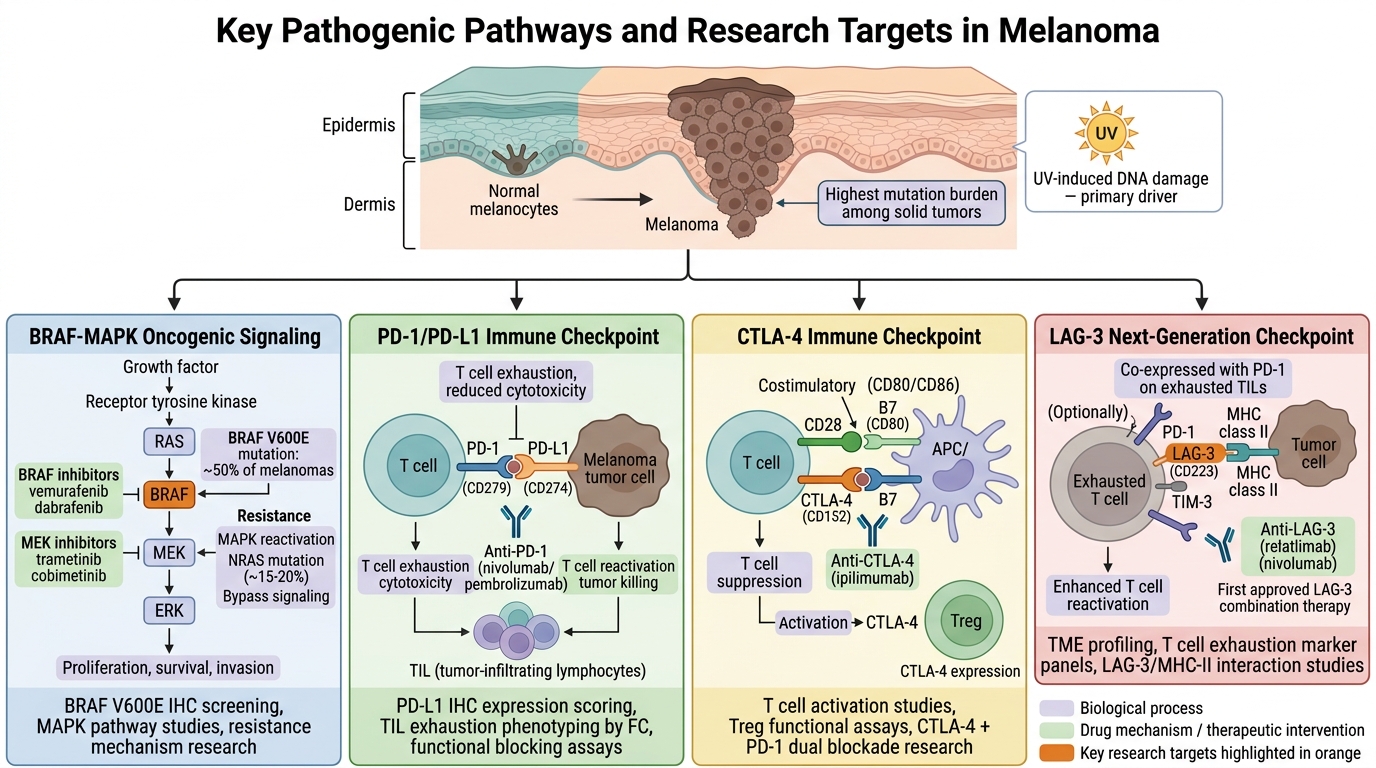
Fig. 1 Key pathogenic pathways and research targets in melanoma. BRAF-MEK-ERK oncogenic signaling, PD-1/PD-L1 and CTLA-4 immune checkpoint axes, and LAG-3 next-generation checkpoint. Key research targets highlighted in orange.
abinScience provides validated antibodies, recombinant proteins, and ELISA kits for key melanoma research targets. All products are manufactured by our parent company AtaGenix Laboratories under ISO quality systems. Browse products below or contact us for custom antibody development.
BRAF V600E — BRAF V600E is the most common oncogenic driver in melanoma (~50%), constitutively activating the RAF-MEK-ERK (MAPK) cascade to promote uncontrolled proliferation. Anti-BRAF V600E mutation-specific antibodies enable IHC-based screening for BRAF/MEK inhibitor eligibility (vemurafenib, dabrafenib + trametinib), and support research into acquired resistance mechanisms including MAPK pathway reactivation and bypass signaling.
→ Browse BRAF antibodies & proteins
PD-1 (CD279) / PD-L1 (CD274) — The PD-1/PD-L1 axis mediates T cell exhaustion in the melanoma tumor microenvironment and represents the most successful therapeutic target in immuno-oncology. Anti-PD-1 and anti-PD-L1 antibodies support flow cytometric analysis of TIL exhaustion phenotypes, PD-L1 expression scoring by IHC, and functional blocking assays critical for checkpoint combination therapy research.
→ Browse PD-1/PD-L1 antibodies & proteins
CTLA-4 (CD152) — CTLA-4 was the first immune checkpoint targeted in melanoma (ipilimumab, FDA-approved 2011). CTLA-4 competes with CD28 for B7 ligand binding, suppressing T cell activation at the priming stage. Anti-CTLA-4 antibodies and recombinant proteins support T cell activation studies, Treg functional assays, and combination immunotherapy research exploring CTLA-4 plus PD-1 dual blockade mechanisms.
→ Browse CTLA-4 antibodies & proteins
LAG-3 (CD223) — LAG-3 is a next-generation immune checkpoint co-expressed with PD-1 on exhausted T cells in the tumor microenvironment. The combination of relatlimab (anti-LAG-3) with nivolumab became the first LAG-3–targeting regimen approved for advanced melanoma. Anti-LAG-3 antibodies enable tumor microenvironment profiling, T cell exhaustion marker panel development, and LAG-3/MHC-II interaction studies.
→ Browse LAG-3 antibodies & proteins
1. Davies H, Bignell GR, Cox C, et al. Mutations of the BRAF gene in human cancer. Nature. 2002;417(6892):949-954. DOI
2. Larkin J, Chiarion-Sileni V, Gonzalez R, et al. Five-year survival with combined nivolumab and ipilimumab in advanced melanoma. N Engl J Med. 2019;381(16):1535-1546. DOI
3. Tawbi HA, Schadendorf D, Lipson EJ, et al. Relatlimab and nivolumab versus nivolumab in untreated advanced melanoma. N Engl J Med. 2022;386(1):24-34. DOI
4. Robert C, Schachter J, Long GV, et al. Pembrolizumab versus ipilimumab in advanced melanoma. N Engl J Med. 2015;372(26):2521-2532. DOI
5. Luke JJ, Flaherty KT, Ribas A, Long GV. Targeted agents and immunotherapies: optimizing outcomes in melanoma. J Clin Oncol. 2017;35(9):1003-1011. DOI
Plasma, Serum
54.8 pg/mL
125 - 8, 000 pg/mL
Mouse
in vivo PD-L1 blockade, in vitro PD-L1 blockade, IF, IHC-F, FCM, WB
Rat
Monoclonal
IgG2b
10F.9G2
Plasma, Serum
9.13 pg/mL
15.63 - 1, 000 pg/mL
Human
ELISA, Bioactivity: FACS, Functional assay, Research in vivo
Human
Monoclonal
IgG1-kappa
Human
ELISA, IF, SPR, WB
Human
Monoclonal
IgG1, kappa
83D4
Human
ELISA, WB, FCM
Human
Monoclonal
VHH-hFc
SAA2018
Human
ELISA, Bioactivity: FCM, Functional assay, Research in vivo
Human
Monoclonal
IgG1-kappa
GSK2831781
Human
ELISA, Bioactivity: FCM, Functional assay, Research in vivo
Human
Monoclonal
IgG1-lambda
Human
ELISA, Bioactivity: FCM, Functional assay, Research in vivo
Human
Monoclonal
IgG1-kappa/kappa-lambda
Human
ELISA, Bioactivity: FCM, Functional assay, Research in vivo
Human
Monoclonal
IgG4-kappa