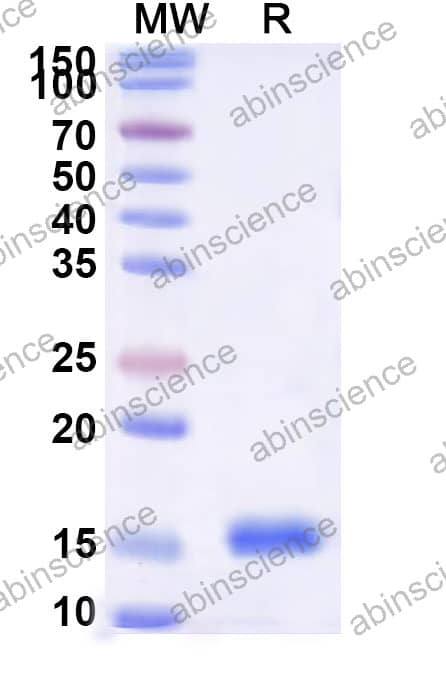
CDKN2A (Cyclin Dependent Kinase Inhibitor 2A) encodes two distinct tumor suppressor proteins — p16INK4a and p14ARF — through alternative reading frames. p16INK4a inhibits CDK4/6, blocking cell cycle progression from G1 to S phase, while p14ARF stabilizes p53 by inhibiting MDM2-mediated degradation. Loss of CDKN2A function is one of the most frequent genetic events in human cancer, and p16 IHC is the standard-of-care ancillary marker in cervical cancer diagnostics and head & neck SCC HPV subtyping.
Research Use Only (RUO)Not intended for diagnostic or therapeutic procedures.
abinScience provides validated polyclonal antibodies, VHH nanobodies, and recombinant proteins for CDKN2A/p16INK4a research. Human and mouse reactivity. All products are manufactured by our parent company AtaGenix Laboratories under ISO quality systems. Browse products below or contact us for custom antibody development.
| Product | Cat# | Host | Clonality | Reactivity | Applications |
|---|---|---|---|---|---|
| Anti-Human CDKN2A Polyclonal Antibody | HP269014 | Rabbit | Polyclonal | Human | ELISA, IHC, WB |
| Anti-Human CDKN2A/p16INK4a Polyclonal Antibody | HW820014 | Rabbit | Polyclonal | Human | ELISA, IHC, WB |
| Anti-Mouse CDKN2A/p16INK4a Polyclonal Antibody | MW820014 | Rabbit | Polyclonal | Mouse | ELISA, IHC, WB |
| Anti-Human CDKN2A/p16INK4a Nanobody (SAA2259) | HW820013 | Alpaca | Monoclonal (VHH) | Human | ELISA |
| Product | Cat# | Species | Tag | Region | Purity |
|---|---|---|---|---|---|
| Human CDKN2A Protein | HP269012 | Human | N-GST & C-His | Val2–Arg54 | >90% |
| Human CDKN2A/p16INK4a Protein | HW820012 | Human | N-His | Met1–Asp156 (full length) | >90% |
| Mouse CDKN2A/p16INK4a Protein | MW820012 | Mouse | N-His | Met1–Ser135 (full length) | >90% |
p16 IHC — Cervical Cancer Diagnostics — p16INK4a immunohistochemistry is the standard-of-care ancillary test for diagnosing high-grade cervical intraepithelial neoplasia (CIN 2/3). Diffuse, strong nuclear and cytoplasmic staining ("block-positive" pattern) is a reliable surrogate marker for high-risk HPV E7 oncoprotein activity. The LAST Project and WHO Classification recommend p16 IHC as the primary adjunctive marker for distinguishing CIN 2 from mimics. For FFPE IHC, use HW820014 (full-length immunogen).
→ IHC Staining Protocol Guide
p16 IHC — Head & Neck Squamous Cell Carcinoma — In oropharyngeal SCC, p16 positivity serves as a surrogate for HPV-driven tumors. HPV-positive OPSCC has significantly better prognosis and different treatment implications. The 8th edition AJCC staging system uses p16 status to define a separate staging classification for oropharyngeal cancers.
→ Head & Neck SCC Research Reagents
CDKN2A in Melanoma & Familial Cancer — Germline CDKN2A mutations are the most common genetic cause of familial melanoma, accounting for 20–40% of hereditary melanoma kindreds. CDKN2A deletions and promoter hypermethylation are also frequent somatic events in non-small cell lung cancer, pancreatic adenocarcinoma, and glioblastoma.
→ Melanoma Research Reagents
p16 as a Cellular Senescence Marker — p16INK4a accumulates in senescent cells and is widely used as a biomarker of cellular senescence in aging research. Increased p16 expression is documented in aged tissues across multiple organs in both mouse and human studies. For mouse senescence models, use MW820014 (mouse-specific). Pair with SA-β-galactosidase and p21/γH2AX for a robust senescence confirmation panel.
→ Western Blot Protocol Guide
CDK4/6 Inhibitor Mechanism & Biomarker — CDK4/6 inhibitors (palbociclib, ribociclib, abemaciclib) mimic p16INK4a's natural function. Tumors with CDKN2A loss rely entirely on CDK4/6 for proliferation, making them strong candidates for CDK4/6 inhibitor therapy. CDKN2A status is increasingly evaluated as a predictive biomarker for CDK4/6 inhibitor response in breast cancer and NSCLC.
→ Browse CDK4 antibodies & proteins
| Gene name | CDKN2A (Cyclin Dependent Kinase Inhibitor 2A) |
| Aliases | p16, p16INK4a, p16INK4, MTS1, CDK4I, CDKN2, CMM2 |
| UniProt | P42771 (Human) |
| Molecular weight | 16.5 kDa (p16INK4a); 13.8 kDa (p14ARF) |
| Chromosomal location | 9p21.3 |
| Protein products | p16INK4a (exons 1α, 2, 3) — inhibits CDK4/6 p14ARF (exons 1β, 2, 3) — stabilizes p53 via MDM2 inhibition |
| Subcellular localization | Nucleus (p16INK4a); nucleolus (p14ARF) |
| Key pathway | p16INK4a —| CDK4/6 → Rb phosphorylation blocked → G1 arrest |
| Cancer types | Cervical cancer, head & neck SCC, melanoma, lung cancer, pancreatic cancer, glioblastoma |
What is the difference between CDKN2A and p16INK4a?
CDKN2A is the gene; p16INK4a is one of two proteins it encodes (the other being p14ARF). They share exons 2 and 3 but use different first exons read in alternative reading frames, producing entirely unrelated amino acid sequences. When selecting antibodies, check whether the immunogen targets the p16INK4a-specific region (exon 1α) or a shared region.
Which p16 antibody is best for IHC on FFPE tissue?
Choose an antibody raised against the full-length p16INK4a protein (Met1–Asp156) to maximize epitope recovery after antigen retrieval. HW820014 uses full-length human p16INK4a as the immunogen and is validated for IHC. Use HIER at pH 6.0 (citrate) or pH 9.0 (EDTA) for optimal results.
What does "block-positive" p16 staining mean?
Block-positive refers to continuous, diffuse, strong nuclear and cytoplasmic staining in the basal and parabasal layers. This pattern indicates functional Rb inactivation by HPV E7 and is the defining IHC criterion for HPV-driven HSIL (CIN 2–3). Patchy, focal, or cytoplasm-only staining is NOT block-positive.
Can p16 be used as a senescence marker in mouse models?
Yes. Use a mouse-reactive antibody such as MW820014 for WB on mouse tissue lysates or IHC on mouse tissue sections. Pair with SA-β-galactosidase, p21, and γH2AX for a robust senescence panel. Mouse p16 shares only ~60% sequence identity with human p16 — always use a species-matched antibody.
What is the role of CDKN2A in CDK4/6 inhibitor therapy?
CDK4/6 inhibitors (palbociclib, ribociclib, abemaciclib) mimic p16INK4a's function. Tumors with CDKN2A loss rely entirely on CDK4/6 for proliferation, making them candidates for CDK4/6 inhibitor therapy. Tumors with intact p16 expression may be intrinsically resistant. CDKN2A status is increasingly evaluated as a predictive biomarker for CDK4/6 inhibitor response.
1. Serrano M, Hannon GJ, Beach D. A new regulatory motif in cell-cycle control causing specific inhibition of cyclin D/CDK4. Nature. 1993;366(6456):704-707. DOI
2. Darragh TM, Colgan TJ, Cox JT, et al. The Lower Anogenital Squamous Terminology Standardization Project for HPV-Associated Lesions. J Low Genit Tract Dis. 2012;16(3):205-242. DOI
3. Krishnamurthy J, Torrice C, Ramsey MR, et al. Ink4a/Arf expression is a biomarker of aging. J Clin Invest. 2004;114(9):1299-1307. DOI
4. Goldstein AM, Chan M, Harland M, et al. High-risk melanoma susceptibility genes and pancreatic cancer, neural system tumors, and uveal melanoma across GenoMEL. Cancer Res. 2006;66(20):9818-9828. DOI
E. coli
P42771
Met1-Asp156
ELISA, Immunogen, SDS-PAGE, WB, Bioactivity testing in progress
Homo sapiens (Human)
E. coli
Q8N726
Val2-Arg54
ELISA, Immunogen, SDS-PAGE, WB, Bioactivity testing in progress
Homo sapiens (Human)
E. coli
P51480
Met1-Ser135
ELISA, Immunogen, SDS-PAGE, WB, Bioactivity testing in progress
Mus musculus (Mouse)
Human
ELISA
Alpaca
Monoclonal
VHH-His
SAA2259
Mouse
ELISA, IHC, WB
Rabbit
Polyclonal
IgG
Human
ELISA, IHC, WB
Rabbit
Polyclonal
IgG
Human
ELISA, IHC, WB
Rabbit
Polyclonal
IgG