Please ensure Javascript is enabled for purposes of website accessibility
Home > Products > Antibodies > Primary antibodies

Anti-Human C1QB Polyclonal Antibody (HY244014)

Anti-Human C1QB Polyclonal Antibody
Price(USD): $
Spec:
  • 50ug
  • 100ug
Number:
Contact us
  • Overview

  • Images

  • References

  • Datasheet

Overview
Catalog No.HY244014
Species reactivityHuman
ApplicationsELISA, IHC, WB
Host speciesRabbit
IsotypeIgG
Clonality Polyclonal
Immunogen E. coli - derived recombinant Human C1QB (Thr119-Ala253).
Target Complement C1q subcomponent subunit B, C1QB
Purification Purified by antigen affinity column.
Accession P02746
RRID Anti-Human C1QB Polyclonal Antibody (abinScience Cat# HY244014, RRID:AB_3723144)
Form Liquid
Storage buffer 0.01M PBS, pH 7.4, 50% Glycerol, 0.05% Proclin 300.

Please refer to the specific buffer information in the hardcopy of datasheet or the lot-specific COA.

Product Usage Information
Application Dilution
ELISA 1:5000-1:20000
IHC 1:50-1:500
WB 1:500-1:2000
Stability and Storage Use a manual defrost freezer and avoid repeated freeze thaw cycles. Store at 2 to 8°C for frequent use. Store at -20 to -80°C for twelve months from the date of receipt.
Background

Complement C1q subcomponent subunit B (C1QB) is a ~26 kDa protein. Core component of the complement C1 complex, a multiprotein complex that initiates the classical pathway of the complement system, a cascade of proteins that leads to phagocytosis and breakdown of pathogens and signaling that strengthens the adaptive immune system. The classical complement pathway is initiated by the C1Q subcomplex of the C1 complex, which specifically binds IgG or IgM immunoglobulins complexed with antigens, forming antigen-antibody complexes on the surface of pathogens: C1QA, together with C1QB and C1QC, specifically recognizes and binds the Fc regions of IgG or IgM via its C1q domain. Immunoglobulin-binding activates the proenzyme C1R, which cleaves C1S, initiating the proteolytic cascade of the complement system. The C1Q subcomplex is activated by a hexamer of IgG complexed with antigens, while it is activated by a pentameric IgM. The C1Q subcomplex also recognizes and binds phosphatidylserine exposed on the surface of cells undergoing programmed cell death, possibly promoting activation of the complement system.

1. Kishore, U. et al. (2003) Journal of immunology (Baltimore, Md. : 1950) 171, 812-20. PMID: 12847249
2. Gadjeva, MG. et al. (2008) Biochemistry 47, 13093-102. PMID: 19006321
3. Diebolder, CA. et al. (2014) Science (New York, N.Y.) 343, 1260-3. PMID: 24626930
4. Ugurlar, D. et al. (2018) Science (New York, N.Y.) 359, 794-797. PMID: 29449492
5. Duncan, AR. et al. (1988) Nature 332, 738-40. PMID: 3258649
6. Zwarthoff, SA. et al. (2021) Proceedings of the National Academy of Sciences of the United States of America 118. PMID: 34155115
7. Lin, TY. et al. (1980) The Journal of biological chemistry 255, 7756-62. PMID: 6249812
8. Burton, DR. et al. (1980) Nature 288, 338-44. PMID: 6776418
Note For research use only.
Images
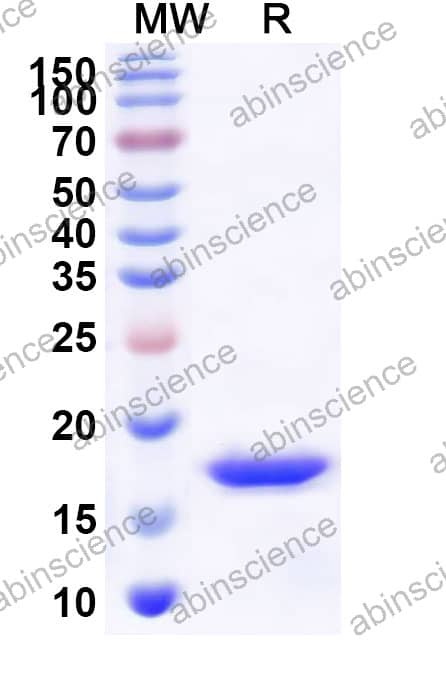
  • Anti-Human C1QB Polyclonal Antibody

    Western blot

    Western blot analysis was performed using anti-Human C1QB polyclonal antibody at 1ug/mL on recombinant Human C1QB (Catalog No. HY244022).

References
Formula
Mass (g) = Concentration (mol/L) × Volume (L) × MW (g/mol)
Enter any 2 of Mass, Concentration, Volume + Molecular Weight to solve for the unknown.
Mass
=
Concentration
×
Volume
Molecular Weight *
g/mol
Formula
C₁ × V₁ = C₂ × V₂
Enter any 3 of the 4 values to solve for the unknown.
Stock Solution
C₁ (Stock Conc.)
×
V₁ (Stock Vol.)
=
Working Solution
C₂ (Working Conc.)
×
V₂ (Working Vol.)
Recommendation

Contact us for custom quotes, bulk requests and any other issues.

Mail: support@abinScience.com

Distributor list