
 中文
中文 English
 한국어
한국어 日本語
日本語 Español
 Français
 Русский
| Catalog No. | HV480107 |
|---|---|
| Species reactivity | Human |
| Applications | FCM |
| Host species | Mouse |
| Isotype | IgG1, kappa |
| Clone ID | 36H12 |
| Clonality | Monoclonal |
| Target | HVEA, HVEM, Herpes virus entry mediator A, Tumor necrosis factor receptor superfamily member 14, Tumor necrosis factor receptor-like 2, HveA, TNFRSF14, CD270, TR2, Herpesvirus entry mediator A |
| Endotoxin level | Please contact with the lab for this information. |
| Purity | >95% as determined by SDS-PAGE. |
| Purification | Protein A/G purified from cell culture supernatant. |
| Accession | Q92956 |
| Form | Liquid |
| Storage buffer | 0.01M PBS pH 7.4 Please refer to the specific buffer information in the hardcopy of datasheet or the lot-specific COA. |
| Stability and Storage | Use a manual defrost freezer and avoid repeated freeze-thaw cycles. Store at 4°C short term (1-2 weeks). Store at -20°C 12 months. Store at -80°C long term. |
| Background | Tumor necrosis factor receptor superfamily member 14 (CD270/TNFRSF14) is a ~30 kDa protein. Receptor for four distinct ligands: The TNF superfamily members TNFSF14/LIGHT and homotrimeric LTA/lymphotoxin-alpha and the immunoglobulin superfamily members BTLA and CD160, altogether defining a complex stimulatory and inhibitory signaling network. Signals via the TRAF2-TRAF3 E3 ligase pathway to promote immune cell survival and differentiation. Participates in bidirectional cell-cell contact signaling between antigen presenting cells and lymphocytes. In response to ligation of TNFSF14/LIGHT, delivers costimulatory signals to T cells, promoting cell proliferation and effector functions. Interacts with CD160 on NK cells, enhancing IFNG production and anti-tumor immune response. 1. Tamada, K. et al. (2000) Journal of immunology (Baltimore, Md. : 1950) 164, 4105-10. PMID: 10754304 2. Cai, G. et al. (2008) Nature immunology 9, 176-85. PMID: 18193050 3. Šedý, JR. et al. (2013) Journal of immunology (Baltimore, Md. : 1950) 191, 828-36. PMID: 23761635 4. Mauri, DN. et al. (1998) Immunity 8, 21-30. PMID: 9462508 5. Cheung, TC. et al. (2009) Journal of immunology (Baltimore, Md. : 1950) 183, 7286-96. PMID: 19915044 6. Hsu, H. et al. (1997) The Journal of biological chemistry 272, 13471-4. PMID: 9153189 7. Marsters, SA. et al. (1997) The Journal of biological chemistry 272, 14029-32. PMID: 9162022 |
| Note | For research use only. |
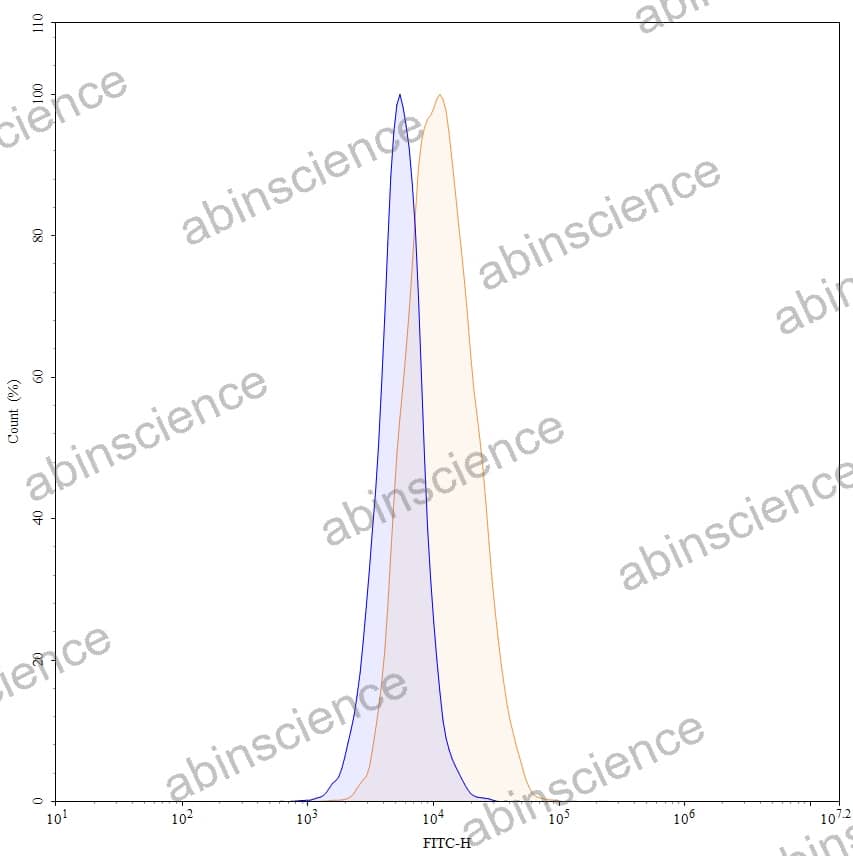
Flow-cytometry using anti-human CD270 antibody.CD270 Transfected CHO cells were stained with an irrelevant antibody (Blue Histogram) or an anti-human CD270 antibody monoclonal antibody (Catalog # HV480107 ,Green Histogram) at a concentration of 5 µg/ml for 30 mins at RT. After washing, bound antibody was detected using a FITC conjugated goat anti-mouse antibody (Catalog # MF690414) and cells analysed on a NovoCyte Flow Cytometer.

Contact us for custom quotes, bulk requests and any other issues.
Mail: support@abinScience.com
+86-27-65523339
Building C, No. 666, Shen Dun Si Lu, Wuhan, 430206, China


