中文
中文 English
 한국어
한국어 日本語
日本語 Español
 Français
 Русский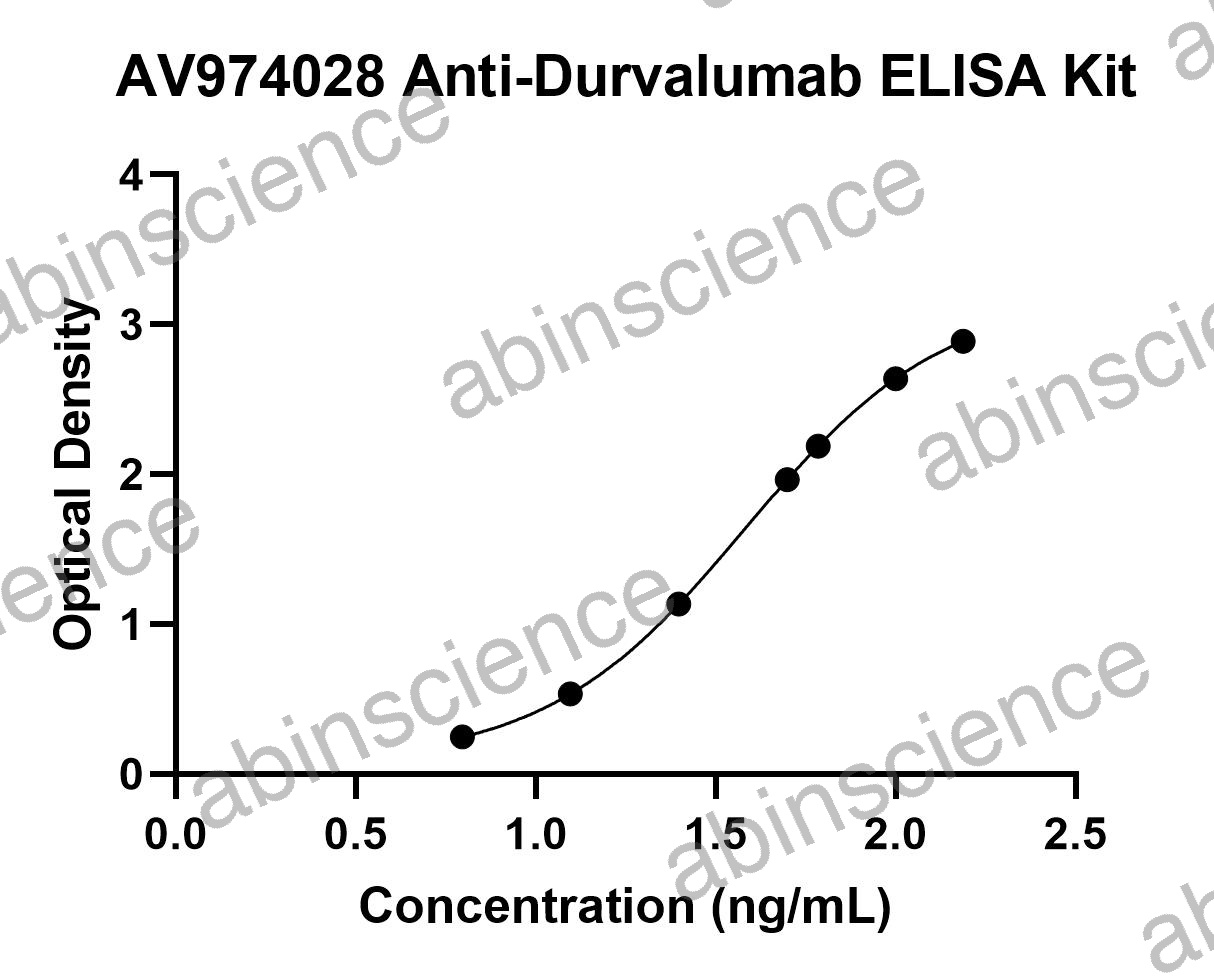
| Catalog No. | AV974028 |
|---|---|
| Description |
Anti-Durvalumab ELISA Kit (AV974028) — Quantitative sandwich ELISA for Anti-Durvalumab. Sample: Plasma, Serum. Range: 156.25 - 10, 000 ng/mL.
Highlights
|
| Sample type | Plasma, Serum |
| Range | 156.25 - 10, 000 ng/mL |
| Accession | Q9NZQ7 |
| Applications | ELISA |
| Detection method | Colorimetric |
| Assay type | Quantitative |
| Recovery | 80-120% |
| Shipping | 2-8 ℃ |
| Stability and Storage | The stability of ELISA kit is determined by the loss rate of activity. The loss rate of this kit is less than 10% prior to the expiration date under appropriate storage condition. |
| Specifications | Durvalumab |
| Alternate Names | MEDI4736, 1428935-60-7 |
| Background | Programmed cell death 1 ligand 1 (Durvalumab) is a ~33 kDa protein. Plays a critical role in induction and maintenance of immune tolerance to self. As a ligand for the inhibitory receptor PDCD1/PD-1, modulates the activation threshold of T-cells and limits T-cell effector response. Through a yet unknown activating receptor, may costimulate T-cell subsets that predominantly produce interleukin-10 (IL10). Can also act as a transcription coactivator: in response to hypoxia, translocates into the nucleus via its interaction with phosphorylated STAT3 and promotes transcription of GSDMC, leading to pyroptosis. 1. Freeman, GJ. et al. (2000) The Journal of experimental medicine 192, 1027-34. PMID: 11015443 2. Mezzadra, R. et al. (2017) Nature 549, 106-110. PMID: 28813410 3. Burr, ML. et al. (2017) Nature 549, 101-105. PMID: 28813417 4. Huang, X. et al. (2019) Cancer immunology research 7, 1580-1590. PMID: 31399419 5. Kennedy, A. et al. (2023) The EMBO journal 42, e111556. PMID: 36727298 6. Dong, H. et al. (1999) Nature medicine 5, 1365-9. PMID: 10581077 7. Hou, J. et al. (2020) Nature cell biology 22, 1264-1275. PMID: 32929201 |
| Note | For Research Use Only. |
Standard Curve of Anti-Durvalumab ELISA Kit
Contact us for custom quotes, bulk requests and any other issues.
Mail: [email protected]
+86-27-65523339
Building C, No. 666, Shen Dun Si Lu, Wuhan, 430206, China