
 中文
中文 English
 한국어
한국어 日本語
日本語 Español
 Français
 Русский
| Catalog No. | HW464012 |
|---|---|
| Description |
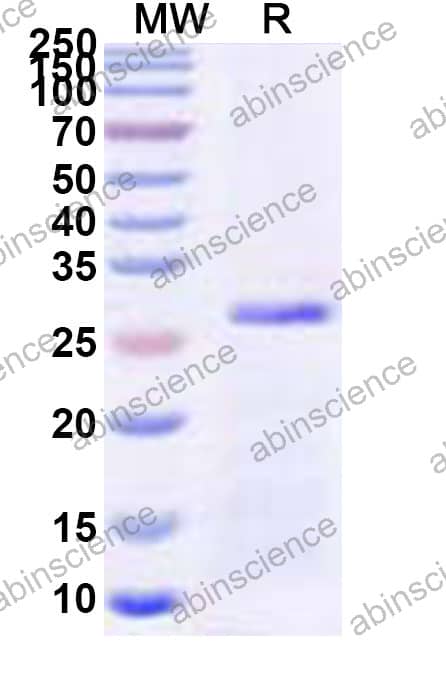
Recombinant Human STT3A Protein, N-His (HW464012) expressed in E. coli, spanning Ser484-Thr705. Purity: >90% by SDS-PAGE.
Highlights
|
| Expression system | E. coli |
| Accession | P46977 |
| Protein length | Ser484-Thr705 |
| Applications | ELISA, Immunogen, SDS-PAGE, WB, Bioactivity testing in progress |
| Species | Homo sapiens (Human) |
| Nature | Recombinant |
| Endotoxin level | Please contact with the lab for this information. |
| Purity | >90% as determined by SDS-PAGE. |
| Predicted molecular weight | 28.04 kDa |
| Form | Lyophilized |
| Storage buffer | Lyophilized from a solution in PBS pH 7.4, 0.02% NLS, 1 mM EDTA, 4% Trehalose, 1% Mannitol. Please refer to the specific buffer information in the hardcopy of datasheet or the lot-specific COA. |
| Reconstitution | Reconstitute in sterile water for a stock solution. Adjust the volume of sterile water so that, after reconstitution, the final stock concentration matches the value indicated on the product label or datasheet. RECONSTITUTION PROTOCOL 1. Allow the product to be reconstituted and the reconstitution diluent to reach room temperature. 2. Tap or briefly centrifuge the product vial before opening to dislodge any lyophilized material that may be dispersed on the wall or cap of the vial. 3. Use the diluent and stock concentration recommended in the product datasheet. If preparing a stock concentration higher than recommended, contact Technical Service. 4. After adding the diluent, re-cap the vial and invert gently by hand or place on a slow rocking platform to allow the reconstitution diluent to coat all the surfaces inside the vial. Note: Do not mix by vortexing or by pipetting the material up and down. 5. Allow the vial to sit at room temperature with gentle agitation for at least 15 minutes before aliquotting or using. 6. Store the reconstituted material in single use aliquots in polypropylene or siliconized tubes. Aliquots of 10 μL or larger are recommended. |
| Shipping | In general, proteins are provided as lyophilized powder/frozen liquid. They are shipped out with dry ice/blue ice unless customers require otherwise. |
| Stability and Storage | Use a manual defrost freezer and avoid repeated freeze thaw cycles. Store at 2 to 8°C for frequent use. Store at -20 to -80°C for twelve months from the date of receipt. |
| Alternate Names | Dolichyl-diphosphooligosaccharide--protein glycosyltransferase subunit STT3A, Oligosaccharyl transferase subunit STT3A, STT3-A, 2.4.99.18, B5, Integral membrane protein 1, Transmembrane protein TMC, STT3A, ITM1, TMC |
| Background | Dolichyl-diphosphooligosaccharide--protein glycosyltransferase subunit STT3A is a ~80 kDa protein. Catalytic subunit of the oligosaccharyl transferase (OST) complex that catalyzes the initial transfer of a defined glycan (Glc(3)Man(9)GlcNAc(2) in eukaryotes) from the lipid carrier dolichol-pyrophosphate to an asparagine residue within an Asn-X-Ser/Thr consensus motif in nascent polypeptide chains, the first step in protein N-glycosylation. N-glycosylation occurs cotranslationally and the complex associates with the Sec61 complex at the channel-forming translocon complex that mediates protein translocation across the endoplasmic reticulum (ER). All subunits are required for a maximal enzyme activity. This subunit contains the active site and the acceptor peptide and donor lipid-linked oligosaccharide (LLO) binding pockets. STT3A is present in the majority of OST complexes and mediates cotranslational N-glycosylation of most sites on target proteins, while STT3B-containing complexes are required for efficient post-translational glycosylation and mediate glycosylation of sites that have been skipped by STT3A. 1. Ruiz-Canada, C. et al. (2009) Cell 136, 272-83. PMID: 19167329 2. Cherepanova, NA. et al. (2019) The Journal of cell biology 218, 2782-2796. PMID: 31296534 3. Ramírez, AS. et al. (2019) Science (New York, N.Y.) 366, 1372-1375. PMID: 31831667 4. Wilson, MP. et al. (2021) American journal of human genetics 108, 2130-2144. PMID: 34653363 5. Lampson, BL. et al. (2024) Cell 187, 2209-2223.e16. PMID: 38670073 6. Ma, M. et al. (2024) Science (New York, N.Y.) 386, 667-672. PMID: 39509507 |
| Note | For research use only. |
SDS-PAGE for Recombinant Human STT3A Protein, N-His
Contact us for custom quotes, bulk requests and any other issues.
Mail: support@abinScience.com
+86-27-65523339
Building C, No. 666, Shen Dun Si Lu, Wuhan, 430206, China


