中文
 English
 한국어
 日本語
 Español
 Français
 Русский
| Catalog No. | HB380014 | ||||||||
|---|---|---|---|---|---|---|---|---|---|
| Description |
Anti-CRYZ Polyclonal Antibody (HB380014) is a rabbit polyclonal antibody detecting Quinone oxidoreductase; 1.6.5.5; NADPH:quinone reductase; Zeta-crystallin; CRYZ in ELISA, IHC, WB. Suitable for Human and Bovine.
Highlights
|
||||||||
| Species reactivity | Human | ||||||||
| Applications | ELISA, IHC, WB | ||||||||
| Host species | Rabbit | ||||||||
| Clonality | Polyclonal | ||||||||
| Isotype | IgG | ||||||||
| Immunogen | E. coli - derived recombinant human CRYZ (Met1-Leu329). | ||||||||
| Target | Quinone oxidoreductase; 1.6.5.5; NADPH:quinone reductase; Zeta-crystallin; CRYZ | ||||||||
| Endotoxin level | Please contact with the lab for this information. | ||||||||
| Purification | Purified by antigen affinity column. | ||||||||
| Accession | Q08257, O97764 | ||||||||
| Form | Liquid | ||||||||
| Storage buffer | 0.01M PBS, pH 7.4, 50% Glycerol, 0.05% Proclin 300. Please refer to the specific buffer information in the hardcopy of datasheet or the lot-specific COA. |
||||||||
| Product Usage Information |
| ||||||||
| Stability and Storage | Use a manual defrost freezer and avoid repeated freeze thaw cycles. Store at 2 to 8°C for frequent use. Store at -20 to -80°C for twelve months from the date of receipt. | ||||||||
| Background | Zeta-crystallin (CRYZ) is a ~35 kDa protein. Multifunctional crystallin endowed with unrelated mRNA stabilization and enzymatic oxidoreductase activities. Binds (AU)-rich elements (ARE) in the 3'-UTR of target mRNA to enhance their stability. Upon metabolic acidosis, stabilizes the mRNA encoding SLC12A1 a cotransporter involved in transepithelial NH4(+) reabsorption in the medullary thick ascending limb in kidney. In response to acidosis, also participates to the adaptive increase in renal ammoniagenesis by stabilizing the mRNAs of enzymes involved in glutamine catabolism. By the same mechanism, it also regulates the expression of the antiapoptotic protein BCL2. 1. Fernández, MR. et al. (2007) Cellular and molecular life sciences : CMLS 64, 1419-27. PMID: 17497241 2. Lapucci, A. et al. (2010) FASEB journal : official publication of the Federation of American Societies for Experimental Biology 24, 1852-65. PMID: 20103721 | ||||||||
| Note | For research use only |
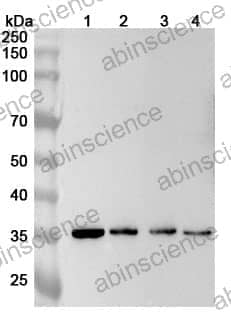
Western blot analysis was performed using anti-CRYZ polyclonal antibody at 1ug/mL on various samples.
Lane 1: HepG2 cell lysate
Lane 2: K562 cell lysate
Lane 3: Jurkat cell lysate
Lane 4: Raji cell lysate
Contact Us
+86-27-65523339
Building C, No. 666, Shen Dun Si Lu, Wuhan, 430206, China