
 中文
中文 English
 한국어
한국어 日本語
日本語 Español
 Français
 Русский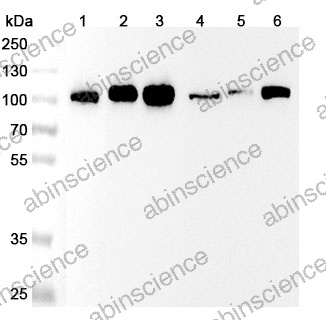

| Catalog No. | HW518014 | ||||||||
|---|---|---|---|---|---|---|---|---|---|
| Description |
Anti-CTNNB1 Polyclonal Antibody (HW518014) is a rabbit polyclonal antibody detecting CTNNB1 in ELISA, IHC, WB. Suitable for Human, Mouse, and Rat.
Highlights
|
||||||||
| Species reactivity | Human, Mouse, Rat | ||||||||
| Applications | ELISA, IHC, WB | ||||||||
| Host species | Rabbit | ||||||||
| Clonality | Polyclonal | ||||||||
| Isotype | IgG | ||||||||
| Immunogen | E. coli - derived recombinant Human CTNNB1 (Met1-Leu781). | ||||||||
| Target | CTNNB, Catenin beta-1, CTNNB1, Beta-catenin | ||||||||
| Endotoxin level | Please contact with the lab for this information. | ||||||||
| Purification | Purified by antigen affinity column. | ||||||||
| Accession | P35222, Q02248, Q9WU82 | ||||||||
| Form | Liquid | ||||||||
| Storage buffer | 0.01M PBS, pH 7.4, 50% Glycerol, 0.05% Proclin 300. Please refer to the specific buffer information in the hardcopy of datasheet or the lot-specific COA. |
||||||||
| Product Usage Information |
| ||||||||
| Stability and Storage | Use a manual defrost freezer and avoid repeated freeze thaw cycles. Store at 2 to 8°C for frequent use. Store at -20 to -80°C for twelve months from the date of receipt. | ||||||||
| Background | Catenin beta-1 (CTNNB1) is a ~85 kDa protein. Key downstream component of the canonical Wnt signaling pathway. In the absence of Wnt, forms a complex with AXIN1, AXIN2, APC, CSNK1A1 and GSK3B that promotes phosphorylation on N-terminal Ser and Thr residues and ubiquitination of CTNNB1 via BTRC and its subsequent degradation by the proteasome. In the presence of Wnt ligand, CTNNB1 is not ubiquitinated and accumulates in the nucleus, where it acts as a coactivator for transcription factors of the TCF/LEF family, leading to activate Wnt responsive genes. Also acts as a coactivator for other transcription factors, such as NR5A2. Promotes epithelial to mesenchymal transition/mesenchymal to epithelial transition (EMT/MET) via driving transcription of CTNNB1/TCF-target genes. 1. Lillehoj, EP. et al. (2007) Biochimica et biophysica acta 1773, 1028-38. PMID: 17524503 2. Weiske, J. et al. (2007) Proceedings of the National Academy of Sciences of the United States of America 104, 20344-9. PMID: 18077326 3. Bahmanyar, S. et al. (2008) Genes & development 22, 91-105. PMID: 18086858 4. Li, H. et al. (2009) The Journal of biological chemistry 284, 2012-22. PMID: 18957423 5. Fiset, A. et al. (2011) Cellular signalling 23, 911-9. PMID: 21262353 6. Satow, R. et al. (2012) Gastroenterology 142, 572-81. PMID: 22155184 7. Genovese, G. et al. (2012) Cell cycle (Georgetown, Tex.) 11, 2206-15. PMID: 22647378 8. Yu, Y. et al. (2012) EMBO reports 13, 750-8. PMID: 22699938 10. Park, J. et al. (2018) Stem cell reports 11, 115-127. PMID: 29910125 | ||||||||
| Note | For research use only. |
Western blot analysis was performed using anti-CTNNB1 polyclonal antibody at 1ug/mL on various samples.
Lane 1: A431 cell lysate
Lane 2: Lncap cell lysate
Contact us for custom quotes, bulk requests and any other issues.
Mail: [email protected]
+86-27-65523339
Building C, No. 666, Shen Dun Si Lu, Wuhan, 430206, China


