
 中文
中文 English
 한국어
한국어 日本語
日本語 Español
 Français
 Русский
| Catalog No. | HC541014 | ||||||||
|---|---|---|---|---|---|---|---|---|---|
| Description |
Anti-Human CAPRIN1 Polyclonal Antibody (HC541014) is a rabbit polyclonal antibody detecting CAPRIN1 in ELISA, IHC, WB. Suitable for Human, Mouse, Rat, and Bovine.
Highlights
|
||||||||
| Species reactivity | Human, Mouse, Rat | ||||||||
| Applications | ELISA, IHC, WB | ||||||||
| Host species | Rabbit | ||||||||
| Clonality | Polyclonal | ||||||||
| Isotype | IgG | ||||||||
| Immunogen | E. coli - derived recombinant Human CAPRIN1 (Arg132-Asn251). | ||||||||
| Target | GPI-anchored protein p137, Cytoplasmic activation- and proliferation-associated protein 1, p137GPI, RNG105, M11S1, Caprin-1, Cell cycle-associated protein 1, RNA granule protein 105, CAPRIN1, GPIP137, GPI-anchored membrane protein 1, GPI-p137, GPIAP1, Membrane component chromosome 11 surface marker 1 | ||||||||
| Purification | Purified by antigen affinity column. | ||||||||
| Accession | Q14444 | ||||||||
| Form | Liquid | ||||||||
| Storage buffer | 0.01M PBS, pH 7.4, 50% Glycerol, 0.05% Proclin 300. Please refer to the specific buffer information in the hardcopy of datasheet or the lot-specific COA. |
||||||||
| Product Usage Information |
| ||||||||
| Stability and Storage | Use a manual defrost freezer and avoid repeated freeze thaw cycles. Store at 2 to 8°C for frequent use. Store at -20 to -80°C for twelve months from the date of receipt. | ||||||||
| Background | Caprin-1 (CAPRIN1) is a ~78 kDa protein. mRNA-binding protein that acts as a regulator of mRNAs transport, translation and/or stability, and which is involved in neurogenesis, synaptic plasticity in neurons and cell proliferation and migration in multiple cell types. Plays an essential role in cytoplasmic stress granule formation. Acts as an mRNA regulator by mediating formation of some phase-separated membraneless compartment: undergoes liquid-liquid phase separation upon binding to target mRNAs, leading to assemble mRNAs into cytoplasmic ribonucleoprotein granules that concentrate mRNAs with associated regulatory factors. Undergoes liquid-liquid phase separation following phosphorylation and interaction with FMR1, promoting formation of cytoplasmic ribonucleoprotein granules that concentrate mRNAs with factors that inhibit translation and mediate deadenylation of target mRNAs. In these cytoplasmic ribonucleoprotein granules, CAPRIN1 mediates recruitment of CNOT7 deadenylase, leading to mRNA deadenylation and degradation. 1. Solomon, S. et al. (2007) Molecular and cellular biology 27, 2324-42. PMID: 17210633 2. Kim, TH. et al. (2019) Science (New York, N.Y.) 365, 825-829. PMID: 31439799 3. Pavinato, L. et al. (2023) Brain : a journal of neurology 146, 534-548. PMID: 35979925 4. Jia, X. et al. (2022) Science advances 8, eabo7112. PMID: 35977029 5. Sanders, DW. et al. (2020) Cell 181, 306-324.e28. PMID: 32302570 6. Yang, P. et al. (2020) Cell 181, 325-345.e28. PMID: 32302571 7. Guillén-Boixet, J. et al. (2020) Cell 181, 346-361.e17. PMID: 32302572 8. Kim, TH. et al. (2021) Proceedings of the National Academy of Sciences of the United States of America 118. PMID: 34074792 9. Toyama, Y. et al. (2022) Proceedings of the National Academy of Sciences of the United States of America 119, e2210492119. PMID: 36040869 | ||||||||
| Note | For research use only. |
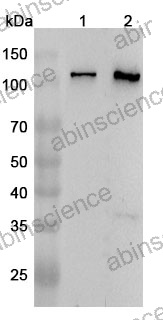
Western blot analysis was performed using anti-CARPIN1 polyclonal antibody at 1ug/mL on various samples.
Lane 1: NIH3T3 cell lysate
Lane 2: Jurkat cell lysate
Lane 3: 293T cell lysate
Lane 4: K562 cell lysate
Lane 5: Mouse brain lysate
Lane 6: Rat brain lysate


Contact us for custom quotes, bulk requests and any other issues.
Mail: [email protected]
+86-27-65523339
Building C, No. 666, Shen Dun Si Lu, Wuhan, 430206, China


