
 中文
中文 English
 한국어
한국어 日本語
日本語 Español
 Français
 Русский
| Catalog No. | HY505023 | ||||
|---|---|---|---|---|---|
| Description |
Anti-Human CFH Nanobody (SAA2038) [SAA2038] (HY505023) is a alpaca monoclonal antibody detecting CFH in ELISA. Suitable for Human.
|
||||
| Species reactivity | Human | ||||
| Applications | ELISA | ||||
| Host species | Alpaca | ||||
| Clonality | Monoclonal | ||||
| Isotype | VHH-8His-Cys-tag | ||||
| Clone ID | SAA2038 | ||||
| Target | Complement factor H, CFH, H factor 1, HF1, HF, HF2 | ||||
| Endotoxin level | Please contact with the lab for this information. | ||||
| Purity | >95% as determined by SDS-PAGE. | ||||
| Purification | Purified by Nickel column. | ||||
| Accession | P08603 | ||||
| Form | Liquid | ||||
| Storage buffer | 0.01M PBS pH 7.4 Please refer to the specific buffer information in the hardcopy of datasheet or the lot-specific COA. |
||||
| Product Usage Information |
| ||||
| Stability and Storage | Use a manual defrost freezer and avoid repeated freeze thaw cycles. Store at 2 to 8°C for frequent use. Store at -20 to -80°C for twelve months from the date of receipt. | ||||
| Background | Complement factor H (CFH) is a ~139 kDa protein. Glycoprotein that plays an essential role in maintaining a well-balanced immune response by modulating complement activation. Acts as a soluble inhibitor of complement, where its binding to self markers such as glycan structures prevents complement activation and amplification on cell surfaces. Accelerates the decay of the complement alternative pathway (AP) C3 convertase C3bBb, thus preventing local formation of more C3b, the central player of the complement amplification loop. As a cofactor of the serine protease factor I, CFH also regulates proteolytic degradation of already-deposited C3b. In addition, mediates several cellular responses through interaction with specific receptors. 1. Kajander, T. et al. (2011) Proceedings of the National Academy of Sciences of the United States of America 108, 2897-902. PMID: 21285368 2. Morgan, HP. et al. (2011) Nature structural & molecular biology 18, 463-70. PMID: 21317894 3. Blaum, BS. et al. (2015) Nature chemical biology 11, 77-82. PMID: 25402769 4. Wu, J. et al. (2009) Nature immunology 10, 728-33. PMID: 19503104 5. Kennedy, AT. et al. (2016) Journal of immunology (Baltimore, Md. : 1950) 196, 1239-48. PMID: 26700768 6. Hocking, HG. et al. (2008) The Journal of biological chemistry 283, 9475-87. PMID: 18252712 7. Simon, N. et al. (2013) Cell host & microbe 13, 29-41. PMID: 23332154 8. Xue, X. et al. (2017) Nature structural & molecular biology 24, 643-651. PMID: 28671664 9. Losse, J. et al. (2010) Journal of immunology (Baltimore, Md. : 1950) 184, 912-21. PMID: 20008295 10. DiScipio, RG. et al. (1998) Journal of immunology (Baltimore, Md. : 1950) 160, 4057-66. PMID: 9558116 | ||||
| Note | For research use only. |
SDS-PAGE for Anti-Human CFH Recombinant Nanobody (SAA2038)
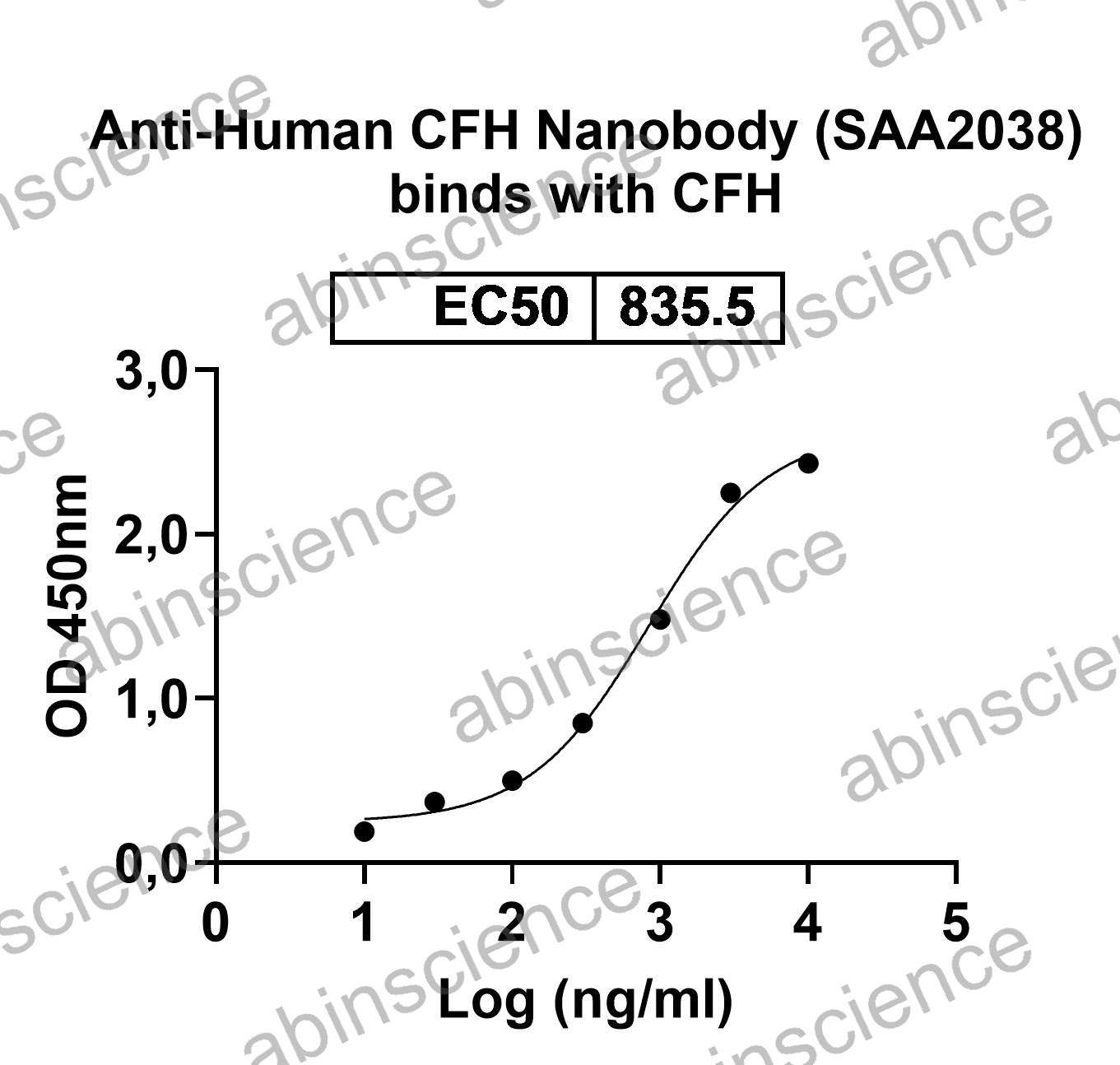
Detects recombinant CFH (Catalog No: HY505012) in indirect ELISA.
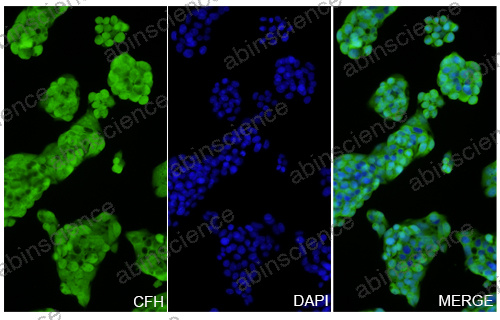
Immunofluorescence staining of Hepg2 with Alpaca monoclonal antibody (20ug/ml, overnight at 4°C), followed by Alexa Fluor-488-conjugated secondary antibody (6.5ug/ml, 50minutes at room temperature). The target protein was detected in the Secreted.


Contact us for custom quotes, bulk requests and any other issues.
Mail: [email protected]
+86-27-65523339
Building C, No. 666, Shen Dun Si Lu, Wuhan, 430206, China


