中文
 English
 한국어
 日本語
 Español
 Français
 Русский

| Catalog No. | HS925013 | ||||
|---|---|---|---|---|---|
| Description |
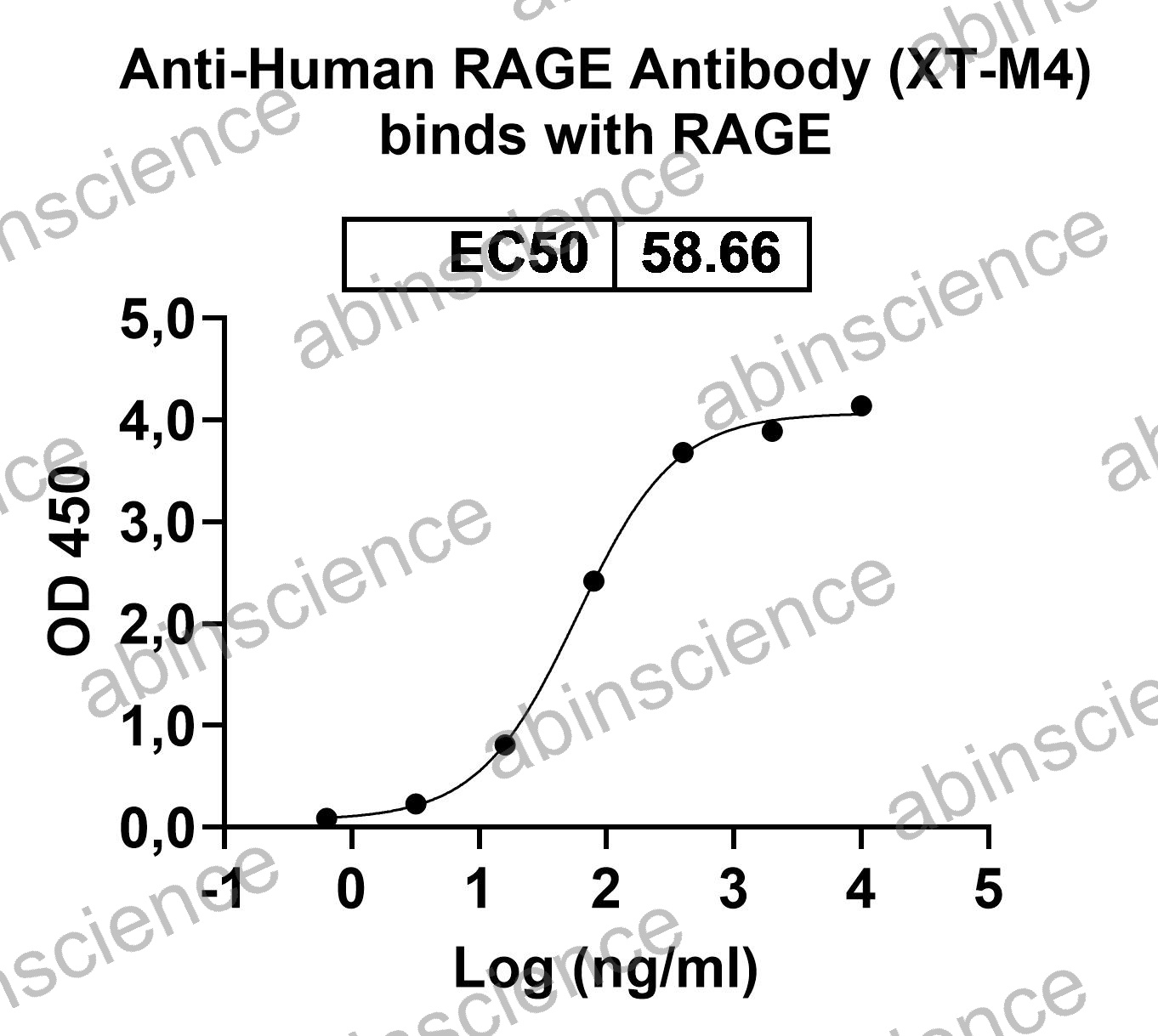
Anti-Human RAGE/AGER Recombinant Antibody (XT-M4) (HS925013) is a human monoclonal antibody detecting RAGE/AGER in ELISA, Neutralization. Suitable for Human.
Highlights
|
||||
| Species reactivity | Human | ||||
| Applications | ELISA, Neutralization | ||||
| Host species | Human | ||||
| Clonality | Monoclonal | ||||
| Isotype | IgG1, kappa | ||||
| Clone ID | XT-M4 | ||||
| Tested applications | WB | ||||
| Target | Advanced glycosylation end product-specific receptor, Receptor for advanced glycosylation end products, AGER, RAGE | ||||
| Endotoxin level | < 10 EU/mg as determined by LAL method. | ||||
| Purity | >95% as determined by SDS-PAGE. | ||||
| Purification | Protein A/G purified from cell culture supernatant. | ||||
| Accession | Q15109 | ||||
| Form | Liquid | ||||
| Storage buffer | 0.01M PBS pH 7.4. Please refer to the specific buffer information in the hardcopy of datasheet or the lot-specific COA. |
||||
| Product Usage Information |
| ||||
| Stability and Storage | Use a manual defrost freezer and avoid repeated freeze-thaw cycles. Store at 4°C short term (1-2 weeks). Store at -20°C 12 months. Store at -80°C long term. | ||||
| Background | Advanced glycosylation end product-specific receptor (RAGE/AGER) is a ~42 kDa protein. Cell surface pattern recognition receptor that senses endogenous stress signals with a broad ligand repertoire including advanced glycation end products, S100 proteins, high-mobility group box 1 protein/HMGB1, amyloid beta/APP oligomers, nucleic acids, histones, phospholipids and glycosaminoglycans. Advanced glycosylation end products are nonenzymatically glycosylated proteins which accumulate in vascular tissue in aging and at an accelerated rate in diabetes. These ligands accumulate at inflammatory sites during the pathogenesis of various diseases including diabetes, vascular complications, neurodegenerative disorders and cancers, and RAGE transduces their binding into pro-inflammatory responses. Upon ligand binding, uses TIRAP and MYD88 as adapters to transduce the signal ultimately leading to the induction of inflammatory cytokines IL6, IL8 and TNFalpha through activation of NF-kappa-B. Interaction with S100A12 on endothelium, mononuclear phagocytes, and lymphocytes triggers cellular activation, with generation of key pro-inflammatory mediators. 1. Shang, D. et al. (2016) Scientific reports 6, 32180. PMID: 27572515 2. Evankovich, J. et al. (2017) FASEB journal : official publication of the Federation of American Societies for Experimental Biology 31, 3894-3903. PMID: 28515150 3. Wang, G. et al. (2021) Cell death discovery 7, 337. PMID: 34743181 4. Yang, Y. et al. (2022) Communications biology 5, 824. PMID: 35974093 5. Sirois, CM. et al. (2013) The Journal of experimental medicine 210, 2447-63. PMID: 24081950 6. Xue, J. et al. (2011) Structure (London, England : 1993) 19, 722-32. PMID: 21565706 7. Sakaguchi, M. et al. (2011) PloS one 6, e23132. PMID: 21829704 8. Yan, Z. et al. (2021) Nature communications 12, 308. PMID: 33436632 9. Moroz, OV. et al. (2009) BMC biochemistry 10, 11. PMID: 19386136 10. Fang, F. et al. (2010) FASEB journal : official publication of the Federation of American Societies for Experimental Biology 24, 1043-55. PMID: 19906677 | ||||
| Note | For research use only. | ||||
| Isotype Control | Human IgG1 (LALA) Recombinant Isotype Control Antibody (HyHEL-10) (HP688107) |


Contact us for custom quotes, bulk requests and any other issues.
Mail: [email protected]
Contact Us
+86-27-65523339
Building C, No. 666, Shen Dun Si Lu, Wuhan, 430206, China