
 中文
中文 English
 한국어
한국어 日本語
日本語 Español
 Français
 Русский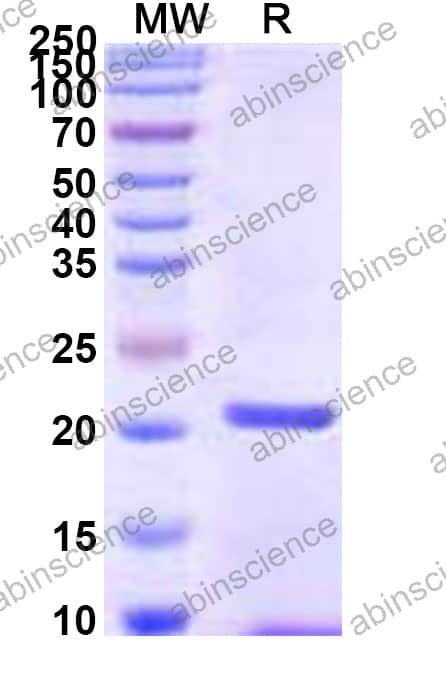

| Catalog No. | HX025014 | ||||||||
|---|---|---|---|---|---|---|---|---|---|
| Description |
Anti-Human RPL11 Polyclonal Antibody (HX025014) is a rabbit polyclonal antibody detecting RPL11 in ELISA, IHC, WB. Suitable for Human.
Highlights
|
||||||||
| Species reactivity | Human, Mouse, Rat | ||||||||
| Applications | ELISA, IHC, WB | ||||||||
| Host species | Rabbit | ||||||||
| Clonality | Polyclonal | ||||||||
| Isotype | IgG | ||||||||
| Immunogen | E. coli - derived recombinant Human RPL11 (Met1-Lys178). | ||||||||
| Target | 60S ribosomal protein L11, CLL-associated antigen KW-12, Large ribosomal subunit protein uL5, RPL11 | ||||||||
| Purification | Purified by antigen affinity column. | ||||||||
| Accession | P62913 | ||||||||
| Form | Liquid | ||||||||
| Storage buffer | 0.01M PBS, pH 7.4, 50% Glycerol, 0.05% Proclin 300. Please refer to the specific buffer information in the hardcopy of datasheet or the lot-specific COA. |
||||||||
| Product Usage Information |
| ||||||||
| Stability and Storage | Use a manual defrost freezer and avoid repeated freeze thaw cycles. Store at 2 to 8°C for frequent use. Store at -20 to -80°C for twelve months from the date of receipt. | ||||||||
| Background | Large ribosomal subunit protein uL5 (RPL11) is a ~20 kDa protein. Component of the ribosome, a large ribonucleoprotein complex responsible for the synthesis of proteins in the cell. The small ribosomal subunit (SSU) binds messenger RNAs (mRNAs) and translates the encoded message by selecting cognate aminoacyl-transfer RNA (tRNA) molecules. The large subunit (LSU) contains the ribosomal catalytic site termed the peptidyl transferase center (PTC), which catalyzes the formation of peptide bonds, thereby polymerizing the amino acids delivered by tRNAs into a polypeptide chain. The nascent polypeptides leave the ribosome through a tunnel in the LSU and interact with protein factors that function in enzymatic processing, targeting, and the membrane insertion of nascent chains at the exit of the ribosomal tunnel. As part of the 5S RNP/5S ribonucleoprotein particle it is an essential component of the LSU, required for its formation and the maturation of rRNAs. 1. Cmejla, R. et al. (2009) Human mutation 30, 321-7. PMID: 19191325 2. Liang, X. et al. (2020) Nature communications 11, 3542. PMID: 32669547 3. Odintsova, TI. et al. (2003) Journal of protein chemistry 22, 249-58. PMID: 12962325 4. Gazda, HT. et al. (2008) American journal of human genetics 83, 769-80. PMID: 19061985 5. Sloan, KE. et al. (2013) Cell reports 5, 237-47. PMID: 24120868 | ||||||||
| Note | For research use only. |
Western blot analysis was performed using anti-RPL11 polyclonal antibody at 1ug/mL on various samples.
Lane 1: BXPC-3 cell lysate
Lane 2: A549 cell lysate
Lane 3: HepG2 cell lysate
Lane 5: NIH3T3 cell lysate
Lane 7: Mouse lung lysate
Lane 8: Mouse pancreas lysate
Lane 9: Rat liver lysate
Lane 10: Rat lung lysate
Lane11: Rat pancreas lysate
Contact us for custom quotes, bulk requests and any other issues.
Mail: [email protected]
+86-27-65523339
Building C, No. 666, Shen Dun Si Lu, Wuhan, 430206, China


