中文
中文 English
 한국어
한국어 日本語
日本語 Español
 Français
 Русский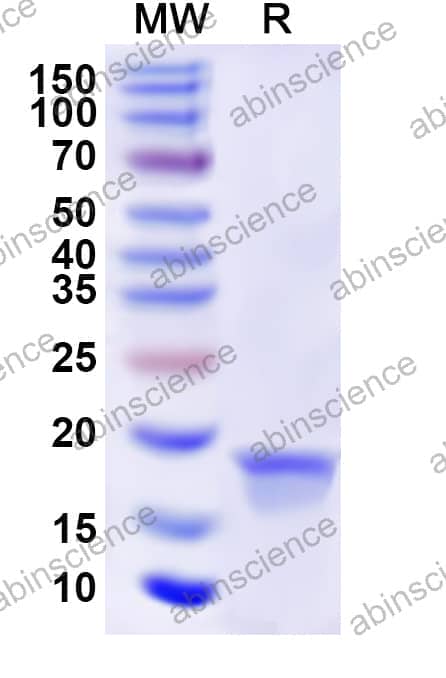
| Catalog No. | HA671014 | ||||||||
|---|---|---|---|---|---|---|---|---|---|
| Description |
Anti-Human SCTR Polyclonal Antibody (HA671014) is a rabbit polyclonal antibody detecting Secretin receptor; SCT-R; SCTR in ELISA, IHC, WB. Suitable for Human.
Highlights
|
||||||||
| Species reactivity | Human | ||||||||
| Applications | ELISA, IHC, WB | ||||||||
| Host species | Rabbit | ||||||||
| Clonality | Polyclonal | ||||||||
| Isotype | IgG | ||||||||
| Immunogen | E. coli - derived recombinant human SCTR (His23-Lys143). | ||||||||
| Target | Secretin receptor; SCT-R; SCTR | ||||||||
| Endotoxin level | Please contact with the lab for this information. | ||||||||
| Purification | Purified by antigen affinity column. | ||||||||
| Accession | P47872 | ||||||||
| Form | Liquid | ||||||||
| Storage buffer | 0.01M PBS, pH 7.4, 50% Glycerol, 0.05% Proclin 300. Please refer to the specific buffer information in the hardcopy of datasheet or the lot-specific COA. |
||||||||
| Product Usage Information |
| ||||||||
| Stability and Storage | Use a manual defrost freezer and avoid repeated freeze thaw cycles. Store at 2 to 8°C for frequent use. Store at -20 to -80°C for twelve months from the date of receipt. | ||||||||
| Background | Secretin receptor (SCTR) is a ~50 kDa protein. G protein-coupled receptor activated by secretin (SCT), which is involved in different processes such as regulation of the pH of the duodenal content, food intake and water homeostasis. Ligand binding causes a conformation change that triggers signaling via guanine nucleotide-binding proteins (G proteins) and activates cAMP-dependent pathway. Upon binding to secretin, regulates the pH of the duodenum by (1) inhibiting the secretion of gastric acid from the parietal cells of the stomach and (2) stimulating the production of bicarbonate (NaHCO(3)) from the ductal cells of the pancreas. In addition to regulating the pH of the duodenal content, plays a central role in diet induced thermogenesis: acts as a non-sympathetic brown fat (BAT) activator mediating prandial thermogenesis, which consequentially induces satiation. Mechanistically, secretin released by the gut after a meal binds to secretin receptor (SCTR) in brown adipocytes, activating brown fat thermogenesis by stimulating lipolysis, which is sensed in the brain and promotes satiation. 1. Afroze, S. et al. (2013) Annals of translational medicine 1, 29. PMID: 25332973 2. Dong, M. et al. (2020) Nature communications 11, 4137. PMID: 32811827 3. Fukuhara, S. et al. (2020) Biochemical and biophysical research communications 533, 861-866. PMID: 33008599 4. Chow, BK. (1995) Biochemical and biophysical research communications 212, 204-11. PMID: 7612008 | ||||||||
| Note | For research use only |
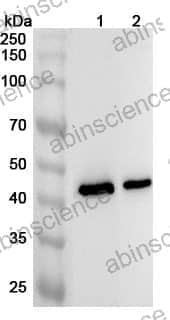
Western blot analysis was performed using anti-SCTR polyclonal antibody at 1ug/mL on various samples.
Lane 1: Mouse brain lysate
Lane 2: Rat brain lysate
Contact us for custom quotes, bulk requests and any other issues.
Mail: [email protected]
+86-27-65523339
Building C, No. 666, Shen Dun Si Lu, Wuhan, 430206, China