
 中文
中文 English
 한국어
한국어 日本語
日本語 Español
 Français
 Русский
| Catalog No. | HA129014 | ||||||||
|---|---|---|---|---|---|---|---|---|---|
| Description |
Anti-Human SUGCT Polyclonal Antibody (HA129014) is a rabbit polyclonal antibody detecting SUGCT in ELISA, IHC, WB. Suitable for Human.
Highlights
|
||||||||
| Species reactivity | Human | ||||||||
| Applications | ELISA, IHC, WB | ||||||||
| Host species | Rabbit | ||||||||
| Clonality | Polyclonal | ||||||||
| Isotype | IgG | ||||||||
| Immunogen | E. coli - derived recombinant Human SUGCT (Gln32-His438). | ||||||||
| Target | Succinate--hydroxymethylglutarate CoA-transferase, 2.8.3.13, Dermal papilla-derived protein 13, SuccinylCoA:glutarate-CoA transferase, SUGCT, C7orf10, DERP13 | ||||||||
| Purification | Purified by antigen affinity column. | ||||||||
| Accession | Q9HAC7 | ||||||||
| Form | Liquid | ||||||||
| Storage buffer | 0.01M PBS, pH 7.4, 50% Glycerol, 0.05% Proclin 300. Please refer to the specific buffer information in the hardcopy of datasheet or the lot-specific COA. |
||||||||
| Product Usage Information |
| ||||||||
| Stability and Storage | Use a manual defrost freezer and avoid repeated freeze thaw cycles. Store at 2 to 8°C for frequent use. Store at -20 to -80°C for twelve months from the date of receipt. | ||||||||
| Background | Succinyl-CoA:glutarate CoA-transferase (SUGCT) is a ~47 kDa protein. Coenzyme A (CoA) transferase that reversibly catalyzes the transfer of a CoA moiety from a dicarboxyl-CoA to a dicarboxylate in a metabolite recycling process. Displays preference for succinyl-CoA and glutarate-CoA as dicarboxyl-CoA donors and glutarate, succinate, adipate/hexanedioate, itaconate and 3-hydroxy-3-methylglutarate as dicarboxylate acceptors. Acts on intermediates or end products of lysine and tryptophan degradation pathway, in particular catalyzes succinyl-CoA-dependent reesterification of free glutarate into glutaryl-CoA to prevent renal excretion of glutarate. Upon inflammation, may convert macrophage-derived itaconate to itaconyl-CoA in erythroid precursors where it negatively regulates the TCA cycle and heme synthesis to limit erythroid differentiation in the context of stress erythropoiesis. 1. Marlaire, S. et al. (2014) Journal of inherited metabolic disease 37, 13-9. PMID: 23893049 2. Marcero, JR. et al. (2021) Blood advances 5, 4831-4841. PMID: 34492704 3. Wu, R. et al. (2024) ACS chemical biology 19, 1544-1553. PMID: 38915184 4. Sherman, EA. et al. (2008) American journal of human genetics 83, 604-9. PMID: 18926513 | ||||||||
| Note | For research use only. |
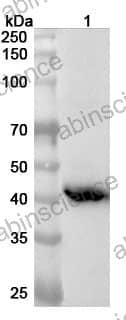
Western blot analysis was performed using anti-SYGCT polyclonal antibody at 1ug/mL on various samples.
Lane 1: Mouse kidney lysate
Contact us for custom quotes, bulk requests and any other issues.
Mail: [email protected]
+86-27-65523339
Building C, No. 666, Shen Dun Si Lu, Wuhan, 430206, China


