
 中文
中文 English
 한국어
한국어 日本語
日本語 Español
 Français
 Русский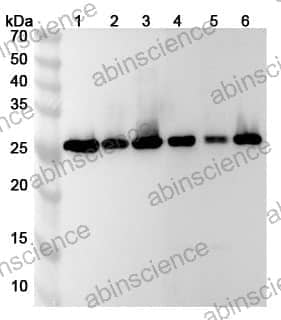
| Catalog No. | HA630014 | ||||||||
|---|---|---|---|---|---|---|---|---|---|
| Description |
Anti-NAA10 Polyclonal Antibody (HA630014) is a rabbit polyclonal antibody detecting N-alpha-acetyltransferase 10; 2.3.1.255; N-terminal acetyltransferase complex ARD1 subunit homolog A; hARD1; NatA catalytic subunit Naa10; NAA10; ARD1; ARD1A; TE2 in ELISA, IHC, WB. Suitable for Human, Bovine, and Mouse.
Highlights
|
||||||||
| Species reactivity | Human, Mouse | ||||||||
| Applications | ELISA, IHC, WB | ||||||||
| Host species | Rabbit | ||||||||
| Isotype | IgG | ||||||||
| Clonality | Polyclonal | ||||||||
| Immunogen | E. coli - derived recombinant human NAA10 (Met1-Ser235). | ||||||||
| Target | N-alpha-acetyltransferase 10; 2.3.1.255; N-terminal acetyltransferase complex ARD1 subunit homolog A; hARD1; NatA catalytic subunit Naa10; NAA10; ARD1; ARD1A; TE2 | ||||||||
| Endotoxin level | Please contact with the lab for this information. | ||||||||
| Purification | Purified by antigen affinity column. | ||||||||
| Accession | P41227, Q2KI14, Q9QY36 | ||||||||
| Form | Liquid | ||||||||
| Storage buffer | 0.01M PBS, pH 7.4, 50% Glycerol, 0.05% Proclin 300. Please refer to the specific buffer information in the hardcopy of datasheet or the lot-specific COA. |
||||||||
| Product Usage Information |
| ||||||||
| Stability and Storage | Use a manual defrost freezer and avoid repeated freeze thaw cycles. Store at 2 to 8°C for frequent use. Store at -20 to -80°C for twelve months from the date of receipt. | ||||||||
| Background | N-alpha-acetyltransferase 10 (NAA10) is a ~26 kDa protein. Catalytic subunit of N-terminal acetyltransferase complexes which display alpha (N-terminal) acetyltransferase activity. Acetylates amino termini that are devoid of initiator methionine. The alpha (N-terminal) acetyltransferase activity may be important for vascular, hematopoietic and neuronal growth and development. Without NAA15, displays epsilon (internal) acetyltransferase activity towards HIF1A, thereby promoting its degradation. Represses MYLK kinase activity by acetylation, and thus represses tumor cell migration. 1. Arnesen, T. et al. (2005) The Biochemical journal 386, 433-43. PMID: 15496142 2. Arnesen, T. et al. (2009) Proceedings of the National Academy of Sciences of the United States of America 106, 8157-62. PMID: 19420222 3. Shin, DH. et al. (2009) PloS one 4, e7451. PMID: 19826488 4. Kuo, HP. et al. (2010) Science signaling 3, ra9. PMID: 20145209 5. Arnesen, T. et al. (2010) Molecular and cellular biology 30, 1898-909. PMID: 20154145 6. Myklebust, LM. et al. (2015) Human molecular genetics 24, 1956-76. PMID: 25489052 7. Seo, JH. et al. (2016) Nature communications 7, 12882. PMID: 27708256 8. Gottlieb, L. et al. (2018) Structure (London, England : 1993) 26, 925-935.e8. PMID: 29754825 9. Deng, S. et al. (2020) Nature communications 11, 818. PMID: 32042062 10. Jeong, JW. et al. (2002) Cell 111, 709-20. PMID: 12464182 | ||||||||
| Note | For research use only |
Western blot analysis was performed using anti-NAA10 polyclonal antibody at 1ug/mL on various samples.
Lane 1: 293T cell lysate
Lane 2: Hela cell lysate
Lane 3: MCF-7 cell lysate
Lane 4: HT-29 cell lysate
Lane 5: C2C12 cell lysate
Lane 6: H1299 cell lysate
+86-27-65523339
Building C, No. 666, Shen Dun Si Lu, Wuhan, 430206, China


