
 中文
中文 English
 한국어
한국어 日本語
日本語 Español
 Français
 Русский
| Catalog No. | HX904014 | ||||||||
|---|---|---|---|---|---|---|---|---|---|
| Description |
Anti-OXCT1 Polyclonal Antibody (HX904014) is a rabbit polyclonal antibody detecting OXCT1 in ELISA, IHC, WB. Suitable for Human, Mouse, Rat, and Pig.
Highlights
|
||||||||
| Species reactivity | Human, Mouse, Rat | ||||||||
| Applications | ELISA, IHC, WB | ||||||||
| Host species | Rabbit | ||||||||
| Clonality | Polyclonal | ||||||||
| Isotype | IgG | ||||||||
| Immunogen | E. coli - derived recombinant Human OXCT1 (Thr40-Leu489). | ||||||||
| Target | 3-oxoacid CoA-transferase 1, OXCT1, Succinyl-CoA:3-ketoacid coenzyme A transferase 1, mitochondrial, Somatic-type succinyl-CoA:3-oxoacid CoA-transferase, OXCT, SCOT, SCOT-s | ||||||||
| Purification | Purified by antigen affinity column. | ||||||||
| Accession | P55809 | ||||||||
| Form | Liquid | ||||||||
| Storage buffer | 0.01M PBS, pH 7.4, 50% Glycerol, 0.05% Proclin 300. Please refer to the specific buffer information in the hardcopy of datasheet or the lot-specific COA. |
||||||||
| Product Usage Information |
| ||||||||
| Stability and Storage | Use a manual defrost freezer and avoid repeated freeze thaw cycles. Store at 2 to 8°C for frequent use. Store at -20 to -80°C for twelve months from the date of receipt. | ||||||||
| Background | Succinyl-CoA:3-ketoacid coenzyme A transferase 1, mitochondrial (OXCT1) is a ~56 kDa protein. Key enzyme for ketone body catabolism. Catalyzes the first, rate-limiting step of ketone body utilization in extrahepatic tissues, by transferring coenzyme A (CoA) from a donor thiolester species (succinyl-CoA) to an acceptor carboxylate (acetoacetate), and produces acetoacetyl-CoA. Acetoacetyl-CoA is further metabolized by acetoacetyl-CoA thiolase into two acetyl-CoA molecules which enter the citric acid cycle for energy production. Forms a dimeric enzyme where both of the subunits are able to form enzyme-CoA thiolester intermediates, but only one subunit is competent to transfer the CoA moiety to the acceptor carboxylate (3-oxo acid) and produce a new acyl-CoA. Formation of the enzyme-CoA intermediate proceeds via an unstable anhydride species formed between the carboxylate groups of the enzyme and substrate. 1. Fukao, T. et al. (2000) Genomics 68, 144-51. PMID: 10964512 | ||||||||
| Note | For research use only. |
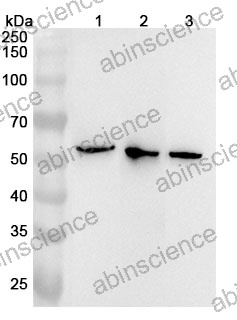
Lane 1: Mouse heart lysate
Lane 2: Mouse kidney lysate
Lane 3: Rat heart lysate
Contact us for custom quotes, bulk requests and any other issues.
Mail: [email protected]
+86-27-65523339
Building C, No. 666, Shen Dun Si Lu, Wuhan, 430206, China


