中文
 English
 한국어
 日本語
 Español
 Français
 Русский
| Catalog No. | HA616014 | ||||||||
|---|---|---|---|---|---|---|---|---|---|
| Description |
Anti-PBLD Polyclonal Antibody (HA616014) is a rabbit polyclonal antibody detecting Phenazine biosynthesis-like domain-containing protein; 5.1.-.-; MAWD-binding protein; MAWDBP; Unknown protein 32 from 2D-page of liver tissue; PBLD; MAWBP in ELISA, IHC, WB. Suitable for Human and Bovine.
Highlights
|
||||||||
| Species reactivity | Human | ||||||||
| Applications | ELISA, IHC, WB | ||||||||
| Host species | Rabbit | ||||||||
| Clonality | Polyclonal | ||||||||
| Isotype | IgG | ||||||||
| Immunogen | E. coli - derived recombinant human PBLD (Met1-Ala288). | ||||||||
| Target | Phenazine biosynthesis-like domain-containing protein; 5.1.-.-; MAWD-binding protein; MAWDBP; Unknown protein 32 from 2D-page of liver tissue; PBLD; MAWBP | ||||||||
| Endotoxin level | Please contact with the lab for this information. | ||||||||
| Purification | Purified by antigen affinity column. | ||||||||
| Accession | P30039, Q2HJF4 | ||||||||
| Form | Liquid | ||||||||
| Storage buffer | 0.01M PBS, pH 7.4, 50% Glycerol, 0.05% Proclin 300. Please refer to the specific buffer information in the hardcopy of datasheet or the lot-specific COA. |
||||||||
| Product Usage Information |
| ||||||||
| Stability and Storage | Use a manual defrost freezer and avoid repeated freeze thaw cycles. Store at 2 to 8°C for frequent use. Store at -20 to -80°C for twelve months from the date of receipt. | ||||||||
| Background | Phenazine biosynthesis-like domain-containing protein (PBLD) is a ~31 kDa protein. Functions as a positive regulator of the antiviral immune response by modulating innate immunity and viral replication by enhancing type I interferon (IFN-I) response. PBLD enhances IFN-I signaling via multiple pathways. Promotes IRF3-mediated IFN-I production and apoptosis, thereby inhibiting viral replication. Upregulates IFN-I response by activating the NF-kappaB signaling pathway, potentially through inhibition of TRIM21-mediated degradation of phosphorylated IKKbeta, thereby sustaining NF-kappaB activation to counteract viral infection. Additionally, promotes the p53-USP4-MAVS signaling axis by stabilizing MAVS through USP4-mediated deubiquitination, thereby enhancing the IFN-I response against RNA virus infection. 1. Zhu, H. et al. (2024) Cell death & disease 15, 727. PMID: 39362857 2. Chu, F. et al. (2024) Proceedings of the National Academy of Sciences of the United States of America 121, e2401174121. PMID: 39589880 3. Hou, P. et al. (2025) Nature communications 16, 496. PMID: 39779683 4. Li, DM. et al. (2013) World journal of gastroenterology 19, 2781-92. PMID: 23687415 | ||||||||
| Note | For research use only |
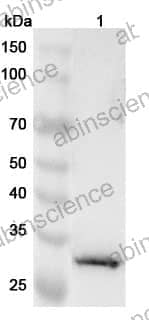
Western blot analysis was performed using anti-PBLD polyclonal antibody at 1ug/mL on various samples.
Lane 1: Mouse liver lysate
Contact Us
+86-27-65523339
Building C, No. 666, Shen Dun Si Lu, Wuhan, 430206, China