中文
 English
 한국어
 日本語
 Español
 Français
 Русский
| Catalog No. | HA706014 | ||||||||
|---|---|---|---|---|---|---|---|---|---|
| Description |
Anti-POLD2 Polyclonal Antibody (HA706014) is a rabbit polyclonal antibody detecting DNA polymerase delta subunit 2; DNA polymerase delta subunit p50; POLD2 in ELISA, IHC, WB. Suitable for Human, Bovine, Mouse, and Rat.
Highlights
|
||||||||
| Species reactivity | Human, Mouse, Rat | ||||||||
| Applications | ELISA, IHC, WB | ||||||||
| Host species | Rabbit | ||||||||
| Clonality | Polyclonal | ||||||||
| Isotype | IgG | ||||||||
| Immunogen | E. coli - derived recombinant human POLD2 (Met1-Pro469). | ||||||||
| Target | DNA polymerase delta subunit 2; DNA polymerase delta subunit p50; POLD2 | ||||||||
| Endotoxin level | Please contact with the lab for this information. | ||||||||
| Purification | Purified by antigen affinity column. | ||||||||
| Accession | P49005, P49004, O35654, Q6AXY4 | ||||||||
| Form | Liquid | ||||||||
| Storage buffer | 0.01M PBS, pH 7.4, 50% Glycerol, 0.05% Proclin 300. Please refer to the specific buffer information in the hardcopy of datasheet or the lot-specific COA. |
||||||||
| Product Usage Information |
| ||||||||
| Stability and Storage | Use a manual defrost freezer and avoid repeated freeze thaw cycles. Store at 2 to 8°C for frequent use. Store at -20 to -80°C for twelve months from the date of receipt. | ||||||||
| Background | DNA polymerase delta subunit 2 (POLD2) is a ~51 kDa protein. Accessory component of both the DNA polymerase delta complex and the DNA polymerase zeta complex. As a component of the trimeric and tetrameric DNA polymerase delta complexes (Pol-delta3 and Pol-delta4, respectively), plays a role in high fidelity genome replication, including in lagging strand synthesis, and repair. Pol-delta3 and Pol-delta4 are characterized by the absence or the presence of POLD4. They exhibit differences in catalytic activity. Most notably, Pol-delta3 shows higher proofreading activity than Pol-delta4. 1. Zhang, S. et al. (2007) The Journal of biological chemistry 282, 15330-40. PMID: 17317665 2. Chea, J. et al. (2012) Cell cycle (Georgetown, Tex.) 11, 2885-95. PMID: 22801543 3. Lee, YS. et al. (2014) Proceedings of the National Academy of Sciences of the United States of America 111, 2954-9. PMID: 24449906 4. Xie, B. et al. (2002) Biochemistry 41, 13133-42. PMID: 12403614 5. Li, H. et al. (2006) The Journal of biological chemistry 281, 14748-55. PMID: 16510448 6. Meng, X. et al. (2009) Nucleic acids research 37, 647-57. PMID: 19074196 7. Meng, X. et al. (2010) Biochemistry 49, 3545-54. PMID: 20334433 8. Lin, SH. et al. (2013) DNA repair 12, 922-35. PMID: 24035200 9. Ogi, T. et al. (2010) Molecular cell 37, 714-27. PMID: 20227374 10. Costantino, L. et al. (2014) Science (New York, N.Y.) 343, 88-91. PMID: 24310611 | ||||||||
| Note | For research use only |
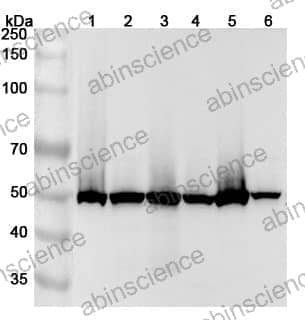
Western blot analysis was performed using anti-POLD2 polyclonal antibody at 1ug/mL on various samples.
Lane 1: Hela cell lysate
Lane 2: Jurkat cell lysate
Lane 3: 293T cell lysate
Lane 4: NIH3T3 cell lysate
Lane 5: HL-60 cell lysate
Lane 6: HepG2 cell lysate
Contact Us
+86-27-65523339
Building C, No. 666, Shen Dun Si Lu, Wuhan, 430206, China