
 中文
中文 English
 한국어
한국어 日本語
日本語 Español
 Français
 Русский
| Catalog No. | HB044014 | ||||||||
|---|---|---|---|---|---|---|---|---|---|
| Description |
Anti-S6K1/RPS6KB1 Polyclonal Antibody (HB044014) is a rabbit polyclonal antibody detecting RPS6KB1 in ELISA, IHC, WB. Suitable for Bovine, Human, Mouse, and Rat.
Highlights
|
||||||||
| Species reactivity | Human, Mouse, Rat | ||||||||
| Applications | ELISA, IHC, WB | ||||||||
| Host species | Rabbit | ||||||||
| Clonality | Polyclonal | ||||||||
| Isotype | IgG | ||||||||
| Immunogen | E. coli - derived recombinant Human S6K1/RPS6KB1 (Phe91-Phe352). | ||||||||
| Target | S6K-beta-1, 70 kDa ribosomal protein S6 kinase 1, p70 S6KA, p70-S6K 1, S6K1, Serine/threonine-protein kinase 14A, p70 ribosomal S6 kinase alpha, p70 S6 kinase alpha, STK14A, RPS6KB1, Ribosomal protein S6 kinase I, p70 S6K-alpha, P70S6K1, Ribosomal protein S6 kinase beta-1 | ||||||||
| Purification | Purified by antigen affinity column. | ||||||||
| Accession | P23443 | ||||||||
| Form | Liquid | ||||||||
| Storage buffer | 0.01M PBS, pH 7.4, 50% Glycerol, 0.05% Proclin 300. Please refer to the specific buffer information in the hardcopy of datasheet or the lot-specific COA. |
||||||||
| Product Usage Information |
| ||||||||
| Stability and Storage | Use a manual defrost freezer and avoid repeated freeze thaw cycles. Store at 2 to 8°C for frequent use. Store at -20 to -80°C for twelve months from the date of receipt. | ||||||||
| Background | Ribosomal protein S6 kinase beta-1 (S6K1/RPS6KB1) is a ~59 kDa protein. Serine/threonine-protein kinase that acts downstream of mTOR signaling in response to growth factors and nutrients to promote cell proliferation, cell growth and cell cycle progression. Regulates protein synthesis through phosphorylation of EIF4B, RPS6 and EEF2K, and contributes to cell survival by repressing the pro-apoptotic function of BAD. Under conditions of nutrient depletion, the inactive form associates with the EIF3 translation initiation complex. Upon mitogenic stimulation, phosphorylation by the mechanistic target of rapamycin complex 1 (mTORC1) leads to dissociation from the EIF3 complex and activation. The active form then phosphorylates and activates several substrates in the pre-initiation complex, including the EIF2B complex and the cap-binding complex component EIF4B. 1. Wang, X. et al. (2001) The EMBO journal 20, 4370-9. PMID: 11500364 2. Fleckenstein, DS. et al. (2003) Leukemia research 27, 687-94. PMID: 12801526 3. Fingar, DC. et al. (2004) Molecular and cellular biology 24, 200-16. PMID: 14673156 4. Raught, B. et al. (2004) The EMBO journal 23, 1761-9. PMID: 15071500 5. Richardson, CJ. et al. (2004) Current biology : CB 14, 1540-9. PMID: 15341740 6. Holz, MK. et al. (2005) Cell 123, 569-80. PMID: 16286006 7. Zhang, HH. et al. (2006) Molecular cell 24, 185-97. PMID: 17052453 8. Dorrello, NV. et al. (2006) Science (New York, N.Y.) 314, 467-71. PMID: 17053147 9. Djouder, N. et al. (2007) Molecular cell 28, 28-40. PMID: 17936702 10. Zhang, J. et al. (2008) The Journal of biological chemistry 283, 35375-82. PMID: 18952604 | ||||||||
| Note | For research use only. |
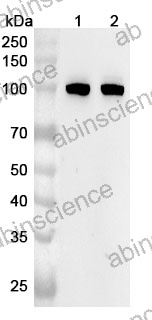
Western blot analysis was performed using anti-RPS6KB1 polyclonal antibody at 1ug/mL on various samples.
Lane 1: Mouse brain lysate
Lane 2: Rat brain lysate
Contact us for custom quotes, bulk requests and any other issues.
Mail: [email protected]
+86-27-65523339
Building C, No. 666, Shen Dun Si Lu, Wuhan, 430206, China


