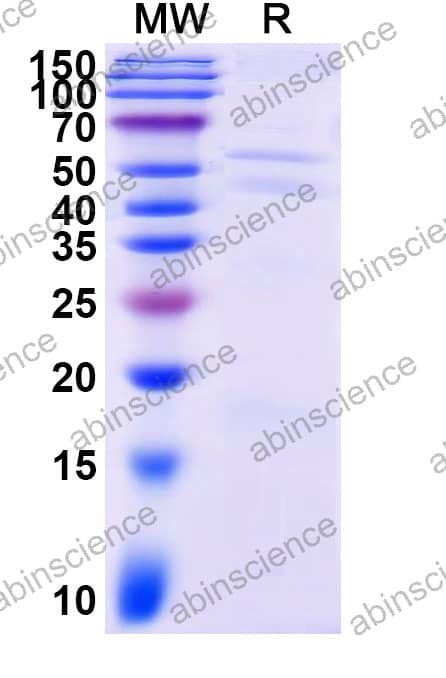
Anti-SRC Polyclonal Antibody (HY387014) is a rabbit polyclonal antibody detecting SRC in ELISA, IHC, WB. Suitable for Human, Mouse, Rat, Avian sarcoma virus, and Danio rerio.
Highlights
●Affinity Purified — Minimal background and high purity for reliable results.
●Multi-Application — Validated across multiple applications.
●Multi-Species — Cross-reactive for translational research.
Species reactivity
Human, Mouse, Rat
Applications
ELISA, IHC, WB
Host species
Rabbit
Isotype
IgG
Clonality
Polyclonal
Immunogen
E. coli - derived recombinant Human SRC (Tyr187-Leu536).
Please refer to the specific buffer information in the hardcopy of datasheet or the lot-specific COA.
Product Usage Information
Application
Dilution
ELISA
1:5000-1:20000
IHC
1:50-1:500
WB
1:500-1:2000
Stability and Storage
Use a manual defrost freezer and avoid repeated freeze thaw cycles. Store at 2 to 8°C for frequent use. Store at -20 to -80°C for twelve months from the date of receipt.
Background
Proto-oncogene tyrosine-protein kinase Src is a ~59 kDa protein. Non-receptor protein tyrosine kinase which is activated following engagement of many different classes of cellular receptors including immune response receptors, integrins and other adhesion receptors, receptor protein tyrosine kinases, G protein-coupled receptors as well as cytokine receptors. Participates in signaling pathways that control a diverse spectrum of biological activities including gene transcription, immune response, cell adhesion, cell cycle progression, apoptosis, migration, and transformation. Due to functional redundancy between members of the SRC kinase family, identification of the specific role of each SRC kinase is very difficult. SRC appears to be one of the primary kinases activated following engagement of receptors and plays a role in the activation of other protein tyrosine kinase (PTK) families. Receptor clustering or dimerization leads to recruitment of SRC to the receptor complexes where it phosphorylates the tyrosine residues within the receptor cytoplasmic domains.
1. Paré, G. et al. (2021) Frontiers in immunology 12, 650808. PMID: 34234773
2. Wang, Y. et al. (2011) Molecular biology of the cell 22, 1529-38. PMID: 21411625
3. Neuber, S. et al. (2015) Cell and tissue research 359, 799-816. PMID: 25501895
4. Giglione, C. et al. (2001) European journal of biochemistry 268, 3275-83. PMID: 11389730
5. Jeulin, C. et al. (2008) American journal of physiology. Lung cellular and molecular physiology 295, L489-96. PMID: 18586953
6. David-Pfeuty, T. et al. (1995) Journal of virology 69, 1699-713. PMID: 7853507
7. Taniyama, Y. et al. (2003) Molecular and cellular biology 23, 8019-29. PMID: 14585963
8. Grano, M. et al. (1996) Proceedings of the National Academy of Sciences of the United States of America 93, 7644-8. PMID: 8755529
9. Li, Z. et al. (2024) Nature communications 15, 1300. PMID: 38346942
10. Miyazaki, T. et al. (2003) The Journal of cell biology 160, 709-18. PMID: 12615910

 中文
中文 English
 한국어
한국어 日本語
日本語 Español
 Français
 Русский