
 中文
中文 English
 한국어
한국어 日本語
日本語 Español
 Français
 Русский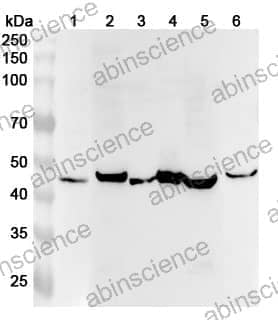
| Catalog No. | HB422014 | ||||||||
|---|---|---|---|---|---|---|---|---|---|
| Description |
Anti-STARD3 Polyclonal Antibody (HB422014) is a rabbit polyclonal antibody detecting StAR-related lipid transfer protein 3; Metastatic lymph node gene 64 protein; MLN 64; Protein CAB1; START domain-containing protein 3; StARD3; STARD3; CAB1; MLN64 in ELISA, IHC, WB. Suitable for Human and Mouse.
Highlights
|
||||||||
| Species reactivity | Human | ||||||||
| Applications | ELISA, IHC, WB | ||||||||
| Host species | Rabbit | ||||||||
| Clonality | Polyclonal | ||||||||
| Isotype | IgG | ||||||||
| Immunogen | E. coli - derived recombinant human STARD3 (Ser232-Ala445). | ||||||||
| Target | StAR-related lipid transfer protein 3; Metastatic lymph node gene 64 protein; MLN 64; Protein CAB1; START domain-containing protein 3; StARD3; STARD3; CAB1; MLN64 | ||||||||
| Endotoxin level | Please contact with the lab for this information. | ||||||||
| Purification | Purified by antigen affinity column. | ||||||||
| Accession | Q14849, Q61542 | ||||||||
| Form | Liquid | ||||||||
| Storage buffer | 0.01M PBS, pH 7.4, 50% Glycerol, 0.05% Proclin 300. Please refer to the specific buffer information in the hardcopy of datasheet or the lot-specific COA. |
||||||||
| Product Usage Information |
| ||||||||
| Stability and Storage | Use a manual defrost freezer and avoid repeated freeze thaw cycles. Store at 2 to 8°C for frequent use. Store at -20 to -80°C for twelve months from the date of receipt. | ||||||||
| Background | StAR-related lipid transfer protein 3 (STARD3) is a ~50 kDa protein. Sterol-binding protein that mediates cholesterol transport from the endoplasmic reticulum to endosomes. The sterol transport mechanism is triggered by phosphorylation of FFAT motif that leads to membrane tethering between the endoplasmic reticulum and late endosomes via interaction with VAPA and VAPB. Acts as a lipid transfer protein that redirects sterol to the endosome at the expense of the cell membrane and favors membrane formation inside endosomes. May also mediate cholesterol transport between other membranes, such as mitochondria membrane or cell membrane. However, such results need additional experimental evidences; probably mainly mediates cholesterol transport from the endoplasmic reticulum to endosomes. 1. Alpy, F. et al. (2001) The Journal of biological chemistry 276, 4261-9. PMID: 11053434 2. Hölttä-Vuori, M. et al. (2005) Molecular biology of the cell 16, 3873-86. PMID: 15930133 3. Liapis, A. et al. (2012) PloS one 7, e34424. PMID: 22514632 4. Wilhelm, LP. et al. (2017) The EMBO journal 36, 1412-1433. PMID: 28377464 5. Di Mattia, T. et al. (2020) The EMBO journal 39, e104369. PMID: 33124732 6. Alpy, F. et al. (2013) Journal of cell science 126, 5500-12. PMID: 24105263 7. Zhang, M. et al. (2002) The Journal of biological chemistry 277, 33300-10. PMID: 12070139 | ||||||||
| Note | For research use only |
Western blot analysis was performed using anti-STARD3 polyclonal antibody at 1ug/mL on various samples.
Lane 1: MCF-7 cell lysate
Lane 2: Mouse brain lysate
Lane 3: Mouse lung lysate
Lane 4: Mouse heart lysate
Lane 5: Rat brain lysate
Lane 6: Rat heart lysate
+86-27-65523339
Building C, No. 666, Shen Dun Si Lu, Wuhan, 430206, China


