
 中文
中文 English
 한국어
한국어 日本語
日本語 Español
 Français
 Русский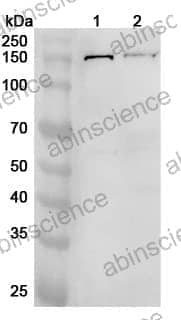
| Catalog No. | HA790014 | ||||||||
|---|---|---|---|---|---|---|---|---|---|
| Description |
Anti-TGFBR3 Polyclonal Antibody (HA790014) is a rabbit polyclonal antibody detecting Transforming growth factor beta receptor type 3; TGF-beta receptor type 3; TGFR-3; Betaglycan; Transforming growth factor beta receptor III; TGF-beta receptor type III; TGFBR3 in ELISA, IHC, WB. Suitable for Human, Pig, Rat, and Mouse.
Highlights
|
||||||||
| Species reactivity | Human | ||||||||
| Applications | ELISA, IHC, WB | ||||||||
| Host species | Rabbit | ||||||||
| Isotype | IgG | ||||||||
| Clonality | Polyclonal | ||||||||
| Immunogen | E. coli - derived recombinant human TGFBR3 (Ser36-Glu360). | ||||||||
| Target | Transforming growth factor beta receptor type 3; TGF-beta receptor type 3; TGFR-3; Betaglycan; Transforming growth factor beta receptor III; TGF-beta receptor type III; TGFBR3 | ||||||||
| Endotoxin level | Please contact with the lab for this information. | ||||||||
| Purification | Purified by antigen affinity column. | ||||||||
| Accession | Q03167, P35054, P26342, O88393 | ||||||||
| Form | Liquid | ||||||||
| Storage buffer | 0.01M PBS, pH 7.4, 50% Glycerol, 0.05% Proclin 300. Please refer to the specific buffer information in the hardcopy of datasheet or the lot-specific COA. |
||||||||
| Product Usage Information |
| ||||||||
| Stability and Storage | Use a manual defrost freezer and avoid repeated freeze thaw cycles. Store at 2 to 8°C for frequent use. Store at -20 to -80°C for twelve months from the date of receipt. | ||||||||
| Background | Transforming growth factor beta receptor type 3 (TGFBR3) is a ~93 kDa protein. Cell surface receptor that regulates diverse cellular processes including cell proliferation, differentiation, migration, and apoptosis. Initiates BMP, inhibin, and TGF-beta signaling pathways by interacting with different ligands including TGFB1, BMP2, BMP5, BMP7 or GDF5. Alternatively, acts as a cell surface coreceptor for BMP ligands, serving to enhance ligand binding by differentially regulating BMPR1A/ALK3 and BMPR1B/ALK6 receptor trafficking. Promotes epithelial cell adhesion, focal adhesion formation and integrin signaling during epithelial cell spreading on fibronectin. By interacting with the scaffolding protein beta-arrestin2/ARRB2, regulates migration or actin cytoskeleton and promotes the activation of CDC42 as well as the inhibition of NF-kappa-B. 1. Chen, W. et al. (2003) Science (New York, N.Y.) 301, 1394-7. PMID: 12958365 2. Mythreye, K. et al. (2009) Proceedings of the National Academy of Sciences of the United States of America 106, 8221-6. PMID: 19416857 3. Kirkbride, KC. et al. (2008) The Journal of biological chemistry 283, 7628-37. PMID: 18184661 4. Lee, NY. et al. (2009) Molecular biology of the cell 20, 4362-70. PMID: 19726563 5. Mythreye, K. et al. (2013) Oncogene 32, 1416-27. PMID: 22562249 6. You, HJ. et al. (2009) Carcinogenesis 30, 1281-7. PMID: 19325136 | ||||||||
| Note | For research use only |
Western blot analysis was performed using anti-TGFBR3 polyclonal antibody at 1ug/mL on various samples.
Lane 1: NIH3T3 cell lysate
Lane 2: PC-12 cell lysate
+86-27-65523339
Building C, No. 666, Shen Dun Si Lu, Wuhan, 430206, China


