
 中文
中文 English
 한국어
한국어 日本語
日本語 Español
 Français
 Русский
| Catalog No. | MF879014 | ||||||||
|---|---|---|---|---|---|---|---|---|---|
| Description |
Anti-TNFa/TNF-alpha Polyclonal Antibody (MF879014) is a rabbit polyclonal antibody detecting TNF-alpha in ELISA, IHC, WB. Suitable for Mouse, Rat, and Peromyscus leucopus.
Highlights
|
||||||||
| Species reactivity | Mouse, Rat | ||||||||
| Applications | ELISA, IHC, WB | ||||||||
| Host species | Rabbit | ||||||||
| Clonality | Polyclonal | ||||||||
| Isotype | IgG | ||||||||
| Immunogen | E. coli - derived recombinant Mouse TNFa/TNF-alpha (Leu80-Leu235). | ||||||||
| Tested applications | WB | ||||||||
| Target | C-domain 1, C-domain 2, Cachectin, ICD1, ICD2, Intracellular domain 1, Intracellular domain 2, N-terminal fragment, NTF, TNF, TNF-a, TNF-alpha, TNFA, TNFSF2, Tumor necrosis factor, Tumor necrosis factor ligand superfamily member 2, Tumor necrosis factor, membrane form, Tumor necrosis factor, soluble form | ||||||||
| Endotoxin level | Please contact with the lab for this information. | ||||||||
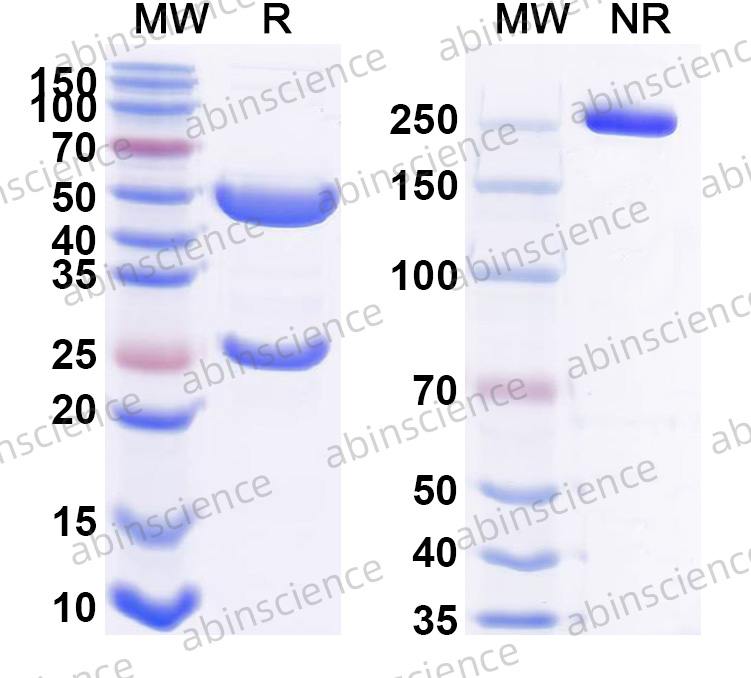
| Purity | >90% as determined by SDS-PAGE. | ||||||||
| Purification | Purified by antigen affinity column. | ||||||||
| Accession | P06804 | ||||||||
| Form | Liquid | ||||||||
| Storage buffer | 0.01M PBS, pH 7.4, 50% glycerol, 0.05% Proclin 300. Please refer to the specific buffer information in the hardcopy of datasheet or the lot-specific COA. |
||||||||
| Product Usage Information |
| ||||||||
| Stability and Storage | Use a manual defrost freezer and avoid repeated freeze thaw cycles. Store at 2 to 8°C for frequent use. Store at -20 to -80°C for twelve months from the date of receipt. | ||||||||
| Background | Tumor necrosis factor (TNFa/TNF-alpha) is a ~25 kDa protein. Cytokine that binds to TNFRSF1A/TNFR1 and TNFRSF1B/TNFBR. It is mainly secreted by macrophages and can induce cell death of certain tumor cell lines. It is potent pyrogen causing fever by direct action or by stimulation of interleukin-1 secretion and is implicated in the induction of cachexia, Under certain conditions it can stimulate cell proliferation and induce cell differentiation. Induces insulin resistance in adipocytes via inhibition of insulin-induced IRS1 tyrosine phosphorylation and insulin-induced glucose uptake. Induces GKAP42 protein degradation in adipocytes which is partially responsible for TNF-induced insulin resistance. TNFa is the therapeutic target of adalimumab (Humira). 1. Ando, Y. et al. (2015) The Journal of biological chemistry 290, 5881-92. PMID: 25586176 2. Jeong, E. et al. (2020) FASEB journal : official publication of the Federation of American Societies for Experimental Biology 34, 12894-12906. PMID: 32741026 | ||||||||
| Note | For research use only. |
Western blot analysis was performed using anti-TNF polyclonal antibody at 1ug/mL on various samples.
Lane 1: PC-12 cell lysate
Lane 2: RAW264.7 cell lysate


Contact us for custom quotes, bulk requests and any other issues.
Mail: [email protected]
+86-27-65523339
Building C, No. 666, Shen Dun Si Lu, Wuhan, 430206, China


