
 中文
中文 English
 한국어
한국어 日本語
日本語 Español
 Français
 Русский
| Catalog No. | HV645014 | ||||||||
|---|---|---|---|---|---|---|---|---|---|
| Description |
Anti-ZBP1 Polyclonal Antibody (HV645014) is a rabbit polyclonal antibody detecting ZBP1 in ELISA, IHC, WB. Suitable for Human.
Highlights
|
||||||||
| Species reactivity | Human | ||||||||
| Applications | ELISA, IHC, WB | ||||||||
| Host species | Rabbit | ||||||||
| Isotype | IgG | ||||||||
| Clonality | Polyclonal | ||||||||
| Immunogen | E. coli - derived recombinant Human ZBP1 (Arg10-Pro167). | ||||||||
| Target | DNA-dependent activator of IFN-regulatory factors, DLM1, ZBP1, C20orf183, Z-DNA-binding protein 1, DAI, Tumor stroma and activated macrophage protein DLM-1 | ||||||||
| Purification | Purified by antigen affinity column. | ||||||||
| Accession | Q9H171 | ||||||||
| Form | Liquid | ||||||||
| Storage buffer | 0.01M PBS, pH 7.4, 50% Glycerol, 0.05% Proclin 300. Please refer to the specific buffer information in the hardcopy of datasheet or the lot-specific COA. |
||||||||
| Product Usage Information |
| ||||||||
| Stability and Storage | Use a manual defrost freezer and avoid repeated freeze thaw cycles. Store at 2 to 8°C for frequent use. Store at -20 to -80°C for twelve months from the date of receipt. | ||||||||
| Background | Z-DNA-binding protein 1 (ZBP1) is a ~46 kDa protein. Key innate sensor that recognizes and binds Z-RNA structures, which are produced by a number of viruses, such as herpesvirus, orthomyxovirus or flavivirus, and triggers different forms of cell death. ZBP1 acts as an essential mediator of pyroptosis, necroptosis and apoptosis (PANoptosis), an integral part of host defense against pathogens, by activating RIPK3, caspase-8 (CASP8), and the NLRP3 inflammasome. Key activator of necroptosis, a programmed cell death process in response to death-inducing TNF family members, via its ability to bind Z-RNA: once activated upon Z-RNA-binding, ZBP1 interacts and stimulates RIPK3 kinase, which phosphorylates and activates MLKL, triggering execution of programmed necrosis. In addition to TNF-induced necroptosis, necroptosis can also take place in the nucleus in response to orthomyxoviruses infection: ZBP1 recognizes and binds Z-RNA structures that are produced in infected nuclei by orthomyxoviruses, such as the influenza A virus (IAV), leading to ZBP1 activation, RIPK3 stimulation and subsequent MLKL phosphorylation, triggering disruption of the nuclear envelope and leakage of cellular DNA into the cytosol. ZBP1-dependent cell death in response to IAV infection promotes interleukin-1 alpha (IL1A) induction in an NLRP3-inflammasome-independent manner: IL1A expression is required for the optimal interleukin-1 beta (IL1B) production, and together, these cytokines promote infiltration of inflammatory neutrophils to the lung, leading to the formation of neutrophil extracellular traps. 1. Zhang, T. et al. (2020) Cell 180, 1115-1129.e13. PMID: 32200799 | ||||||||
| Note | For research use only. |
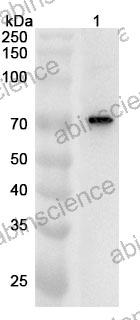
Lane 1: Mouse thymus lysate
Contact us for custom quotes, bulk requests and any other issues.
Mail: support@abinScience.com
+86-27-65523339
Building C, No. 666, Shen Dun Si Lu, Wuhan, 430206, China


