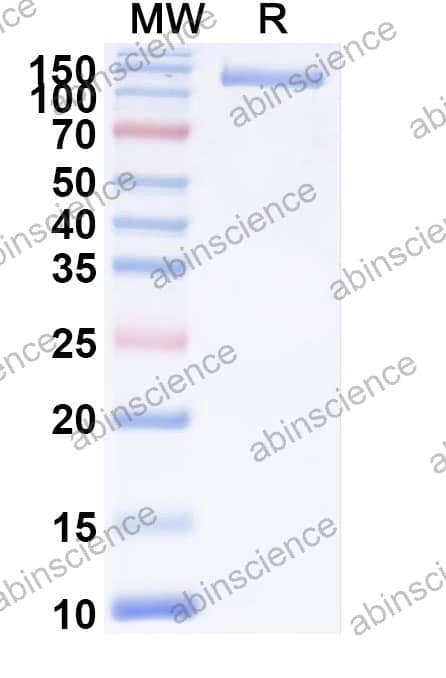
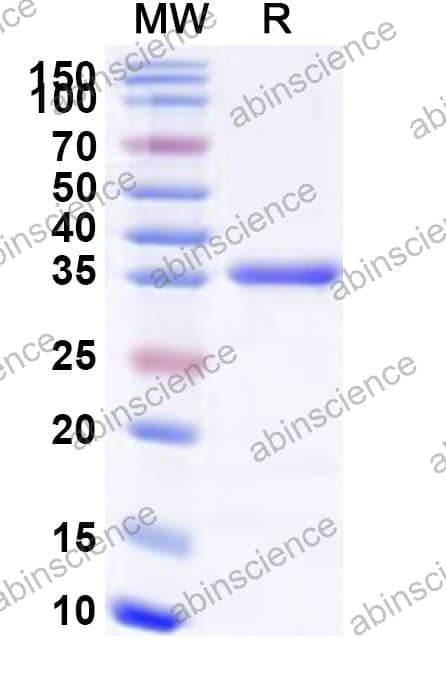
ELISA, Immunogen, SDS-PAGE, WB, Bioactivity testing in progress
Species
Homo sapiens (Human)
Nature
Recombinant
Endotoxin level
Please contact with the lab for this information.
Purity
>90% as determined by SDS-PAGE.
Predicted molecular weight
129.13 kDa
Form
Lyophilized
Storage buffer
Lyophilized from a solution in PBS pH 7.4, 1 mM EDTA, 4% Trehalose, 1% Mannitol.
Please refer to the specific buffer information in the hardcopy of datasheet or the lot-specific COA.
Reconstitution
Reconstitute in sterile water for a stock solution. A copy of datasheet will be provided with the products, please refer to it for details.
Shipping
In general, proteins are provided as lyophilized powder/frozen liquid. They are shipped out with dry ice/blue ice unless customers require otherwise.
Stability and Storage
Use a manual defrost freezer and avoid repeated freeze thaw cycles. Store at 2 to 8°C for frequent use. Store at -20 to -80°C for twelve months from the date of receipt.
Alternate Names
DDB p127 subunit, DDB1, DDBa, DNA damage-binding protein 1, DNA damage-binding protein a, Damage-specific DNA-binding protein 1, HBV X-associated protein 1, UV-DDB 1, UV-damaged DNA-binding factor, UV-damaged DNA-binding protein 1, XAP-1, XAP1, XPCe, XPE-BF, XPE-binding factor, Xeroderma pigmentosum group E-complementing protein
Background
DNA damage-binding protein 1 is a ~126 kDa protein. Protein, which is both involved in DNA repair and protein ubiquitination, as part of the UV-DDB complex and DCX (DDB1-CUL4-X-box) complexes, respectively. Core component of the UV-DDB complex (UV-damaged DNA-binding protein complex), a complex that recognizes UV-induced DNA damage and recruit proteins of the nucleotide excision repair pathway (the NER pathway) to initiate DNA repair. The UV-DDB complex preferentially binds to cyclobutane pyrimidine dimers (CPD), 6-4 photoproducts (6-4 PP), apurinic sites and short mismatches. Also functions as a component of numerous distinct DCX (DDB1-CUL4-X-box) E3 ubiquitin-protein ligase complexes which mediate the ubiquitination and subsequent proteasomal degradation of target proteins. The functional specificity of the DCX E3 ubiquitin-protein ligase complex is determined by the variable substrate recognition component recruited by DDB1.
1. Wertz, IE. et al. (2004) Science (New York, N.Y.) 303, 1371-4. PMID: 14739464
2. Hu, J. et al. (2004) Nature cell biology 6, 1003-9. PMID: 15448697
3. Kulaksiz, G. et al. (2005) Molecular and cellular biology 25, 9784-92. PMID: 16260596
4. Hu, J. et al. (2006) The Journal of biological chemistry 281, 3753-6. PMID: 16407242
5. Senga, T. et al. (2006) The Journal of biological chemistry 281, 6246-52. PMID: 16407252
6. Nishitani, H. et al. (2006) The EMBO journal 25, 1126-36. PMID: 16482215
7. Lovejoy, CA. et al. (2006) Molecular and cellular biology 26, 7977-90. PMID: 16940174
8. He, YJ. et al. (2006) Genes & development 20, 2949-54. PMID: 17079684
9. Sjögren, B. et al. (2015) PloS one 10, e0123581. PMID: 25970626

 中文
中文 English
 한국어
한국어 日本語
日本語 Español
 Français
 Русский