
 中文
中文 English
 한국어
한국어 日本語
日本語 Español
 Français
 Русский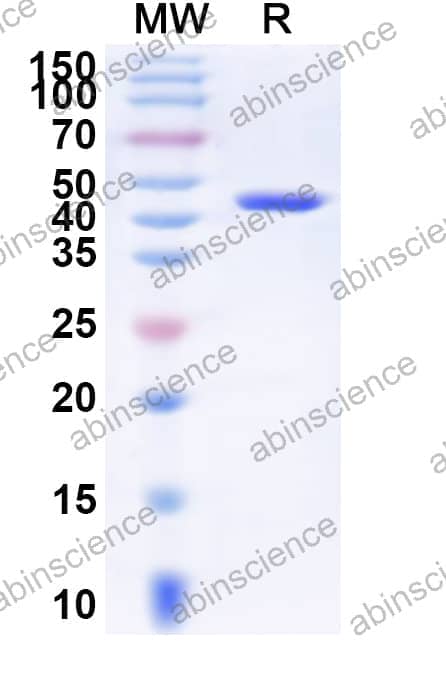
| Catalog No. | HA782012 |
|---|---|
| Description |
Recombinant Human ERCC8 Protein, N-His (HA782012) expressed in E. coli, spanning Met1-Pro370. Purity: >90% by SDS-PAGE.
Highlights
|
| Expression system | E. coli |
| Accession | Q13216 |
| Protein length | Met1-Pro370 |
| Applications | ELISA, Immunogen, SDS-PAGE, WB, Bioactivity testing in progress |
| Species | Homo sapiens (Human) |
| Nature | Recombinant |
| Endotoxin level | Please contact with the lab for this information. |
| Purity | >90% as determined by SDS-PAGE. |
| Predicted molecular weight | 43.36 kDa |
| Form | Lyophilized |
| Storage buffer | Lyophilized from a solution in PBS pH 7.4, 1 mM EDTA, 4% Trehalose, 1% Mannitol. Please refer to the specific buffer information in the hardcopy of datasheet or the lot-specific COA. |
| Reconstitution | Reconstitute in sterile water for a stock solution. Adjust the volume of sterile water so that, after reconstitution, the final stock concentration matches the value indicated on the product label or datasheet. RECONSTITUTION PROTOCOL 1. Allow the product to be reconstituted and the reconstitution diluent to reach room temperature. 2. Tap or briefly centrifuge the product vial before opening to dislodge any lyophilized material that may be dispersed on the wall or cap of the vial. 3. Use the diluent and stock concentration recommended in the product datasheet. If preparing a stock concentration higher than recommended, contact Technical Service. 4. After adding the diluent, re-cap the vial and invert gently by hand or place on a slow rocking platform to allow the reconstitution diluent to coat all the surfaces inside the vial. Note: Do not mix by vortexing or by pipetting the material up and down. 5. Allow the vial to sit at room temperature with gentle agitation for at least 15 minutes before aliquotting or using. 6. Store the reconstituted material in single use aliquots in polypropylene or siliconized tubes. Aliquots of 10 μL or larger are recommended. |
| Shipping | In general, proteins are provided as lyophilized powder/frozen liquid. They are shipped out with dry ice/blue ice unless customers require otherwise. |
| Stability and Storage | Use a manual defrost freezer and avoid repeated freeze thaw cycles. Store at 2 to 8°C for frequent use. Store at -20 to -80°C for twelve months from the date of receipt. |
| Alternate Names | DNA excision repair protein ERCC-8; Cockayne syndrome WD repeat protein CSA; ERCC8; CKN1; CSA |
| Background | DNA excision repair protein ERCC-8 is a ~44 kDa protein. Substrate-recognition component of the CSA complex, a DCX (DDB1-CUL4-X-box) E3 ubiquitin-protein ligase complex, involved in transcription-coupled nucleotide excision repair (TC-NER), a process during which RNA polymerase II-blocking lesions are rapidly removed from the transcribed strand of active genes. Following recruitment to lesion-stalled RNA polymerase II (Pol II), the CSA complex mediates ubiquitination of Pol II subunit POLR2A/RPB1 at 'Lys-1268', a critical TC-NER checkpoint, governing RNA Pol II stability and initiating DNA damage excision by TFIIH recruitment. The CSA complex also promotes the ubiquitination and subsequent proteasomal degradation of ERCC6/CSB in a UV-dependent manner; ERCC6 degradation is essential for the recovery of RNA synthesis after transcription-coupled repair. Also plays a role in DNA double-strand breaks (DSSBs) repair by non-homologous end joining (NHEJ). 1. Groisman, R. et al. (2003) Cell 113, 357-67. PMID: 12732143 2. Groisman, R. et al. (2006) Genes & development 20, 1429-34. PMID: 16751180 3. Angers, S. et al. (2006) Nature 443, 590-3. PMID: 16964240 4. Nakazawa, Y. et al. (2020) Cell 180, 1228-1244.e24. PMID: 32142649 5. Kokic, G. et al. (2021) Nature 598, 368-372. PMID: 34526721 6. Kokic, G. et al. (2024) Nature structural & molecular biology 31, 536-547. PMID: 38316879 7. Carnie, CJ. et al. (2024) Nature cell biology 26, 797-810. PMID: 38600235 8. van Sluis, M. et al. (2024) Nature cell biology 26, 770-783. PMID: 38600236 9. van der Weegen, Y. et al. (2020) Nature communications 11, 2104. PMID: 32355176 |
| Note | For research use only |
SDS-PAGE for Recombinant Human ERCC8 Protein, N-His
+86-27-65523339
Building C, No. 666, Shen Dun Si Lu, Wuhan, 430206, China


