
 中文
中文 English
 한국어
한국어 日本語
日本語 Español
 Français
 Русский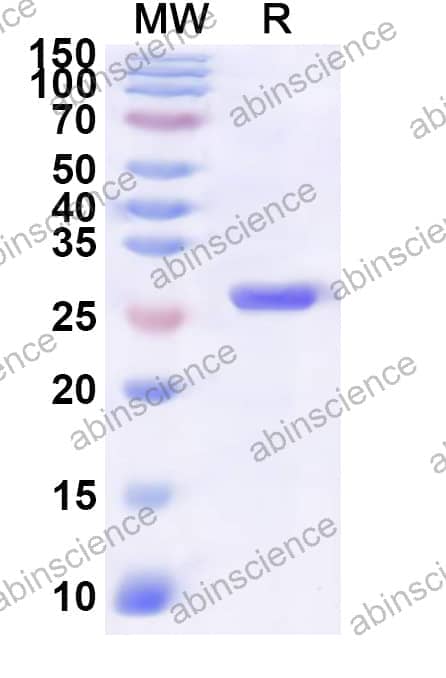
| Catalog No. | HB427012 |
|---|---|
| Description |
Recombinant Human KANK1 Protein, N-His (HB427012) expressed in E. coli, spanning Tyr1083-Asp1352. Purity: >90% by SDS-PAGE.
Highlights
|
| Expression system | E. coli |
| Accession | Q14678 |
| Protein length | Tyr1083-Asp1352 |
| Applications | ELISA, Immunogen, SDS-PAGE, WB, Bioactivity testing in progress |
| Species | Homo sapiens (Human) |
| Nature | Recombinant |
| Endotoxin level | Please contact with the lab for this information. |
| Purity | >90% as determined by SDS-PAGE. |
| Predicted molecular weight | 31.23 kDa |
| Form | Lyophilized |
| Storage buffer | Lyophilized from a solution in PBS pH 7.4, 1 mM EDTA, 4% Trehalose, 1% Mannitol. Please refer to the specific buffer information in the hardcopy of datasheet or the lot-specific COA. |
| Reconstitution | Reconstitute in sterile water for a stock solution. Adjust the volume of sterile water so that, after reconstitution, the final stock concentration matches the value indicated on the product label or datasheet. RECONSTITUTION PROTOCOL 1. Allow the product to be reconstituted and the reconstitution diluent to reach room temperature. 2. Tap or briefly centrifuge the product vial before opening to dislodge any lyophilized material that may be dispersed on the wall or cap of the vial. 3. Use the diluent and stock concentration recommended in the product datasheet. If preparing a stock concentration higher than recommended, contact Technical Service. 4. After adding the diluent, re-cap the vial and invert gently by hand or place on a slow rocking platform to allow the reconstitution diluent to coat all the surfaces inside the vial. Note: Do not mix by vortexing or by pipetting the material up and down. 5. Allow the vial to sit at room temperature with gentle agitation for at least 15 minutes before aliquotting or using. 6. Store the reconstituted material in single use aliquots in polypropylene or siliconized tubes. Aliquots of 10 μL or larger are recommended. |
| Shipping | In general, proteins are provided as lyophilized powder/frozen liquid. They are shipped out with dry ice/blue ice unless customers require otherwise. |
| Stability and Storage | Use a manual defrost freezer and avoid repeated freeze thaw cycles. Store at 2 to 8°C for frequent use. Store at -20 to -80°C for twelve months from the date of receipt. |
| Alternate Names | KN motif and ankyrin repeat domain-containing protein 1; Ankyrin repeat domain-containing protein 15; Kidney ankyrin repeat-containing protein; KANK1; ANKRD15; KANK; KIAA0172 |
| Background | KN motif and ankyrin repeat domain-containing protein 1 is a ~147 kDa protein. Adapter protein that links structural and signaling protein complexes positioned to guide microtubule and actin cytoskeleton dynamics during cell morphogenesis. At focal adhesions (FAs) rims, organizes cortical microtubule stabilizing complexes (CMSCs) and directly interacts with major FA component TLN1, forming macromolecular assemblies positioned to control microtubule-actin crosstalk at the cell edge. Recruits KIF21A in CMSCs at axonal growth cones and regulates axon guidance by suppressing microtubule growth without inducing microtubule disassembly once it reaches the cell cortex. Interacts with ARFGEF1 and participates in establishing microtubule-organizing center (MTOC) orientation and directed cell movement in wound healing. Regulates actin stress fiber formation and cell migration by inhibiting RHOA activation in response to growth factors; this function involves phosphorylation through PI3K/Akt signaling and may depend on the competitive interaction with 14-3-3 adapter proteins to sequester them from active complexes. 1. Li, CC. et al. (2011) Proceedings of the National Academy of Sciences of the United States of America 108, 19228-33. PMID: 22084092 2. van der Vaart, B. et al. (2013) Developmental cell 27, 145-160. PMID: 24120883 3. Bouchet, BP. et al. (2016) eLife 5. PMID: 27410476 4. Kakinuma, N. et al. (2008) The Journal of cell biology 181, 537-49. PMID: 18458160 5. Gee, HY. et al. (2015) The Journal of clinical investigation 125, 2375-84. PMID: 25961457 6. Roy, BC. et al. (2009) The Journal of cell biology 184, 253-67. PMID: 19171758 7. Wang, Y. et al. (2006) Journal of cell science 119, 4002-10. PMID: 16968744 |
| Note | For research use only |
SDS-PAGE for Recombinant Human KANK1 Protein, N-His
+86-27-65523339
Building C, No. 666, Shen Dun Si Lu, Wuhan, 430206, China


