
 中文
中文 English
 한국어
한국어 日本語
日本語 Español
 Français
 Русский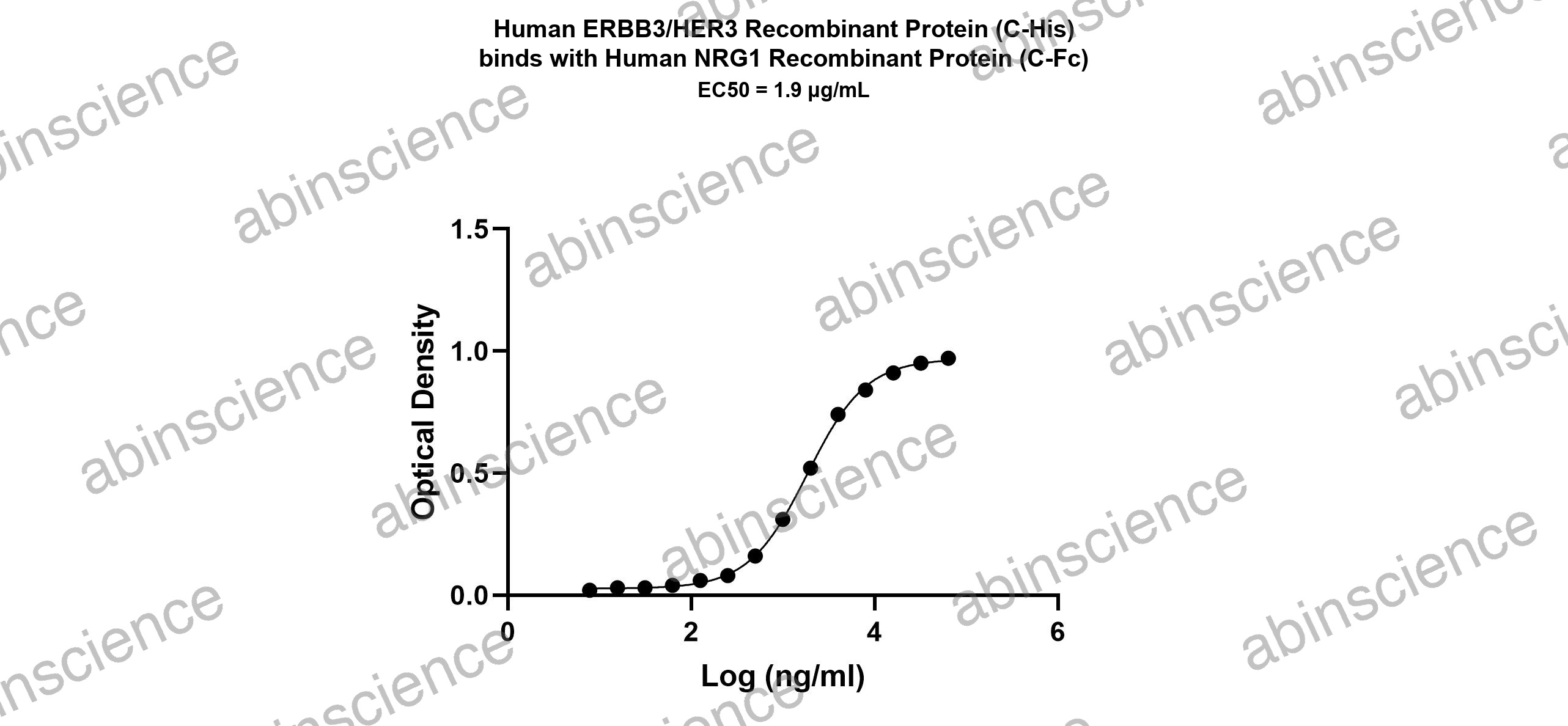
| Catalog No. | HX096041 |
|---|---|
| Description |
Recombinant Human NRG1 Protein, C-Fc (HX096041) expressed in Mammalian Cells, spanning Lys22-Lys241. Purity: >90% by SDS-PAGE.
Highlights
|
| Expression system | Mammalian cells |
| Accession | Q02297 |
| Protein length | Lys22-Lys241 |
| Applications | ELISA, Immunogen, SDS-PAGE, WB, Bioactivity testing in progress |
| Species | Homo sapiens (Human) |
| Nature | Recombinant |
| Endotoxin level | Please contact with the lab for this information. |
| Purity | >90% as determined by SDS-PAGE. |
| Predicted molecular weight | 52.23 kDa |
| Form | Lyophilized |
| Storage buffer | Lyophilized from a solution in PBS pH 7.4, 1 mM EDTA, 4% Trehalose, 1% Mannitol. Please refer to the specific buffer information in the hardcopy of datasheet or the lot-specific COA. |
| Reconstitution | Reconstitute in sterile water for a stock solution. A copy of datasheet will be provided with the products, please refer to it for details. |
| Shipping | In general, proteins are provided as lyophilized powder/frozen liquid. They are shipped out with dry ice/blue ice unless customers require otherwise. |
| Stability and Storage | Use a manual defrost freezer and avoid repeated freeze thaw cycles. Store at 2 to 8°C for frequent use. Store at -20 to -80°C for twelve months from the date of receipt. |
| Alternate Names | ARIA, Acetylcholine receptor-inducing activity, Breast cancer cell differentiation factor p45, GGF, Glial growth factor, HGL, HRG, HRGA, Heregulin, NDF, NRG1, Neu differentiation factor, Neuregulin-1, Pro-NRG1, Pro-neuregulin-1, membrane-bound isoform, SMDF, Sensory and motor neuron-derived factor |
| Background | Pro-neuregulin-1, membrane-bound isoform is a ~70 kDa protein. Direct ligand for ERBB3 and ERBB4 tyrosine kinase receptors. Concomitantly recruits ERBB1 and ERBB2 coreceptors, resulting in ligand-stimulated tyrosine phosphorylation and activation of the ERBB receptors. The multiple isoforms perform diverse functions such as inducing growth and differentiation of epithelial, glial, neuronal, and skeletal muscle cells; inducing expression of acetylcholine receptor in synaptic vesicles during the formation of the neuromuscular junction; stimulating lobuloalveolar budding and milk production in the mammary gland and inducing differentiation of mammary tumor cells; stimulating Schwann cell proliferation; implication in the development of the myocardium such as trabeculation of the developing heart. Isoform 10 may play a role in motor and sensory neuron development. Binds to ERBB4. 1. Sweeney, C. et al. (2000) The Journal of biological chemistry 275, 19803-7. PMID: 10867024 2. Plowman, GD. et al. (1993) Nature 366, 473-5. PMID: 7902537 3. Ieguchi, K. et al. (2010) The Journal of biological chemistry 285, 31388-98. PMID: 20682778 |
| Note | For research use only |
Immobilized HB116011 Human ERBB3/HER3 Recombinant Protein (C-His) at 2 μg/mL(100 μL/well) can bind HX096041 Human NRG1 Recombinant Protein (C-Fc), the EC 50 is 1.9 μg/mL.


Contact us for custom quotes, bulk requests and any other issues.
Mail: [email protected]
+86-27-65523339
Building C, No. 666, Shen Dun Si Lu, Wuhan, 430206, China


