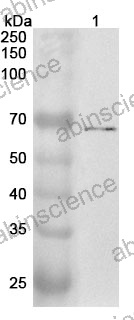
ELISA, Immunogen, SDS-PAGE, WB, Bioactivity testing in progress
Species
Homo sapiens (Human)
Nature
Recombinant
Endotoxin level
Please contact with the lab for this information.
Purity
>90% as determined by SDS-PAGE.
Predicted molecular weight
18.02 kDa
Form
Lyophilized
Storage buffer
Lyophilized from a solution in PBS pH 7.4, 1 mM EDTA, 4% Trehalose, 1% Mannitol.
Please refer to the specific buffer information in the hardcopy of datasheet or the lot-specific COA.
Reconstitution
Reconstitute in sterile water for a stock solution. A copy of datasheet will be provided with the products, please refer to it for details.
Shipping
In general, proteins are provided as lyophilized powder/frozen liquid. They are shipped out with dry ice/blue ice unless customers require otherwise.
Stability and Storage
Use a manual defrost freezer and avoid repeated freeze thaw cycles. Store at 2 to 8°C for frequent use. Store at -20 to -80°C for twelve months from the date of receipt.
Alternate Names
MyD88-3, PRVTIRB, Proline-rich, vinculin and TIR domain-containing protein B, Putative NF-kappa-B-activating protein 502H, TICAM-1, TICAM1, TIR domain-containing adapter molecule 1, TIR domain-containing adapter protein inducing IFN-beta, TRIF, Toll-interleukin-1 receptor domain-containing adapter protein inducing interferon beta
Background
TIR domain-containing adapter molecule 1 is a ~76 kDa protein. Involved in innate immunity against invading pathogens. Adapter used by TLR3, TLR4 (through TICAM2) and TLR5 to mediate NF-kappa-B and interferon-regulatory factor (IRF) activation, and to induce apoptosis. Ligand binding to these receptors results in TRIF recruitment through its TIR domain. Distinct protein-interaction motifs allow recruitment of the effector proteins TBK1, TRAF6 and RIPK1, which in turn, lead to the activation of transcription factors IRF3 and IRF7, NF-kappa-B and FADD respectively. Phosphorylation by TBK1 on the pLxIS motif leads to recruitment and subsequent activation of the transcription factor IRF3 to induce expression of type I interferon and exert a potent immunity against invading pathogens.
1. Yamamoto, M. et al. (2002) Journal of immunology (Baltimore, Md. : 1950) 169, 6668-72. PMID: 12471095
2. Oshiumi, H. et al. (2003) Nature immunology 4, 161-7. PMID: 12539043
3. Han, KJ. et al. (2004) The Journal of biological chemistry 279, 15652-61. PMID: 14739303
4. Ye, W. et al. (2017) Journal of immunology (Baltimore, Md. : 1950) 199, 1856-1864. PMID: 28747347
5. Pallett, MA. et al. (2022) Viruses 14. PMID: 35215908
6. Liu, S. et al. (2015) Science (New York, N.Y.) 347, aaa2630. PMID: 25636800

 中文
中文 English
 한국어
한국어 日本語
日本語 Español
 Français
 Русский