
 中文
中文 English
 한국어
한국어 日本語
日本語 Español
 Français
 Русский


| Catalog No. | HY525016 |
|---|---|
| Species reactivity | Human |
| Applications | ELISA, Bioactivity: FACS, Functional assay, Research in vivo |
| Host species | Human |
| Clonality | Monoclonal |
| Isotype | IgG1-kappa |
| Clone ID | AMG 529 |
| Biological activity | AMG-529 induces a dose-dependent increase in alkaline phosphatase (ALP) levels, but no significant effect on blood lipid levels (including non-high-density lipoprotein cholesterol) is observed [1]. |
| Expression system | Mammalian cells |
| Target | HL-1, ASGP-R 1, Asialoglycoprotein receptor 1, CLEC4H1, ASGR1, C-type lectin domain family 4 member H1, ASGPR 1, Hepatic lectin H1 |
| Endotoxin level | < 10 EU/mg |
| Purity | >95% purity as determined by SDS-PAGE. |
| Purification | Protein A/G purified from cell culture supernatant. |
| Accession | P07306 |
| Form | Liquid |
| Storage buffer | 0.01M PBS pH 7.4 Please refer to the specific buffer information in the hardcopy of datasheet or the lot-specific COA. |
| Stability and Storage | Use a manual defrost freezer and avoid repeated freeze thaw cycles. Store at 2 to 8°C for frequent use. Store at -20 to -80°C for twelve months from the date of receipt. |
| Alternate Names | AMG-529, AMG529, AMG529 |
| Background | Asialoglycoprotein receptor 1 (ASGR1) is a ~33 kDa protein. Transmembrane protein predominantly expressed on hepatocytes that plays a key role in endocytosis of plasma glycoproteins that lack terminal sialic acid residues. Specifically recognizes terminal galactose and N-acetylgalactosamine residues, facilitating the clearance of desialylated glycoproteins from circulation. Plays thereby a role in a variety of physiological processes, such as removal of desialylated platelets, elimination of activated lymphocytes and maintenance of serum glycoprotein homeostasis. Plays a role in the removal of desialylated platelets by activating a feedback loop regulating thrombopoietin (TPO) expression via the JAK2-STAT3 signaling pathway. Contributes also to recognition and elimination of activated lymphocytes by hepatocytes that can act as cytotoxic effectors. 1. Grozovsky, R. et al. (2015) Nature medicine 21, 47-54. PMID: 25485912 2. Guy, CS. et al. (2011) Hepatology (Baltimore, Md.) 54, 1043-50. PMID: 21656538 |
| References | 1. Janiszewski M, et al. A randomized, placebo-controlled, double-blind, ascending single-dose, phase 1 study to evaluate the safety, tolerability, pharmacokinetics, and pharmacodynamics of AMG 529, a novel anti-ASGR1 monoclonal antibody, in healthy subjects. Journal of the American College of Cardiology. 2019 Mar 12;73(9S1):1755-. [HY525016] |
| Note | For research use only. Not suitable for clinical or therapeutic use. |
| Isotype Control | Human IgG1 (LALAPG) Recombinant Isotype Control Antibody (HyHEL-10) (HP688307) |
SDS-PAGE for Research Grade Anti-Human ASGR1 (AMG 529).
Flow-cytometry using APC anti-human ASGR1 antibody. HepG-2 cells were stained with an irrelevant antibody (Blue Histogram) or an APC anti-human ASGR1 monoclonal antibody (Catalog: HY525016, Yellow Histogram) at a concentration of 5 µg/ml for 30 mins at RT. After washing, and cells analysed on a NovoCyte Flow Cytometer.
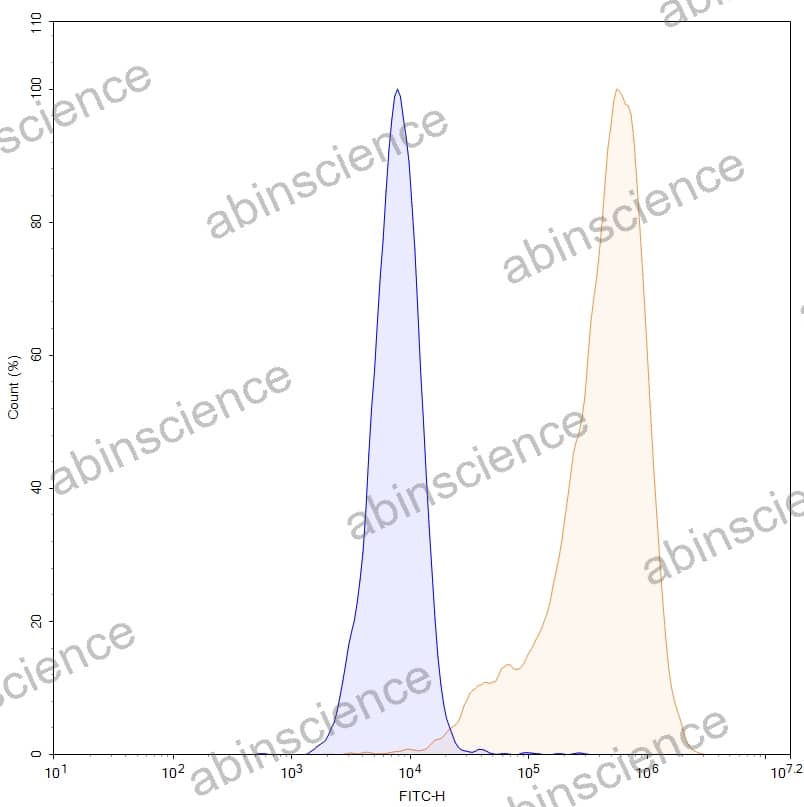
Flow-cytometry using FITC anti-human ASGR1 antibody. HepG-2 cells were stained with an irrelevant antibody (Blue Histogram) or an FITC anti-human ASGR1 monoclonal antibody (Catalog: HY525016, Yellow Histogram) at a concentration of 5 µg/ml for 30 mins at RT. After washing, and cells analysed on a NovoCyte Flow Cytometer.
Flow-cytometry using PE anti-human ASGR1 antibody. HepG-2 cells were stained with an irrelevant antibody (Blue Histogram) or an PE anti-human ASGR1 monoclonal antibody (Catalog: HY525016, Yellow Histogram) at a concentration of 5 µg/ml for 30 mins at RT. After washing, and cells analysed on a NovoCyte Flow Cytometer.
Flow-cytometry using anti-human ASGR1 antibody. HepG2 cells were stained with an irrelevant antibody (Blue Histogram) or an anti-human ASGR1 monoclonal antibody (Catalog HY525016, Yellow Histogram) at a concentration of 5 µg/ml for 30 mins at RT. After washing, bound antibody was detected using a Goat Anti-Human IgG H&L Polyclonal Antibody, FITC (abinScience: HF690414) and cells analysed on a NovoCyte Flow Cytometer.


Contact us for custom quotes, bulk requests and any other issues.
Mail: [email protected]
+86-27-65523339
Building C, No. 666, Shen Dun Si Lu, Wuhan, 430206, China


