
 中文
中文 English
 한국어
한국어 日本語
日本語 Español
 Français
 Русский

| Catalog No. | HT018016 |
|---|---|
| Species reactivity | Human |
| Applications | ELISA, Bioactivity: FACS, Functional assay, Research in vivo |
| Host species | Human |
| Clonality | Monoclonal |
| Isotype | IgG |
| Clone ID | AGS-16C3F |
| Biological activity | AGS-16C3F (0.001-1350 nM, 96 h) has IC 50 of 1.1 nM, 2.73 nM, 109.9 nM and 146.5 nM in ROSA KIT D816V, ROSA KIT D816V-Gluc, HMC-1.1 and HMC-1.2 cells, respectively, shows potent inhibitory activity against the proliferation of ROSA cells with high expression of CD203c [2]. AGS-16C3F (0.5-100 nM, 96-120 h) induces apoptosis and kills tumor cells with high expression of CD203c in ROSA KIT D816V, ROSA KIT D816V-Gluc, HMC-1.1 and HMC-1.2 cells [2]. Apoptosis Analysis [2] Cell Line: ROSA KIT D816V, ROSA KIT D816V-Gluc, HMC-1.1 and HMC-1.2 cells Concentration: 0.5-100 nM Incubation Time: 96-120 h Result: Significantly increased the proportion of apoptotic cells in ROSA cells (dose-dependent). Had a low apoptosis rate in HMC-1 cells. AGS-16C3F (1,4 mg/kg, i.v. once every 4 days, 4 times in total) significantly reduces tumor burden and prolongs survival in the NOD-SCID γ mice model transplants with ROSA KIT D816V-Gluc cells without significant toxicity [2]. |
| Expression system | Mammalian cells |
| Target | NPPase, PD-Ibeta, Phosphodiesterase I beta, PDNP3, CD203c, Ectonucleotide pyrophosphatase/phosphodiesterase family member 3, E-NPP 3, ENPP3, NPP3, Phosphodiesterase I/nucleotide pyrophosphatase 3, Nucleotide diphosphatase |
| Endotoxin level | < 10 EU/mg |
| Purity | >95% purity as determined by SDS-PAGE. |
| Purification | Protein A/G purified from cell culture supernatant. |
| Accession | O14638 |
| Form | Liquid |
| Storage buffer | 0.01M PBS pH 7.4 Please refer to the specific buffer information in the hardcopy of datasheet or the lot-specific COA. |
| Stability and Storage | Use a manual defrost freezer and avoid repeated freeze thaw cycles. Store at 2 to 8°C for frequent use. Store at -20 to -80°C for twelve months from the date of receipt. |
| Alternate Names | AGS-16C3F, AGS16C3F, AGS16C3F |
| Background | Ectonucleotide pyrophosphatase/phosphodiesterase family member 3 (CD203c/ENPP3) is a ~100 kDa protein. Hydrolase that metabolizes extracellular nucleotides, including ATP, GTP, UTP and CTP. Also hydrolyzes extracellular 2',3'-cGAMP (cyclic GMP-AMP), a second messenger that activates TMEM173/STING and triggers type-I interferon production, and is therefore involved in the regulation of innate immune response. 2',3'-cGAMP appears to be further processed to GMP, AMP and inorganic phosphate. Limits mast cells and basophils response during inflammation and during the chronic phases of allergic responses by eliminating extracellular ATP, a signaling molecule activating these cells in an autocrine manner. Metabolizes extracellular ATP in the lumen of the small intestine, and thereby prevents ATP-induced apoptosis of intestinal plasmacytoid dendritic cells. 1. Gorelik, A. et al. (2018) The FEBS journal 285, 2481-2494. PMID: 29717535 2. Jin-Hua, P. et al. (1997) Genomics 45, 412-5. PMID: 9344668 3. Mardjuki, R. et al. (2024) Cell reports 43, 114209. PMID: 38749434 4. Vollmayer, P. et al. (2003) European journal of biochemistry 270, 2971-8. PMID: 12846830 5. Bühring, HJ. et al. (2001) Blood 97, 3303-5. PMID: 11342463 |
| References | 1. Kollmannsberger C, et al. A Randomized Phase II Study of AGS-16C3F Versus Axitinib in Previously Treated Patients with Metastatic Renal Cell Carcinoma. Oncologist. 2021 Mar;26(3):182-e361. [HT018016] 2. Zhang Y, et al. In vitro and in vivo efficacy of an anti-CD203c conjugated antibody (AGS-16C3F) in mouse models of advanced systemic mastocytosis. Blood Adv. 2019 Feb 26;3(4):633-643. [HT018016] |
| Note | For research use only. Not suitable for clinical or therapeutic use. |
| Isotype Control | Human IgG2 Recombinant Isotype Control Antibody (HyHEL-10) (HV988107) |
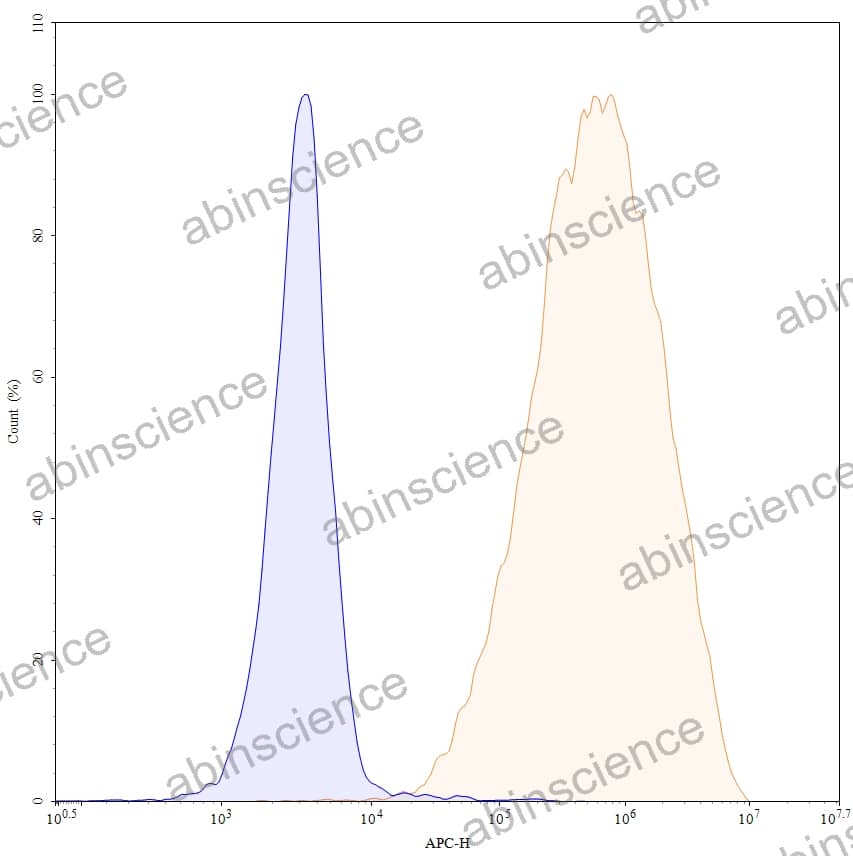
HepG2 cells were stained with an irrelevant antibody (Blue Histogram) or an anti-CD203c monoclonal antibody (Catalog HT018016, Yellow Histogram) at a concentration of 5 µg/ml for 30 mins at RT. After washing, bound antibody was detected using a Goat Anti-Human IgG H&L Polyclonal Antibody, FITC (abinScience: HF690414) and cells analyzed on a NovoCyte Flow Cytometer.
Untransfected cells or cells transfected with CD203c/ENPP3 were stained with an irrelevant antibody (Blue Histogram) or an anti-human CD203c monoclonal antibody (Catalog HT018016, Yellow Histogram) at a concentration of 5 µg/ml for 30 mins at RT. After washing, bound antibody was detected using a Goat Anti-Human IgG H&L Polyclonal Antibody, FITC (abinScience: HF690414) and cells analyzed on a NovoCyte Flow Cytometer.


Contact us for custom quotes, bulk requests and any other issues.
Mail: [email protected]
+86-27-65523339
Building C, No. 666, Shen Dun Si Lu, Wuhan, 430206, China


