Multiple sclerosis (MS) is the most common autoimmune demyelinating disease of the central nervous system and a leading cause of non-traumatic neurological disability in young adults. The third edition of the Atlas of MS and subsequent Global Burden of Disease analyses estimate that around 2.8 million people were living with MS worldwide in 2020, with prevalence still rising. The typical age at diagnosis is 20–40 years, and women are roughly twice as likely to be affected as men.
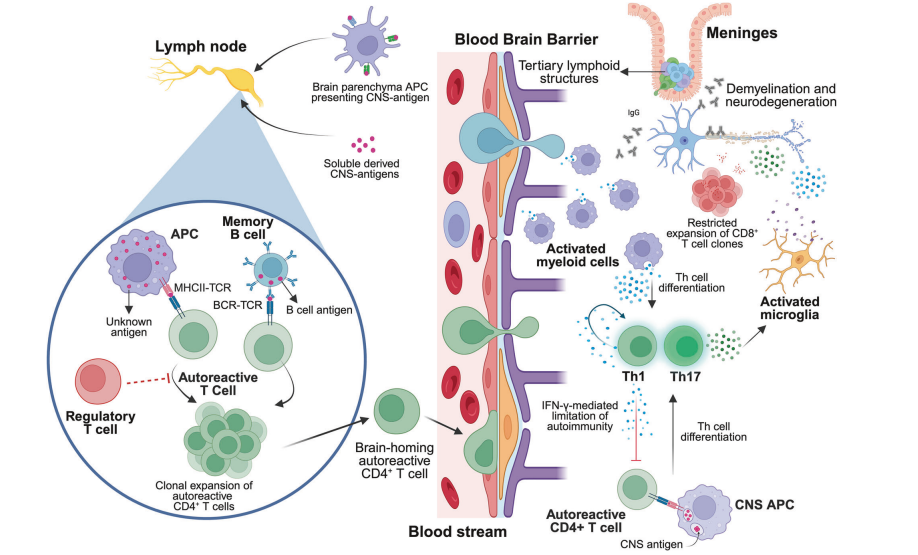
Pathologically, MS lesions show multifocal inflammation, demyelination, axonal transection, neuronal loss and gliosis throughout the brain and spinal cord. Over the past decade, converging work from neuropathology, imaging and immunology has reframed MS as a B cell–driven disease: CD20+ B cells, T cells and myeloid cells interact across the blood–brain barrier, activate microglia and astrocytes through NF-κB–centred cytokine networks, and form meningeal ectopic lymphoid follicles that sustain chronic cortical demyelination and neurodegeneration.
Large longitudinal cohorts now support latent Epstein–Barr virus (EBV) infection in memory B cells as an upstream driver of this cascade, while high-efficacy CD20-depleting antibodies have confirmed the central role of B cells in disease propagation. In parallel, disease-modifying therapies targeting sphingosine 1-phosphate (S1P) receptors, Bruton’s tyrosine kinase (BTK), NF-κB signalling and EBV-directed strategies are reshaping the treatment landscape.
This 2025 review highlights five core mechanistic pillars that dominate current and emerging pipelines—S1P receptor modulation, BTK inhibition, CD20+ B-cell depletion, NF-κB–driven glial inflammation and EBV latency—and links each to a practical MS research toolkit, including human UniProt IDs and the full abinScience catalog of recombinant proteins, antibodies, Research Grade biosimilars and ELISA kits.
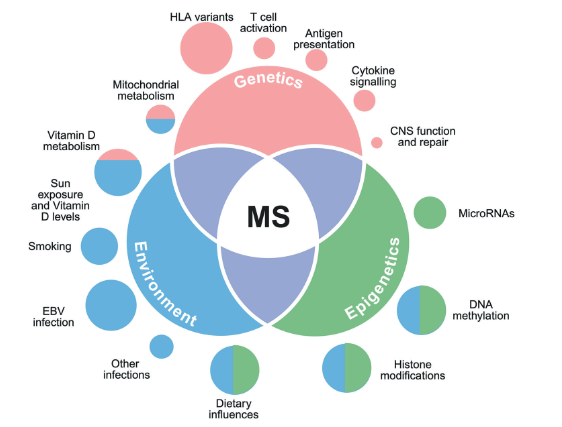
Fig 1. The interplay of genetic, environmental, and epigenetic factors in multiple sclerosis risk(2025-10, Vol.10 (1), p.324-40, Article 324)
Core Target Classes in Multiple Sclerosis
From a translational perspective, most late-stage MS pipelines can be mapped onto five mechanistic pillars: (1) S1P receptor modulation to control lymphocyte trafficking; (2) BTK inhibition to dampen B-cell and myeloid activation; (3) high-efficacy CD20+ B-cell depletion; (4) NF-κB–centred inflammatory cascades in microglia and astrocytes; and (5) therapeutic strategies targeting EBV latency in memory B cells. The table below summarizes representative targets, human genes and UniProt identifiers, together with their core pathological roles.
Category / Target
Gene
Protein Full Name
UniProt ID
Pathological Role
1. S1P Receptor Modulation
S1PR1
Sphingosine 1-phosphate receptor 1
P21453
Controls lymphocyte egress from lymph nodes; S1P modulators reduce recirculating autoreactive lymphocytes while largely sparing innate immunity.
S1PR5
Sphingosine 1-phosphate receptor 5
Q9H228
Highly expressed in oligodendrocytes and NK cells; implicated in oligodendrocyte survival, remyelination and brain-resident immune modulation.
2. BTK Signaling
BTK
Bruton’s tyrosine kinase
Q06187
Non-receptor kinase integrating B-cell receptor and FcγR signalling in B cells and myeloid cells; drives B-cell activation, antigen presentation and microglial pro-inflammatory programs.
3. CD20 B-cell Depletion
MS4A1
B-lymphocyte antigen CD20
P11836
Pan–B-cell surface marker from pre-B to memory B cells; depletion interrupts antigen presentation and cytokine networks that sustain autoreactive T cells.
4. NF-κB Inflammatory Cascade
RELA
Transcription factor p65
Q04206
Central transcription hub for TNF, IL-1, IL-6 and chemokines; coordinates microglial M1 polarisation, astrocyte activation and chronic lesion maintenance.
Maintain long-lived EBV-infected memory B cells, ectopic meningeal follicles and intrathecal antibody production; strongly implicated as an upstream trigger of MS.
Research Insight : Clinical pipelines in 2025 are dominated by oral S1P modulators (fingolimod, ozanimod, ponesimod), covalent/irreversible BTK inhibitors (tolebrutinib, evobrutinib, fenebrutinib), high-efficacy CD20-depleting antibodies (ocrelizumab, ofatumumab, ublituximab) and emerging EBV-directed strategies (vaccine, CTL therapy). Together with NF-κB–focused glial modulation, these five pillars frame most current translational MS programmes.
Why Choose abinScience for Multiple Sclerosis Research?
Broad, pathway-based coverage of mainstream MS targets: CD20, ITGA4, MOG, MBP, PLP1, Research Grade biosimilars, flow cytometry antibodies and drug-monitoring ELISA kits—126 catalog items mapped to clinically relevant mechanisms.
Recombinant proteins characterised by purity and identity (including mass spectrometry); key antibodies tested in EAE and cuprizone models, with lot-to-lot consistency monitored and typical assay CV values < 5% for critical ELISA formats.
Complete documentation package for each product, including certificate of analysis (CoA), WB/IHC/FC validation images and literature-style protocols that can be directly integrated into methods sections.
Customisable panel design (for example, CD20 B-cell panel, BTK pathway panel, myelin protein panel) to align tools with your specific animal model, cell system or clinical cohort.
Used by MS groups worldwide and cited in high-impact neurology and immunology journals; updated publication lists are available on request or via the abinScience website.
Partnering with abinScience keeps your MS experiments aligned with the latest mechanistic and clinical insights.
Walton C, et al. Rising prevalence of multiple sclerosis worldwide: Insights from the Atlas of MS. Neurology. 2020;94:e1027-e1040.
Bjornevik K, et al. Longitudinal analysis reveals high prevalence of Epstein-Barr virus associated with multiple sclerosis. Science. 2022;375:296-301.
Hauser SL, et al. Ofatumumab versus teriflunomide in multiple sclerosis. N Engl J Med. 2020;383:546-557.
Hauser SL, et al. Ocrelizumab versus interferon beta-1a in relapsing multiple sclerosis. N Engl J Med. 2017;376:221-234.
Montalban X, et al. Ocrelizumab versus placebo in primary progressive multiple sclerosis. N Engl J Med. 2017;376:209-220.
Gruber RC, et al. BTK regulates microglial function and neuroinflammation in multiple sclerosis models. Nat Commun. 2024;15:10116.
Bar-Or A, et al. Safety and efficacy of fenebrutinib in relapsing multiple sclerosis (FENopta). Lancet Neurol. 2025;24:656-666.
Kappos L, et al. A placebo-controlled trial of oral fingolimod in relapsing multiple sclerosis. N Engl J Med. 2010;362:387-401.
Cantó E, et al. Association between serum neurofilament light chain levels and long-term disease course among patients with multiple sclerosis. JAMA Neurol. 2019;76:1359-1366.
For research use only. Not for use in diagnostic or therapeutic procedures.


 中文
中文 English
 한국어
한국어 日本語
日本語 Español
 Français
 Русский