Hashimoto's Thyroiditis: Latest Research & New Treatments (2025–2026)
Release date:
2026-01-04 View count: 3551
2025 Comprehensive Review of Hashimoto's Thyroiditis (HT): Multi-Dimensional Mechanisms in Immunity, Microenvironment, Metabolism, and Epigenetics with Complete Research Toolkit
Hashimoto's thyroiditis was first described in 1912 by Japanese physician Hakaru Hashimoto, after whom it is named. It is a classic organ-specific autoimmune disease characterized by lymphocytic infiltration of the thyroid gland, positivity for anti-thyroid peroxidase antibodies (TPOAb) and/or anti-thyroglobulin antibodies (TgAb), and often progressive hypothyroidism. The global prevalence in adults is approximately 5–10%; it is significantly more common in women than in men, with the peak incidence occurring between ages 30 and 50. Diagnosis rates have risen in recent years in China. Typical symptoms include fatigue, cold intolerance, weight gain, goiter, depression, bloating, constipation or diarrhea, forgetfulness, anxiety, insomnia, dry skin, and hair loss. The disease progresses slowly, and most patients eventually require lifelong levothyroxine (LT4) replacement therapy. Quality of life is markedly reduced, particularly in terms of overall health and vitality, which correlate negatively with TPOAb/TgAb levels. These antibodies also correlate positively with inflammatory cytokines TNF-α and IFN-γ, suggesting that elevated antibodies exacerbate multi-system symptoms affecting digestion, endocrinology, neuropsychiatry, and skin.
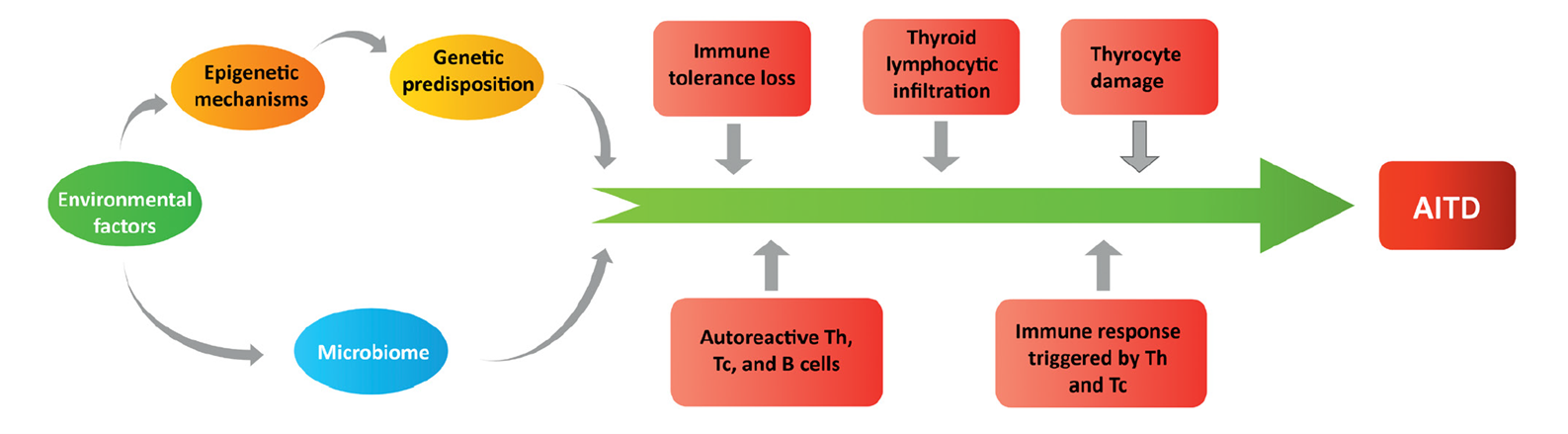
Figure 1. Mechanisms contributing to the pathology of autoimmune thyroid disease (AITD)
The core pathogenic mechanism of Hashimoto's thyroiditis (HT) involves breakdown of immune tolerance, typically driven by a combination of genetic susceptibility and environmental triggers, ultimately leading to thyroid fibrosis and loss of function. The specific pathological processes and regulatory mechanisms are as follows:
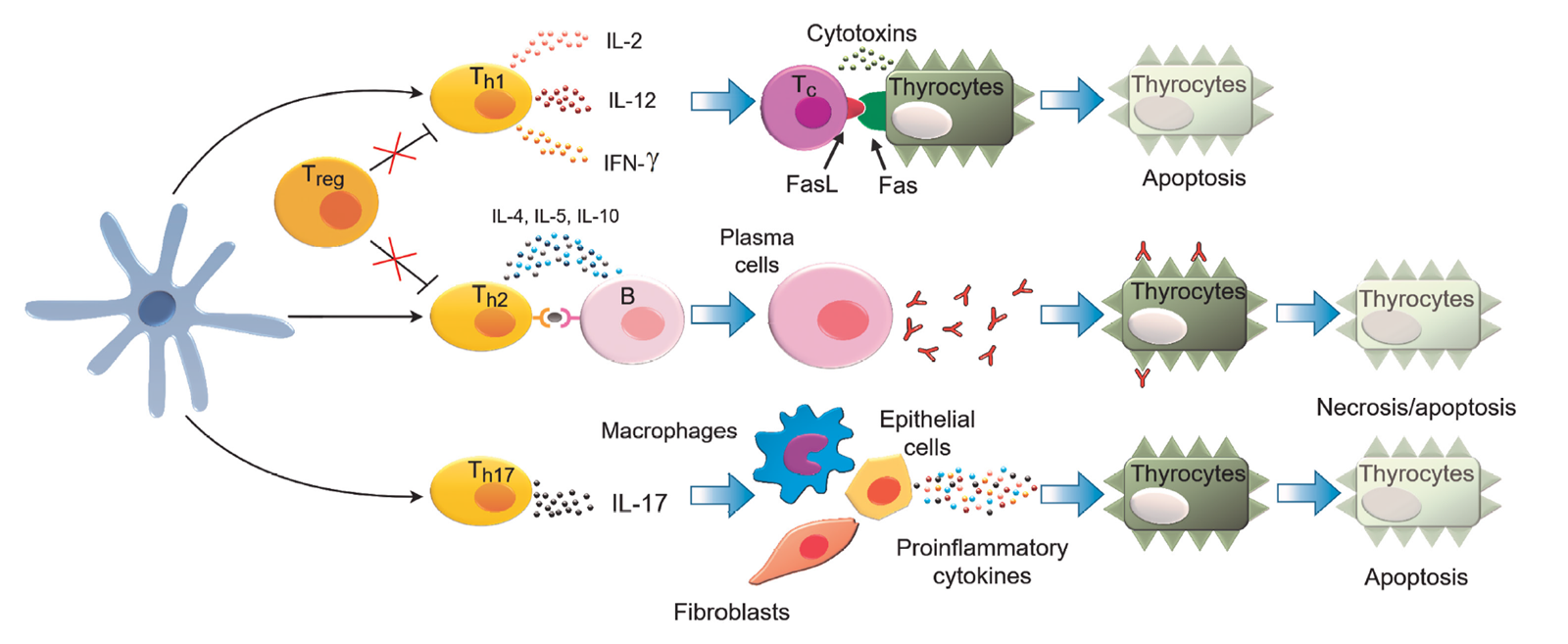
Central role of immune cells and cytokines: Immune imbalance is the key driver—Th1/Th17 cell subset polarization triggers a cytokine storm, accompanied by increased oxidative stress that promotes follicular cell apoptosis; B lymphocytes produce autoantibodies, T lymphocytes mediate inflammatory responses, and reduced Treg cell numbers lead to loss of immune regulation; NK cells and macrophages induce apoptosis via perforin, granzymes, and serglycin, while IFN-γ and TNF-α activate the NLRC4 inflammasome to trigger pyroptosis, further amplifying inflammatory damage.
Tissue microenvironment features revealed by spatial transcriptomics: Damaged thyroid follicular cells (TFCs) upregulate CD74 and MIF expression, enhancing antigen presentation; the stroma is enriched with inflammatory fibroblasts (distinct from ADIRF+ myofibroblasts in Graves' disease); increased PLVAP+ fenestrated vessels promote lymphocyte infiltration and accelerate local disease progression.
Metabolic and epigenetic regulatory mechanisms: At the metabolic level, there are disruptions in phospholipid, eicosanoid, and carnitine metabolism, with significant enrichment in choline, glycerophospholipid, and linoleic acid pathways; at the epigenetic and signaling level, dysregulation of vitamin D receptor signaling, gut microbiota dysbiosis, mitochondrial variants, and non-coding RNAs (miRNAs regulating TSHR expression, lncRNAs affecting Th cell differentiation, and circRNAs mediating epigenetic modifications) collectively contribute to immune imbalance.
HT is a complex disease involving intertwined abnormalities across immunity, tissue microenvironment, metabolism, and epigenetics, with immune dysregulation as the central driver and multiple pathways synergistically promoting disease progression.
Figure 2. Key mechanisms leading to thyroid damage in Hashimoto's thyroiditis (HT)
Key Research Targets in Hashimoto's Thyroiditis
Target
Normal Biological Function
Pathological Role in Hashimoto's Thyroiditis
Research Applications
TG
Precursor for thyroid hormone synthesis; stores iodine and participates in T3/T4 production
Core autoantigen; induces TgAb production, forms immune complexes, and mediates thyroid damage and fibrosis
Vitamin D signaling: Inhibits dendritic cell maturation, promotes Treg cells, and reduces Th17 activity.
Microbiome and ncRNAs: Gut microbiota dysbiosis affects immune tolerance; ncRNAs (e.g., miR-155) regulate autoreactivity.
Summary of Recent Research Advances
• Selenium supplementation: A 2024 systematic review and meta-analysis showed that selenium supplementation significantly reduces TPOAb titers (independent of baseline selenium status and LT4 treatment) and improves mood/overall well-being, though effects on TSH or quality of life are limited.
• Vitamin D intervention: Multiple RCT meta-analyses indicate that vitamin D supplementation (especially >3 months or active calcitriol) significantly lowers TPOAb and TgAb titers, improves TSH, FT3/FT4 levels, and delays progression to hypothyroidism.
• Emerging directions: Antigen-specific immunotherapy (e.g., nanomaterial delivery of autoantigens to induce tolerance, mRNA vaccines targeting TSHR) shows promise in animal models, with clinical trials evaluating safety and efficacy; stem cell therapy (MSC immunomodulation), metformin as an adjunct to reduce antibodies, combined LT4+LT3 therapy for persistent symptoms, and early exploration of targeting NK cells or inflammasome pathways. Probiotic supplementation can modulate the microbiome and improve thyroid function. Research in 2025 emphasizes multi-pathway systemic regulation, such as inhibiting pro-inflammatory cytokines and stimulating anti-inflammatory cytokines (IL-10, IL-2).
These advances highlight that although HT is driven by multiple factors, single hormone replacement cannot fully reverse immune damage. Multi-pathway adjunctive interventions (e.g., selenium + vitamin D + probiotics) can lower antibodies and alleviate inflammation, offering new strategies for disease modification. High-quality recombinant proteins and antibody tools (e.g., anti-TPO, anti-Tg, vitamin D receptor-related) are essential for mechanism validation and drug screening.
abinScience Hashimoto's Thyroiditis Research Toolkit
Below are the latest abinScience recombinant proteins and antibodies related to Hashimoto's thyroiditis. Catalog numbers link directly to product pages.
Professional technical support | Customized services | Fast quoting
References
Ragusa F, Fallahi P, Elia G, et al. Hashimotos' thyroiditis: Epidemiology, pathogenesis, clinic and therapy. Best Pract Res Clin Endocrinol Metab. 2019;33(6):101367. doi:10.1016/j.beem.2019.101367
Vargas-Uricoechea H, Castellanos-Pinedo A, Urrego-Noguera K, Pinzón-Fernández MV, Meza-Cabrera IA, Vargas-Sierra H. A Scoping Review on the Prevalence of Hashimoto's Thyroiditis and the Possible Associated Factors. Med Sci (Basel). 2025;13(2):43. Published 2025 Apr 10. doi:10.3390/medsci13020043
Li J, Huang Q, Sun S, et al. Thyroid antibodies in Hashimoto's thyroiditis patients are positively associated with inflammation and multiple symptoms. Sci Rep. 2024;14(1):27902. Published 2024 Nov 13. doi:10.1038/s41598-024-78938-7
Tywanek E, Michalak A, Świrska J, Zwolak A. Autoimmunity, New Potential Biomarkers and the Thyroid Gland—The Perspective of Hashimoto's Thyroiditis. Int J Mol Sci. 2024;25(9):4703. Published 2024 Apr 26. doi:10.3390/ijms25094703
Bogusławska J, Godlewska M, Gajda E, Piekiełko-Witkowska A. Cellular and molecular basis of thyroid autoimmunity. Eur Thyroid J. 2022;11(1):e210024. Published 2022 Jan 1. doi:10.1530/ETJ-21-0024
Wrońska K, Hałasa M, Szczuko M. The Role of the Immune System in the Course of Hashimoto's Thyroiditis: The Current State of Knowledge. Int J Mol Sci. 2024;25(13):6883. Published 2024 Jun 23. doi:10.3390/ijms25136883
Martínez-Hernández R, Sánchez de la Blanca N, Sacristán-Gómez P, et al. Unraveling the molecular architecture of autoimmune thyroid diseases at spatial resolution. Nat Commun. 2024;15(1):5895. Published 2024 Jul 13. doi:10.1038/s41467-024-50192-5
Wang G, Ye X, Lu T, Yang Y, Sun B, Xiao H. Integrated plasma metabolomics and lipidomics profiling highlight distinctive signatures with hashimoto's thyroiditis. Sci Rep. 2025;15(1):21081. Published 2025 Jul 1. doi:10.1038/s41598-025-07905-7
Huwiler VV, Maissen-Abgottspon S, Stanga Z, et al. Selenium Supplementation in Patients with Hashimoto Thyroiditis: A Systematic Review and Meta-Analysis of Randomized Clinical Trials. Thyroid. 2024;34(3):295-313. doi:10.1089/thy.2023.0556
Jiang H, Chen X, Qian X, Shao S. Effects of vitamin D treatment on thyroid function and autoimmunity markers in patients with Hashimoto's thyroiditis—A meta-analysis of randomized controlled trials. J Clin Pharm Ther. 2022;47(6):767-775. doi:10.1111/jcpt.13605
For Research Use Only. Not for use in diagnostic or therapeutic procedures.


 中文
中文 English
 한국어
한국어 日本語
日本語 Español
 Français
 Русский