Pharmacokinetic (PK) and anti-drug antibody (ADA) bioanalytical assays for therapeutic antibodies and biosimilars require anti-idiotype (anti-ID) antibodies as critical reagents. An anti-ID antibody binds the unique variable region (idiotype) of the drug antibody, enabling specific detection and quantification in biological matrices. This guide explains how anti-idiotype antibodies are used and how to select the right one for your assay. For a complete walkthrough of ADA assay formats and kit selection, see our ADA ELISA Kit Selection Guide.
What Is an Anti-Idiotype Antibody?
An anti-idiotype antibody recognizes the unique antigen-binding region (CDR loops) of a specific therapeutic antibody. Because each therapeutic mAb has a unique variable region, the anti-ID is specific to that drug—it does not cross-react with other immunoglobulins in the patient or animal sample.
Anti-ID antibodies fall into three functional categories:
| Type |
Binding Site |
Use in Bioanalysis |
Neutralizing
(also termed Blocking) |
Binds the CDR/paratope; competes with drug target |
PK assays (capture in bridging format); detects free drug only |
Non-Neutralizing
(also termed Non-blocking) |
Binds the variable region framework; does not compete with target |
PK assays (detection in bridging format); detects total drug; ADA positive control |
Complex-specific
(also termed Idiotypic) |
Binds an idiotypic determinant that mimics the drug’s target epitope |
Detects drug–target complex specifically; used in select PK assay formats |
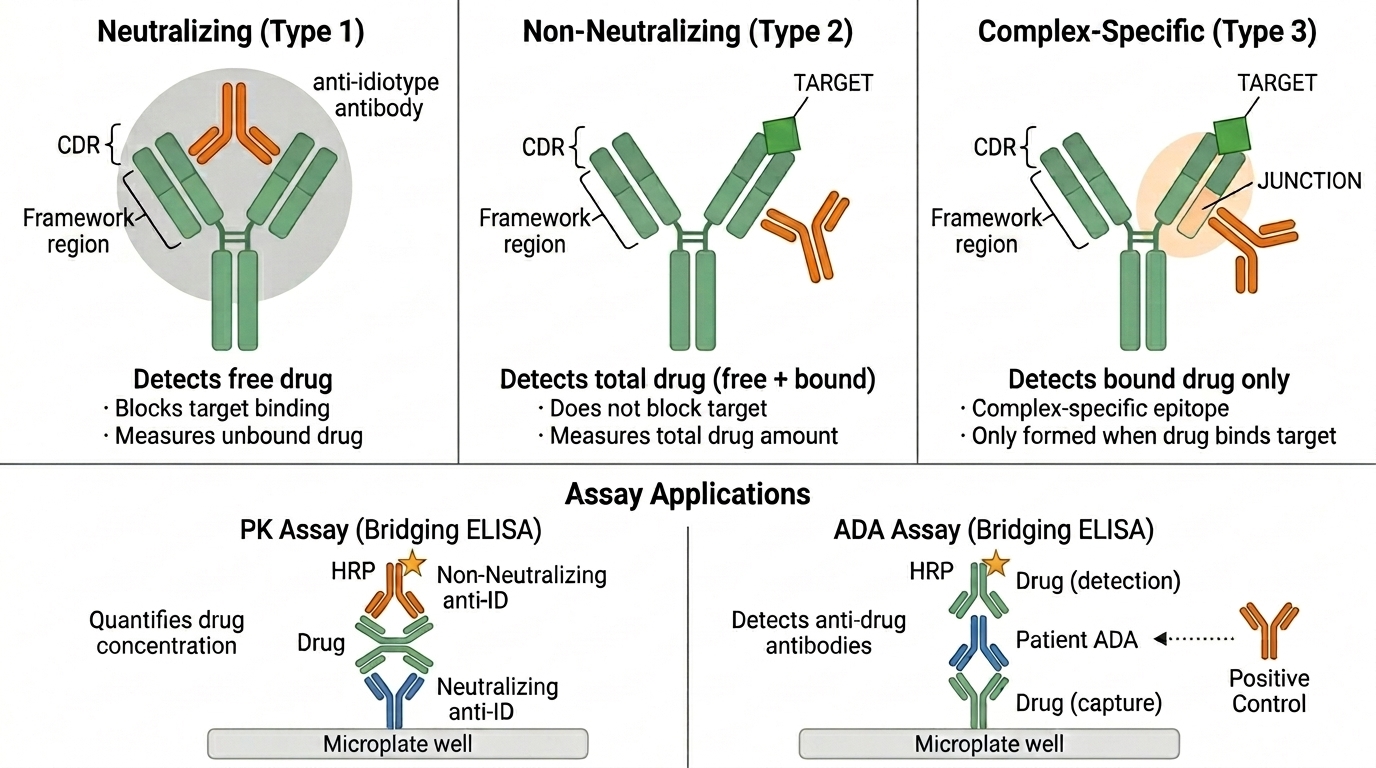
Fig 1. Three types of anti-idiotype antibodies and their roles in PK and ADA bioanalytical assays. Neutralizing (Type 1) binds the CDR and detects free drug; Non-Neutralizing (Type 2) binds the framework region and detects total drug; Complex-Specific (Type 3) recognizes the drug–target junction. Bottom: PK bridging ELISA uses anti-ID pairs for drug quantification; ADA bridging ELISA uses anti-ID as positive control for immunogenicity assessment.
Anti-ID Antibodies in PK Assays
Bridging PK ELISA Format
The most common PK assay format uses two anti-ID antibodies in a sandwich configuration. For a detailed comparison of bridging vs direct vs competitive ELISA formats, see our ADA ELISA guide:
- Capture: Anti-ID #1 (typically neutralizing type) coated on plate
- Analyte: Drug antibody in serum/plasma
- Detection: Anti-ID #2 (different epitope, typically non-neutralizing, biotinylated or HRP-conjugated)
This format specifically detects the drug antibody and ignores endogenous immunoglobulins, because both anti-IDs only recognize the drug’s unique variable region.
Matched Pair Requirement
PK bridging assays require two anti-ID antibodies that bind non-competing epitopes on the drug’s variable region. If both anti-IDs compete for the same epitope, the sandwich will not form. Always verify non-competition before building your assay.
Anti-ID Antibodies in ADA Assays
ADA assays detect whether the patient or animal has developed immune responses against the therapeutic antibody. For guidance on cut point determination and positive control setup in GLP-1 ADA assays, see our GLP-1 ADA FAQ. Anti-ID antibodies serve as:
- Positive control: A known anti-ID antibody at defined concentrations validates that the assay can detect anti-drug antibodies. Non-neutralizing anti-IDs are preferred because they mimic the binding behavior of a real patient ADA response.
- System suitability control: Confirms assay sensitivity on each plate/run.
How to Select Anti-ID Antibodies
| Selection Criterion |
What to Check |
Why It Matters |
| Target drug specificity |
Anti-ID must be raised against your specific drug mAb |
Generic anti-human IgG will not work—idiotype is unique to each drug |
| Neutralizing vs. Non-neutralizing |
Determine assay format requirements first |
PK capture typically needs neutralizing; ADA positive control needs non-neutralizing |
| Matrix tolerance |
Test in relevant biological matrix (serum, plasma) |
Matrix proteins can interfere with anti-ID binding |
| Species cross-reactivity |
If drug is humanized/chimeric, ensure anti-ID does not bind endogenous Ig |
Critical for mouse PK studies where endogenous mouse Ig is abundant |
| Available formats |
Currently unconjugated; custom labeling (Biotin, HRP) available upon request |
Match your detection system; contact us for conjugation options |
Anti-Idiotype Antibodies & Matched ELISA Kits by Drug Target
Each therapeutic antibody requires drug-specific anti-idiotype reagents. The table below maps abinScience's anti-ID polyclonal antibodies (for use as ADA positive controls) alongside matched PK and ADA ELISA kits and research-grade biosimilar reference standards for 21 drug targets.
Anti-TNF Biologics
Immune Checkpoint Inhibitors
Anti-HER2, Anti-VEGF & Anti-EGFR
Other Therapeutic Biologics
GLP-1 Receptor Agonists
For a head-to-head comparison of GLP-1 drug ELISA kits, see Semaglutide vs Tirzepatide vs Retatrutide ELISA Kits. For drug-specific ADA assay design guidance, see the GLP-1 ADA & PK Detection Guide.
Research Biosimilar as Reference Standard
When developing PK/ADA assays, you need a reference standard to build the calibration curve. Research-grade biosimilars—recombinant versions of the originator drug produced for research use only—can serve as cost-effective calibrators and positive controls during assay development, replacing expensive clinical-grade material.
Cost Advantage
A research biosimilar at $326/100µg can replace clinical-grade originator drug that may cost >$2,000/mg for early-stage assay development and method optimization. Once the assay is validated, switch to the appropriate reference standard for GLP studies.
Anti-Idiotype Antibodies for 21 Drug Targets
Drug-specific anti-ID polyclonal antibodies, matched PK/ADA/NAb ELISA kits, and research-grade biosimilar reference standards for immunogenicity assessment and bioanalytical method development.
Browse Research Biosimilars & Anti-ID Antibodies →


 中文
中文 English
 한국어
한국어 日本語
日本語 Español
 Français
 Русский


