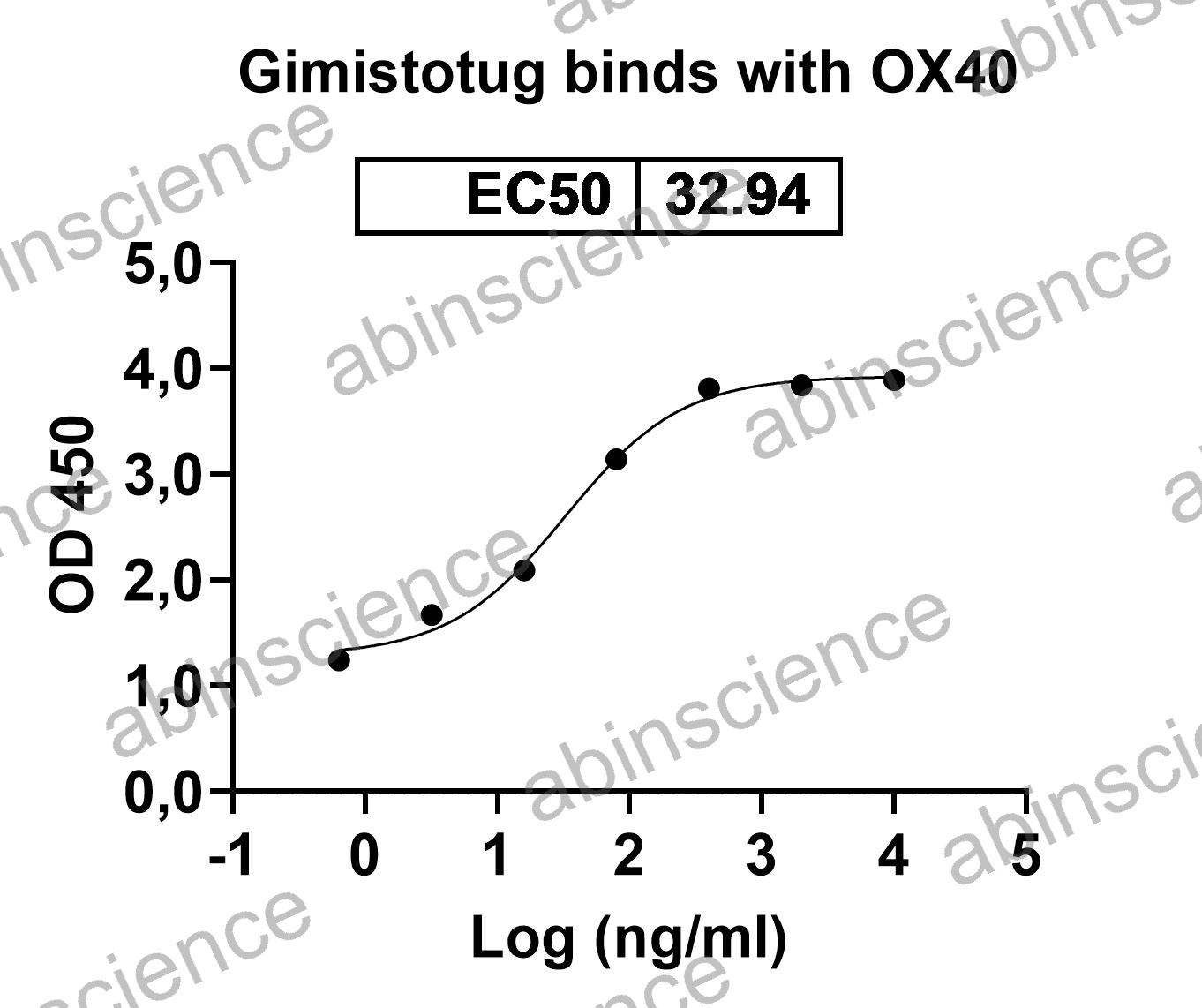
OX40 (CD134 / TNFRSF4) is a co-stimulatory receptor of the TNF receptor superfamily expressed on activated CD4⁺ and CD8⁺ T cells. Upon engagement by its ligand OX40L (CD252 / TNFSF4), OX40 delivers survival and proliferation signals that enhance effector T-cell responses and inhibit regulatory T-cell (Treg) suppressive function. OX40 agonist antibodies are in clinical development as immuno-oncology agents — both as monotherapy and in combination with checkpoint inhibitors (anti-PD-1/CTLA-4). abinScience offers recombinant OX40 and OX40L proteins, anti-OX40 antibodies, biosimilar reference standards, and ELISA kits.
OX40 Biology and Mechanism
OX40 is a ~50 kDa type I transmembrane glycoprotein with four cysteine-rich domains (CRDs) in its extracellular region. Unlike checkpoint receptors (PD-1, CTLA-4) which are constitutively expressed or rapidly induced, OX40 expression is transient and activation-dependent — it peaks 24-72 hours after TCR stimulation on effector T cells and is constitutively expressed on a subset of tumor-infiltrating Tregs.
OX40 signaling through TRAF2/TRAF5 activates NF-κB and PI3K/AKT pathways, promoting T-cell survival (upregulation of Bcl-2, Bcl-xL), sustained proliferation, enhanced cytokine production (IL-2, IFN-γ), and memory T-cell formation. Critically, OX40 engagement on Tregs can inhibit their suppressive function and reduce FoxP3 expression, providing a dual mechanism: boosting effectors while restraining Tregs. This makes OX40 agonism complementary to checkpoint blockade — PD-1/CTLA-4 antibodies release the brakes, while OX40 agonists press the accelerator.
Key Research Applications
OX40 Agonist Antibody Development Recombinant OX40 ECD proteins for screening agonist anti-OX40 antibodies by SPR/BLI and T-cell co-stimulation bioassays. OX40L protein for receptor-ligand interaction studies and competitive blocking assays.
T-Cell Co-Stimulation Assays Agonist anti-OX40 antibodies and OX40L-Fc proteins for enhancing T-cell proliferation, cytokine production (IL-2, IFN-γ), and survival in sub-optimal TCR stimulation conditions. Plate-bound or cross-linked formats for agonist activity.
Combination Therapy Studies Anti-OX40 + anti-PD-1 or anti-CTLA-4 combination studies in co-culture assays. OX40 agonism synergizes with checkpoint blockade by simultaneously boosting effector function and reducing Treg suppression.
Flow Cytometry & T-Cell Profiling Anti-OX40/CD134 antibodies for identifying activated T cells and OX40⁺ Tregs in tumor tissue, peripheral blood, and draining lymph nodes. OX40 is a key activation marker in immunophenotyping panels.
OX40 Product Selection Guide
| Application |
Recommended Product |
Format |
| SPR/BLI binding kinetics |
Recombinant OX40 ECD protein |
Avi-tagged or biotinylated |
| T-cell co-stimulation (agonism) |
OX40L-Fc protein or agonist anti-OX40 Ab |
Fc-chimera (requires cross-linking) |
| OX40/OX40L blocking ELISA |
OX40-Fc + OX40L protein |
Fc-chimera + His-tagged |
| Flow cytometry / T-cell activation |
Anti-CD134/OX40 antibody |
PE, APC, or BV421 conjugated |
| IHC / TIL characterization |
Anti-OX40 monoclonal antibody |
Unconjugated |
| PK/ADA ELISA |
Anti-OX40 antibody pair + calibrator |
Capture/detection pair |
OX40 FAQs
How does OX40 agonism differ from checkpoint blockade?
Checkpoint inhibitors (anti-PD-1, anti-CTLA-4) work by removing inhibitory signals — releasing the brakes on exhausted or suppressed T cells. OX40 agonists work by delivering positive co-stimulatory signals — pressing the accelerator on activated T cells to enhance their proliferation, survival, and effector function. The two mechanisms are complementary: checkpoint blockade alone may be insufficient if T cells lack adequate co-stimulatory signals, while OX40 agonism alone may be insufficient if T cells are simultaneously receiving strong inhibitory signals.
Why do OX40 agonist antibodies require Fc cross-linking for activity?
OX40, like other TNFR superfamily members, signals as a trimer. Bivalent IgG antibodies can only engage two OX40 molecules, which is insufficient for receptor clustering and signaling. Higher-order cross-linking — provided by FcγR-expressing cells in vivo (macrophages, DCs) or by plate-coating/secondary antibody cross-linking in vitro — is required to achieve the multimerization needed for agonist activity. This is why most OX40 agonist clinical candidates use IgG1 or IgG2 isotypes with strong FcγR engagement, and in vitro assays require plate-bound or cross-linked antibody formats.
How do I set up an OX40 co-stimulation bioassay?
Activate human PBMCs or purified CD4⁺ T cells with sub-optimal anti-CD3 stimulation (0.1-0.5 μg/mL plate-bound OKT3, without anti-CD28). Add plate-bound OX40 agonist antibody or cross-linked OX40L-Fc protein (with anti-human IgG Fc secondary antibody). After 72 hours, measure T-cell proliferation (CFSE dilution or CellTiter-Glo) and IL-2/IFN-γ secretion by ELISA. The key is using sub-optimal TCR stimulation — OX40 co-stimulation enhances responses that would otherwise be weak, demonstrating the co-stimulatory effect.
What is the relationship between OX40 and 4-1BB (CD137)?
Both are co-stimulatory TNFR superfamily members expressed on activated T cells, but with distinct kinetics and cell-type preferences. OX40 (CD134) is preferentially expressed on CD4⁺ T cells and peaks at 24-72 hours post-activation. 4-1BB (CD137) is preferentially expressed on CD8⁺ T cells and NK cells and peaks at 12-48 hours. OX40 agonism primarily enhances CD4⁺ helper responses and memory formation, while 4-1BB agonism primarily enhances CD8⁺ cytotoxic responses. Both are under clinical investigation, and some combination strategies target both simultaneously.
How do I detect OX40 expression on tumor-infiltrating T cells?
OX40 is a surface marker — no permeabilization needed. For flow cytometry, use a PE- or APC-conjugated anti-CD134 antibody in combination with CD3, CD4, CD8, and FoxP3 (intracellular) to distinguish OX40⁺ effector T cells from OX40⁺ Tregs. For fresh tumor tissue, enzymatic digestion (Collagenase IV + DNase I) is recommended. OX40 expression is typically higher on intratumoral Tregs (constitutive) than on effector T cells (activation-dependent), which is relevant for understanding the dual agonist/Treg-modulating mechanism of anti-OX40 therapy.
Key References
1. Croft M. (2010) Control of immunity by the TNFR-related molecule OX40 (CD134). Annu Rev Immunol. 28:57-78. PMID: 20307208
2. Aspeslagh S, et al. (2016) Rationale for anti-OX40 cancer immunotherapy. Eur J Cancer. 52:50-66. PMID: 26645122
3. Curti BD, et al. (2013) OX40 is a potent immune-stimulating target in late-stage cancer patients. Cancer Res. 73(24):7189-7198. PMID: 24177180


 中文
中文 English
 한국어
한국어 日本語
日本語 Español
 Français
 Русский