Rubella Virus Research Reagents — Anti-Rubella Antibodies & Proteins for Diagnostics & Vaccine Development
Rubella virus (RuV) is a togavirus in the genus Rubivirus that causes German measles, a generally mild febrile illness in children and adults, but poses severe teratogenic risks during pregnancy. Infection during the first trimester results in congenital rubella syndrome (CRS), characterized by cardiac defects, cataracts, sensorineural deafness, and intellectual disability. The virus persists in the endothelial layer of blood vessels and infects multiple fetal tissues, causing long-term sequelae in survivors. RuV is an enveloped, positive-sense single-stranded RNA virus with a genome encoding three structural proteins: the envelope glycoproteins E1 and E2, and the capsid protein C. E1 is the primary determinant of neutralizing immunity and the principal target for vaccine development, while E2 plays a supportive role in virus assembly and immune recognition. Despite decades of successful vaccination campaigns using live-attenuated vaccines (MMR), RuV remains a public health concern in regions with suboptimal immunization coverage, and diagnostic assays for rapid IgM/IgG serodetection remain essential for outbreak control and antenatal screening. Therapeutic antibody research and vaccine development continue to focus on epitope mapping and functional characterization of neutralizing antibodies against E1.
Research Use Only (RUO)Not intended for diagnostic or therapeutic procedures.
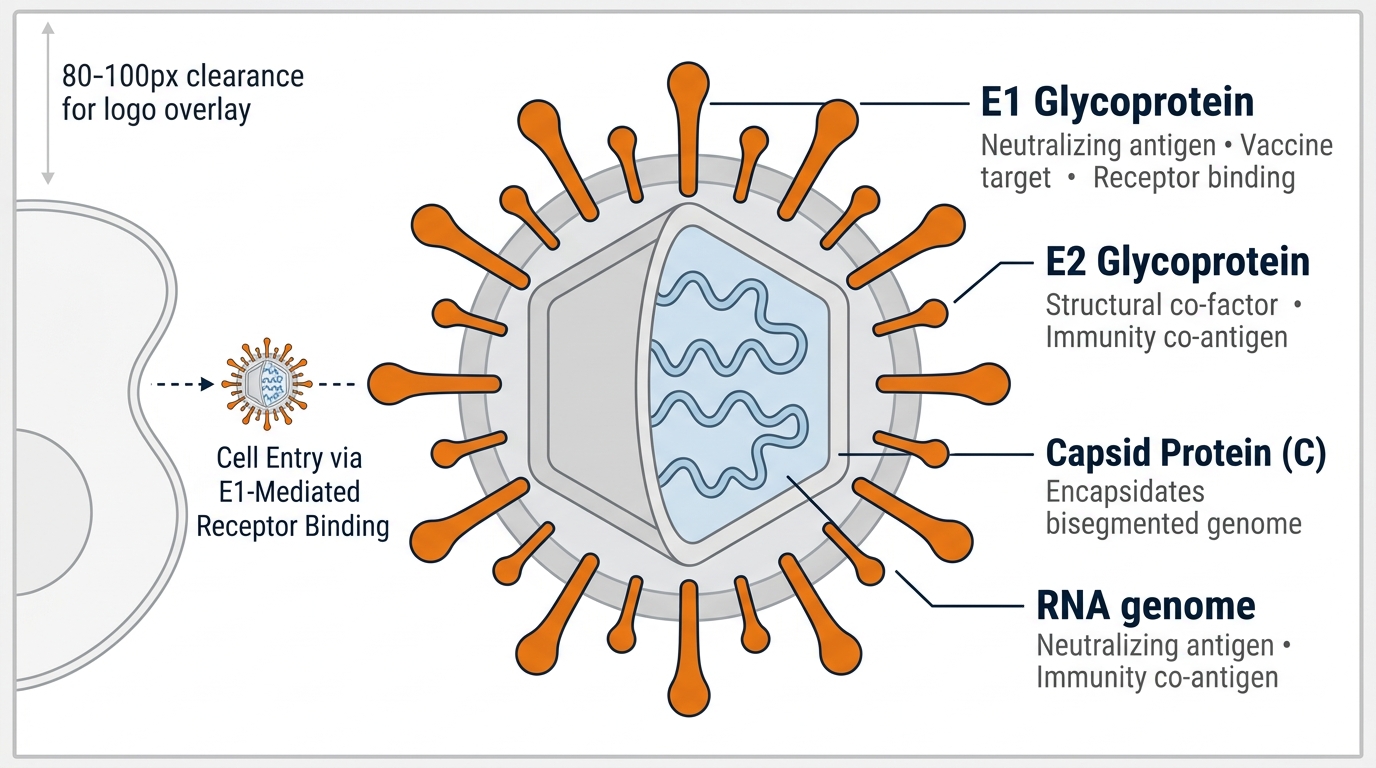
Fig. 1 Rubella virus structure and immunity pathway. E1 glycoprotein mediates receptor binding and cell entry; E2 supports virion assembly and immune response; C protein encapsidates the genome. Key vaccine and diagnostic targets highlighted in orange.
abinScience provides recombinant antibodies, polyclonal antibodies, InVivoMAb functional-grade antibodies, and recombinant proteins for key Rubella virus research targets. Products are validated for ELISA, WB, IHC, IF, neutralization assays, and SPR. All manufactured by our parent company AtaGenix Laboratories under ISO 9001 & ISO 13485 quality systems. Contact us for custom antibody development.
Key Research Targets
Envelope Glycoprotein E1 — E1 is the primary neutralizing antigen and the dominant target for vaccine-induced immunity. E1 mediates receptor binding and cell entry through interaction with cellular receptors, and undergoes significant conformational changes following viral assembly and budding. E1-specific antibodies are highly protective and form the basis of serological immunity assessment in vaccinated populations. Anti-E1 antibodies support neutralization assays, vaccine immunogenicity evaluation, conformational epitope mapping, and functional antibody kinetics studies. InVivoMAb-grade anti-E1 enables passive immunization and protective efficacy studies. E1 is the primary diagnostic target for rapid serodetection (IgM/IgG ELISA).
→ Browse Rubella E1 antibodies & proteins
Envelope Glycoprotein E2 — E2 is the second envelope glycoprotein and plays a critical role in virion assembly and structural stability. While less immunogenic than E1, E2 contains important epitopes recognized by both neutralizing and non-neutralizing antibodies. E2-specific responses contribute to overall vaccine-induced immunity and are important in characterizing the breadth of the humoral immune response. Anti-E2 antibodies support epitope mapping, conformational analysis of the E1-E2 heterodimer complex, and studies of non-neutralizing antibody function in viral control.
→ Browse Rubella E2 antibodies & proteins
Capsid Protein (C) — The capsid protein encapsidates the viral genome and forms the nucleocapsid core within the virion. C protein is highly conserved and is recognized early in infection, remaining detectable in persistently infected cells in congenital infections. The capsid protein assembles into icosahedral core particles 65-70 nm in diameter and dimerizes to form disulfide-linked structures in the mature virion. Anti-Capsid antibodies support indirect immunofluorescence assays, quantitative replication studies, and investigations of viral persistence in infected tissues. Recombinant Capsid protein serves as a diagnostic antigen in ELISA assays and as a molecular weight standard in Western blot validation.
abinScience Capsid Products:
⊕ Anti-Rubella virus/RUBV Capsid Polyclonal Antibody (VK659014) — Rabbit-raised, purified, validated for ELISA, IHC, WB
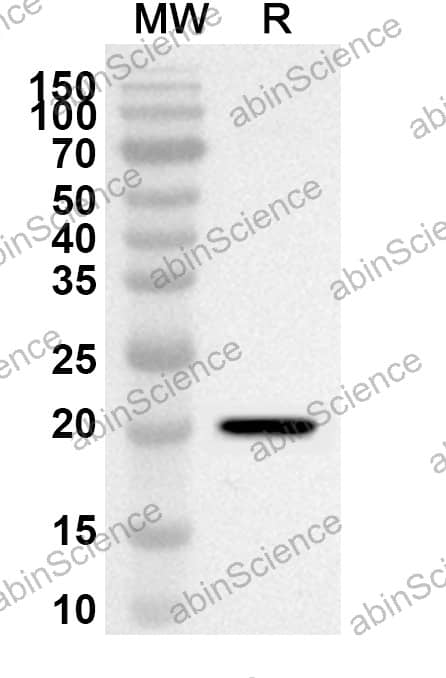
⊕ Rubella virus/RUBV Capsid Recombinant Protein N-His (VK659012) — E. coli-expressed, >90% pure, for ELISA coating, immunization, SDS-PAGE
→ Browse all Rubella antibodies & proteins
Rubella Virus (Whole Antigen) — Whole RuV preparations and lysates are used in diagnostic assays and as reference antigens for validating polyclonal and monoclonal antibody specificity. Whole-virus antigen supports indirect ELISA development, IHC confirmation, and functional assays evaluating antibody detection capacity. Recombinant whole-virus-like particles (VLPs) expressing structural proteins are valuable for immunogenicity studies and as immunogens in vaccine development pipelines.
→ Browse all Rubella antibodies & proteins
Recommended Applications
Serological Diagnosis
Rubella Capsid protein (VK659012) serves as an optimal ELISA coating antigen for diagnostic immunoassays. Anti-Rubella Capsid polyclonal antibodies (VK659014) provide sensitive detection in indirect ELISA and capture assay formats for rapid IgM/IgG serodetection.
Western Blotting & Protein Detection
Anti-Rubella Capsid polyclonal antibody (VK659014) is validated for Western blotting of denatured viral proteins in infected cell lysates. The recombinant Capsid protein (VK659012) serves as a positive control and molecular weight standard in WB assays.
Immunohistochemistry
Anti-Rubella Capsid polyclonal antibody enables IHC detection of viral antigen in infected tissues and infected cell cultures. Suitable for histopathological examination in congenital infection cases and viral replication studies.
Immunization & Vaccine Development
Recombinant Rubella Capsid protein (VK659012) functions as an immunogen for generating antibody responses and as an assay standard for vaccine development pipelines. Validated for use in SDS-PAGE, immunoassay standardization, and bioactivity testing.
References
1. Reef SE, Frey TK, Theall K, et al. The changing epidemiology of rubella in the 21st century. J Infect Dis. 2002;187 Suppl 1:S480-S489.
2. Plotkin SA. Rubella vaccine. In: Plotkin SA, Orenstein WA, Offit PA, eds. Vaccines. 7th ed. Philadelphia: Elsevier; 2018:905-934.
3. Moss WJ, Griffin DE. Global measles and rubella laboratory networks. J Infect Dis. 2011;204 Suppl 1:S504-S508.
4. Terry FM, Ho-Terry Y, Londesborough P. Rubella-specific IgG, IgA, and IgM responses after primary immunization and reimmunization with Cendehill vaccine. J Med Virol. 1980;5(2):157-166.
5. Cutts FT, Metcalf CJ, Edmunds WJ. Rubella control, elimination, and eradication—the role of vaccination. Semin Pediatr Infect Dis. 2012;23(2):140-147.
All products manufactured by AtaGenix Laboratories under ISO 9001 & ISO 13485 quality systems. For custom antibody development, monoclonal antibody discovery, or InVivoMAb production, contact our team.


 中文
中文 English
 한국어
한국어 日本語
日本語 Español
 Français
 Русский